THE SAGA OF PRINCE HELGI ‘ARROW ODD’ ERIKSON Has Been Added to The Site Under the New Heading The VARANGIANS / UKRAINIANS Book Series – The True History of ‘The Great Viking Manifestation of Medieval Europe’© and the below Post Covers CHAPTER ZERO POINT ONE:
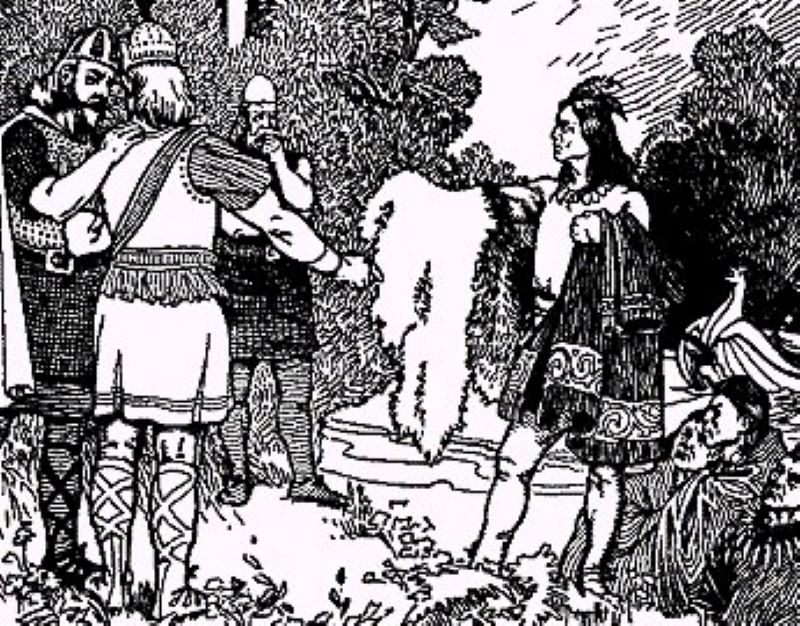
Prince Helgi ‘Arrow Odd’ Erikson trading with Natives of the Newfoundland
BOOK THREE: THE SAGA OF PRINCE HELGI ‘ARROW ODD’ ERIKSON
A Novel By Brian Howard Seibert
© Copyright by Brian Howard Seibert
THE VARANGIANS – BOOK THREE
THE SAGA OF PRINCE HELGI ‘ARROW ODD’ ERIKSON
— PRINCE HELGI ERIKSON OF KONOGARD —
— PRINCE OLEG RURIKSON OF KIEV —
A Novel By
Brian Howard Seibert
© Copyright by Brian Howard Seibert
WRITER’S UNCUT EDITION
(Contains Scenes of Violence and Sexuality Consistent with the Viking Period)
(May be Offensive to Some)
Kelowna, B.C.
2018
Table of Contents
0.1 BABY HELGI – BORN IN A FIRESTORM (Circa 839 AD) 5
1.0 GRIM ‘HAIRY-CHEEK’ KETILSON (Circa 840 AD) 22
2.0 THE SACK OF PARIS OF 845. 27
3.0 THE PROPHECY (Circa 852 AD) 36
4.0 THE VARANGERS OF SEVILLE (Circa 855 AD) 42
5.0 ODDI AND THE NOR’WAY (Circa 856 AD) 50
6.0 HILDER THE GIANT (Circa 856 AD) 66
7.0 THE ATTACK ON CONSTANTINOPLE OF 860. 78
8.0 THE SIEGE OF KIEV (Circa 861 AD) 89
9.0 HALFDAN’S GIFT (Circa 861 AD) 96
10.0 SOTI’S GIFT (Circa 861 AD) 101
11.0 HJALMAR THE BRAVE (Circa 861 AD) 106
12.0 THE CALLING BACK OF THE HRAES’ (Circa 862 AD) 110
13.0 FIVE EASY BERSERKS (Circa 862 AD) 116
14.0 THE DEATH OF RAGNAR ‘LOTHBROK’ SIGURDSON (Circa 863 AD) 120
15.0 PRINCESS OLVOR’S SCALE-MAIL SHIRT (Circa 864 AD) 130
16.0 HOLMGANGER ON SAMSO (Circa 865 AD) 146
17.0 THE GREAT PAGAN ARMY ATTACK ON ANGLELAND (Circa 866 AD) 158
17.1 THE PLUNDERING OF PRINCESS BLAEJA (Circa 866 AD) 170
18.0 WARLOCK SONGS (Circa 866 AD) 237
19.0 NEW IRELAND, NEW SCOTLAND, NEW ANGLELAND (Circa 866 AD) 249
20.0 THE VALLEY OF THE MOUND BUILDERS (Circa 867 AD) 256
21.0 VIGNIR (Circa 868 AD) 275
22.0 TALE OF TWO CITIES (Circa 869 AD) 282
23.0 THE CITY OF ROUEN (Circa 870 AD) 289
24.0 GEIRROD THE GIANT AND OGMUND (Circa 875 AD) 306
25.0 THE BARKMAN (Circa 880 AD) 315
26.0 THE SIEGE OF PARIS OF 885. 345
27.0 HAVE SWORD — WILL TRAVEL (Circa 886) 351
28.0 KING ALF ‘THE OLD’ FRODISON (Circa 887) 368
29.0 THE SECOND SIEGE OF KIEV (Circa 888) 378
30.0 RECONQUERING THE SOUTHERN WAY (Circa 889-891 AD) 382
31.0 THE BIRTH OF IVAR THE BONELESS (Circa 896 AD) 391
32.0 THE SIEGE OF CONSTANTINOPLE OF 907 or T.B.B.T.N.W. 404
33.0 THE TREATY OF 911 or THE WAKING OF ANGANTYR.. 414
34.0 THE PROPHECY OF ARROW ODD, Part One (Circa 911 AD) 424
35.0 THE PROPHECY OF ARROW ODD, Part Two (Circa 912 AD) 436
APPENDIX A: HELGI ‘ARROW ODD’ ERIKSON GLOSSARY OF TERMS.. 469
APPENDIX B: MAP OF EASTERN EUROPE OF THE NINTH CENTURY.. 475
© Copyright by Brian Howard Seibert
All rights reserved.
No part of this book may be reproduced or transmitted in any form or by any means, electronic or mechanical, including photocopy, recording, or any information or storage retrieval system, without permission in writing from the author.
The author wishes to acknowledge his indebtedness to the following works, upon which he has based much of his research and a great deal of his writing:
Saxo Grammaticus. The First Nine Books of the Danish History of Saxo Grammaticus. Denmark, c.1200. As translated by Oliver Elton, B.A. London, 1893, with consideration toward the translation by Peter Fisher. Cambridge, 1979.
Author unknown. Arrow-Odd: A Medieval Novel. Iceland, c.1200. As translated by Paul Edwards and Hermann Palsson. New York, 1970.
Author unknown. The Saga of Arrow-Odd. Iceland, c.1200. As translated by Gavin Chappell. Thor’s Stone Press. 2014.
Authors unknown. The Hrafnista Sagas (The Saga of Arrow-Odd). Iceland, c.1200. As translated by Ben Wagonner. Lulu.com, 2012.
Author unknown. The Saga of King Heidrek the Wise (Hervor’s Saga). Iceland, c.1200. As translated by Christopher Tolkien. Oxford, 1960.
Vernadsky, George. The Origins of Russia. Oxford, 1959.
Pritsak, Omeljan. The Origin of Rus’. Cambridge, Mass., 1981.
Davidson, H.R. Ellis. The Viking Road to Byzantium. London, 1976.
Dunlop, D.M. The History of the Jewish Khazars. New York, 1967.
Author unknown. The Way of a Man With a Maid England, c. 1900. Public Domain.
PREVIOUSLY (From Book 2, Chapter 31):
CHAPTER ZERO POINT ONE
0.1 BABY HELGI – BORN IN A FIRESTORM (Circa 839 AD)
“One morning at sunrise Hervor stood on a watchtower
above the fortress-gate, and she saw a great cloud of dust from
horses’ hooves rising southwards towards the forest, which for a
long time hid the sun. Presently she saw a glittering beneath the
dustcloud, as though she were gazing upon a mass of gold, bright
shields overlaid with gold, gilded helms and bright corselets; and
then she saw it was the army of the Huns, and a mighty host.”
Anonymous; Hervor’s Saga.
(839 AD) One morning, King Olmar and General Ygg returned to Gardariki from a scouting expedition and called Princess Gunwar forth to the fortress gate. From a high stone tower of her city wall, Gunwar saw a mighty cloud of dust rising up on the eastern horizon, obscuring the orient pearl of dawn, the sun, the dust rolling slowly and effortlessly west across the plain. An aura glowed gold beneath the dusty cloud, evincing glittering armour and bristling raiment, as the fiery mass of the Hunnish host blazed slowly across the eastern firmament. The brightly arrayed Hunnish horse led the host and kicked up all the dust, and a distance behind which the wind carried the dust away, marched the footsoldiers of the Khazars, with their Roman red rectangular shields, like legions out of the past, and behind them trailed their great baggage train, wains and wagons drawn by oxen and mules and the creaking and groaning of axles threatened to drown out the clatter of spears and rattle of swords.
They had come out of the Mirkwood Forest and marched south and west across the Dun Heath and were now approaching the walls of Gardariki, Erik’s Keep. It was her nephew, young Prince Hlod and his grandfather, King Hunn, here to claim, by force of arms, Tmutorokan, the southernmost land of the Hraes’. She wished for a second that her husband, Prince Erik was with her, but she remembered that he must be dead, killed by the Caesar of Constantinople, Emperor Theophilos. She thanked the gods that she was carrying his son and she put her hands upon her swollen belly and she felt her legs and then her feet getting wet and she realized that her water had just broke.
“Not now!” she cried, and King Olmar saw the puddle growing about her feet and he knew what had happened. “Come,” he said, “we must get you inside,” and he and General Ygg helped her down the granite tower stairs, a man on either side, and they guided her across the streets of Gardariki and into her highseat hall. Her shield-maidens rushed to her sides and displaced the older men and they took her down the hall and into her master suite and they sent for the midwives.
Prince Erik had left Gardariki in the spring, to seek Roman aid from Constantinople, and it was summer before the crew of his ship, Fair Faxi, returned from the great city without him. They brought news that Emperor Theophilos had sent their prince and several crew members on a Roman mission to Frankland. From there, Erik was to be allowed make his way to Kiev, to Konogard, and King Frodi and gain the aid of the Kievan Hraes’. Princess Gunwar had heard their report but she did not believe it. She knew that, if her husband had failed to gain the support of the Greeks, Emperor Theophilos would not allow Erik to go elsewhere for aid. The Emperor was half Khazar on his mother’s side and was unlikely to help, but the Hraes’ had a trading agreement with the Eastern Romans and it included mutual support, so her husband had gone there to ask for it. But she knew her husband was either imprisoned or, more likely, dead, and the mission to Frankland was likely a trap, a place where princes could be killed without contracts being broken. It was the Roman way.
Princess Gunwar was right, for her husband was now a guest of Emperor Louis ‘the Pious’ Charlemagneson in Ingelheim (Engilinheim) and was languishing in a dungeon cell of the Imperial Palace there. Prince Erik had avoided execution by changing the wording of the sealed orders that Emperor Theophilos’ emissaries had carried with them, and he was now planning his escape by befriending the emperor’s young skald and teaching him about the German’s Pagan past and poems in exchange for help. The Christian Franks had burned all their Pagan rune panels and scrolls and now their history was lost. Erik was going to escape and head north and raise an army in Denmark and Norway and Sweden and take it east and then south across the Southern Way, the Dane Way, to Kiev and on to Gardariki to fend off an expected attack by the Khazars in the spring. In the slim chance that the Huns attacked early, he had left express orders with all that Gardariki was to be evacuated.
King Olmar had arrived in Gardariki with a contingent of Slav soldiers shortly after Prince Erik had set out for Constantinople. He brought word from Kiev that Queen Alfhild was dead, slain by her husband, and that King Frodi had fallen into an abyss of alcoholism and degradation. In an unexplained fit of rage, he’d had all his senior officers hanged, and shortly after that King Olmar had gathered up his Poljane Slav troops and abandoned the capital for Gardariki. The presence of his soldiers over the summer had helped ensure that the victorious, but decimated, Hun army had retreated back into Khazaria to regroup rather than press on into Tmutorokan.
The day before the ship, Fair Faxi, had returned from Constantinople, ambassadors of King Hunn and Prince Hlod had visited Gardariki with demands that Princess Gunwar relinquish her rights to Tmutorokan. The Hraes’ army had been crushed in the Battle of Sarkel, and the Huns believed, once again, that Prince Erik was dead. Gunwar had sent the emissaries home with a firm rejection of their demands and had assured them that Erik was still very much alive, drawing his famed sword Tyrfingr from its scabbard and showing them its strange glow as proof of her husband’s escape. She had then sheathed the sword and sent the ambassadors back to the land of the Huns with reassurances that her husband still lived, but now she was no longer so sure of that claim.
In the early fall, a shield-maiden, a messenger that Princess Gunwar routinely sent out to try and contact her brother, King Frodi, got through the Magyar blockade at the Dnieper Rapids and she made it to Kiev. She managed to gain an audience with the king, and, even more incredibly, she made it back past the Magyar horde. In Gotland, she found General Ygg at the head of a large contingent of Goth troops bound for Gardariki, so, being in the guise of a male warrior, she joined them on the return home. When the Goths arrived, Princess Gunwar announced that there would be a great feast of welcoming for General Ygg and his Gothic host, but she had a private audience with her messenger.
“It is like Denmark of old,” the shield-maiden claimed, “when King Frodi ruled with his berserker champions.” She had been a long time with Gunwar’s retinue. “He is in a drunken and tragic state, and crime runs rampant in Konogard. All the citizens of note have fled the capital, and a new cadre of young officers control the city with a vile hand. We can expect no help from your brother,” she concluded.
As summer waned and the seasons changed, the demands of the Huns had grown increasingly aggressive. Military units replaced ambassadors in presenting the Hun terms, and these were, in turn, replaced by cavalry regiments presenting demands. Finally, in late fall, word filtered into Gardariki, as news often does in a city under threat of siege, that the Huns had raised a huge host and that it was on its way to Tmutorokan. When the rumoured army failed to materialize, the Gardariki Hraes’ breathed a sigh of relief. There had been a revolt in Atil, the capital of Khazaria, and the loyal Hun regiments were recalled to put down the rebellion. Several noble houses of the At-Khazars had attempted to overthrow the rule of the great kagan, and King Hunn, as kagan bek of the Khazars, was forced to return to the capital to rescue his Caesar. At the approach of the feared Hunnish host, the rebellious At-Khazar forces fled the country to shelter among the Magyars on the Dnieper. There, beyond reach of the Khazar regular forces, they continued to foment trouble for the Khaganate. But a large part of the Hun army was freed up to carry on its campaign against the Hraes’.
‘And now they’re here,’ Gunwar thought as she was tucked into the bed of her master suite and she gave the order to sound the general alarm. Soon church bells were heard ringing and bronze shields of temples were clanging and there was a great movement of troops without as the Slav king and the Goth general rushed out of the high seat hall and rallied their warriors. The dwarf, Durin, sent for Brother Gregory, and he arrived in Gunwar’s bedchamber just as her baby was being born.
Two of the princess’s warrior maidens were at each side as Gunwar cried out in agony. A midwife was at the foot of the bed massaging her swollen belly. Durin stood back a little and watched a small crown of hair issuing forth from between the princess’s legs. Gunwar was breathing in short gasps and pushing hard.
“Stop pushing,” the midwife said, as the head of the infant cleared its mother, and she untangled the blue-white cord wrapped about the throat of the baby and cleared mucus from around the nose, mouth and eyes. “Now push!” the midwife said, and the rest of the baby slid out into the cool still air of the room. Gunwar cried out in pain and relief. The midwife cradled the baby in one arm and held the umbilical cord in her other hand, feeling for the pulse. When it ceased, she knew the baby was ready. Durin watched, in awe, the spectacle of birth. Brother Gregory saw his premonition come into existence from the doorway. Suddenly, the still body came to life, and it kicked and it cried. “The knife,” the midwife said, and Durin stepped forward and cut the umbilical cord with his seax. The midwife drew a brand from a nearby brazier and cauterised the cord, then passed the brand to Durin and raised the infant so that Gunwar could see.
“It’s a boy!” Brother Gregory exclaimed, as the midwife passed the infant up to his mother.
Immediately, Gunwar ceased her painful sobbing and, as if by magic, all pain was gone, and a passionate glow overcame her. “I knew it was a boy,” Princess Gunwar said weakly, exhausted, but radiant with the aura of motherhood.
Just then, King Olmar and General Ygg entered the chamber. General Ygg surveyed the situation in dismay and said, “The Huns are but a day’s march away, my lady,” but King Olmar went straight to the child in Gunwar’s arms and exclaimed, “It’s a boy!” and he held the child up, proudly, for all to see.
General Ygg continued on, “We must evacuate the city! That is what Prince Erik has ordered.”
Princess Gunwar had the baby up to her breast and weakly said, “Prepare the evacuation. Send emissaries to the Huns and stall for time while we pack up our belongings. The ships are all at ready up and down the quays.” She was yet weak from the ordeal of birth and she wanted to rest and feed her son in peace. Her shield-maidens sensed this and took the men out into the highseat hall to celebrate the birth while the princess switched her little prince over to her other breast. The midwives, once satisfied, left Princess Gunwar alone with her child and they closed the double doors to the suite behind themselves. Gunwar studied her young son as he suckled greedily and she saw her Erik in his eyes and then she saw Gardariki burning. Perhaps she had been hasty in ordering the evacuation, she thought, as her strength began returning. Her son was the heir to Gardariki, not her brother’s bastard boy, the cuckold son.
The next day Princess Gunwar stood up off her high seat and paced. Age had not touched her at all. Tall and lithe, she walked the dais, her long blond hair flowing over her plate-mail byrnie, which was still loose at the bottom. She had resumed wearing her warrior maiden’s armour the day Erik had left; male warriors viewed a woman in war gear with a certain uneasy reverence, and Gunwar knew she would need all the leverage she could muster in order to hold their crumbling little trading empire together. Her crumbling little empire, Gunwar corrected herself, as the weight of Erik’s likely death came down upon her. She wished she could die with her husband, but she held their baby and she was thankful. A small part of Erik was with her now. Erik’s son. Gunwar had felt all along in her pregnancy that it was a boy and now she held him in her arms. Now she had to hold her little empire together for him.
The next day, Princess Gunwar sent King Olmar and General Ygg out onto the plains outside Gardariki and they marked their battlefield with hazel poles and then they challenged the Hunnish host to battle in two days’ time. This was, of course, done against the protests of all her officers. General Ygg recommended a general retreat to the land of the Goths and offered Gunwar and the Gardariki Hraes’ sanctuary there. King Olmar suggested that they sail up the Dnieper and fight their way through the Magyar blockade. The dwarf Durin was the only one to side with Gunwar in her desire to fight the Huns. After the battle of Sarkel he had no love of the Khazar army.
After two days respite, in the soft frosty glow of false dawn, the Hunnish host drew up in battle array, their ranks bristling with gilded barbs, their war ponies pawing at the hoarfrost dew. Gunwar led a smaller but determined force out from the protective walls of Gardariki and onto the field of battle, leaving her new-born son suckling at the breast of a voluptuous nursemaid. The dwarf, Durin, rode before her, in the vanguard of the Gardariki Hraes’, with King Olmar leading his Slav troops on the left flank and General Ygg commanding his Goths on the right. With her long blond hair tucked up under her Greek helmet, and her body clad in her plate-mail armour, Gunwar looked every bit a Roman cavalry officer. She drew Tyrfingr from its sheath, raised the famed sword above her, and gave the signal for her army to move forward. The Huns, in turn, began their advance.
First the archers on both sides loosed their arrows, then the heavy infantry hurled their spears, and then the armies merged, two wavering lines blending into one mass, and the fighting began in earnest. Up and down the main line of battle, the standards danced, first advancing a little, then falling back. Mounted soldiers and officers fought side by side with foot-soldiers all along the front, while Hraes’ cavalry regiments fought the Hun horsemen on the outer flanks. A dull clattering roar sounded across the plain and would not stop.
As the sun rose up high into the late fall sky, it looked as though neither side would budge, but a savage blow from a Hun horseman’s lance knocked the helmet off Gunwar’s head, and the force of it stunned the princess momentarily, as her bright flowing locks leapt about the gold gilt mail on her shoulders. She thought about her young son momentarily and the thought of his dependence upon her brought her clarity. Regaining control of her mount, Gunwar lashed out at the Turk with Tyrfingr and killed him. All the Huns before the princess fell back and none would withstand the fierce blows of the female warrior and it looked as though the Hunnish host was breaking up before her attacks, when Prince Hlod, slinking in from her blind side, pierced his aunt with a bright golden lance. Princess Gunwar dropped Tyrfingr into the battlefield dust, and she clutched at the lance stuck between her ribs, and she pulled the spear free of her nephew’s grip. She held the lance ever so gently and she slid from the saddle of her mount, then she kneeled by her husband’s cursed sword, and, like someone grown suddenly tired, she lay down beside the blade and she died. Durin flew into a great rage and he drove back the cowardly attack of the Hun prince, then leapt down from his mount, but he was too late–Princess Gunwar was already dead. The dwarf dragged her body into the sheltering ranks of the Hraes’ army, then he laid Gunwar across the saddle of her mount and he tied her in place. He then gathered up his own mount and led Gunwar’s horse in trot back to Gardariki.
General Ygg came to the vanguard from the flank and attempted to rally the Hraes’ forces, but their losses were too great and the Hun warriors too numerous. Soon a general panic came over the Hraes’ army, and everyone began to flee to the safety of the walls of Gardariki. King Olmar and his Slav troops fought a brave rear guard battle as the Hraes’ and then the Goths fled the field. Within the walls of Gardariki, calm returned to the troops and they took to the battlements and prevented the pursuing Huns from overrunning the city. Once the surviving rear guard forces had entered the fortress, King Olmar broke away from the fight, looking for Gunwar in her high seat hall. He found General Ygg and Durin and Brother Gregory there, all gathered in a semi-circle about the serene body of Princess Gunwar laid out upon her dais.
“How died she?” King Olmar asked.
“Slain from behind by her nephew, Prince Hlod,” Durin answered.
“Oh, infamous day!” General Ygg cried. “Murderously early the evil whelp claims his inheritance. Pray to your God, brother that Erik yet lives to avenge her.”
But Brother Gregory did not hear his brother, Yggerus. He was busy administering last rites to the slain Princess Gunwar, but by her Christian name, Hervor, for she had been newly baptized in the faith.
Outside the hall, chaos reigned. The citizens of Gardariki were in a panic and frightened groups of women and children thronged in and about the small stone church of the Christians. King Olmar and General Ygg took joint control of the Hraes’ troops and began to organize the evacuation of Gardariki, placing all the ships in the city on standby for a retreat to the land of the Goths under cover of darkness. As evening came upon the steppe, the victorious Huns withdrew from the walls of the city and returned to their war camp.
When Brother Gregory had finished his obsequies over the body of Princess Hervor, he looked about himself to find everyone gone. The high seat hall was deserted and quiet, and even the sounds from without ceased suddenly. Then Brother Gregory heard the crying of an infant, and Durin entered the hall from the bedchambers carrying Prince Erik and Princess Hervor’s baby in his arms. The child was crying as Durin placed him up to Hervor’s cheek, and the rivulet of a tear from the infant could be seen running down her pale dusty countenance. “She didn’t even get to name him,” Durin cried. “She had a name picked out but was waiting to give him a naming feast.”
“What name did she pick?”
“Helgi”, replied the dwarf. “It means holy.”
“What is to become of the child?” Brother Gregory asked the dwarf.
“Erik placed me under oath to protect his household, and, again, I have failed him. I must take the child across the Nor’Way, to King Roller of Norway, Prince Erik’s older brother. The Huns must never know he is alive, for he has a just claim to Gardariki. He must be raised in the north, safe from Khazar treachery.”
“I shall help you,” the cleric offered.
“I intend to take him in his father’s ship up and across their family’s Nor’Way. The path will be through Hun lands, long, hard and dangerous. All would understand if you chose not to go.”
“I give you my word that I shall do all within my powers to see that you fulfil your oath.”
That night, Brother Gregory, King Olmar, General Ygg and Durin buried Princess Hervor in an unmarked grave beside the small stone church of the Christians. Then King Olmar and General Ygg began to argue over what was to be done with the baby. King Olmar wanted to take it back to Kiev. General Ygg wanted it raised amongst the Crimean Goths. But Durin and Brother Gregory insisted on taking him to Prince Erik’s family in Norway. King Olmar was about to announce to all that Prince Erik was his grandson and as grandfather, he had rights to his great grandson, Prince Helgi, but he had never acknowledged his relationship with Erik and he knew that everyone would consider him to be lying to get control of the baby, so he stood there and said nothing. General Ygg also relented, so, when the midnight evacuation of Gardariki took place, all the ships of the Hraes’ sailed to the mouth of the Kuban River, and, while the rest of the fleet sailed west for the Crimea, Durin and Brother Gregory sailed north in Fair Faxi, bound for the Don River and beyond.
After crossing the Sea of Azov, the dwarf Durin and the cleric Brother Gregory had sailed Fair Faxi up the Don Estuary with its tiny precious cargo to the Fortress of Sarkel. As Prince Erik had done several years prior, the dwarf and the monk waited till just before dawn to navigate past the anchored Greek ships and the shore defences of the fortress. This time there was no sighting and no pursuit as the Hraes’ ship slipped past the Khazar outpost, but, in dawn’s early light, Durin saw a great Khazar encampment outside the walls of the fortress, as though an army had laid siege to Sarkel. All wondered at the spectacle as Fair Faxi slipped past the fortifications. They could not even suspect that the Kara-Khazars had fled the might of the Huns and were now travelling west to meet up with their allies, the At-Khazars, and begin a great journey into Europe, where the Magyars were to become the Hungarians and the At and Kara Khazars were to settle in the land of the Wends, remaining forever faithful to their new Jewish religion.
Durin led the Hraes’ up the Don River and into the Khopel tributary, and once they reached its source they portaged across land to the Sura River and on up the Volga to the Kama tributary. One last portage across to the Northern Dvina and they were soon outside the walls of Arthor’s settlement of Hawknista. A month of hard rowing and harder living had gotten the Hraes’ there with, to Brother Gregory’s surprise, Hervor’s baby no worse for wear.
As the Hraes’ beached their ship a large force of Varangians came out from the settlement to meet them. Arthor, tall, lean and enduringly grizzled, stood out at their forefront. “Hrae! Durin!” he shouted in cold greeting. “It has been a long time!”
‘Not long enough,’ thought Durin of the man that had captured his father. “Too long, Arthor!” Durin lied. “I have with me one Brother Gregory,” he said as the two groups closed together, “a Goth from Gardariki.”
“A Christian? So far north?” Arthor asked. “Well, how do you do brother? I’ve never met a Christian before. Heard a lot about you Christians, though.”
“Only good things, I hope,” Brother Gregory said, watching the tall Varangian, more or less eye to eye.
“Not a one,” replied Arthor staring back at the monk. They stood eyeing each other for a time, with Durin wondering what was to become of this confrontation of giants, and then Arthor decided that this Christian was clearly a man of mettle and he warmed to him somewhat. “But, then again, I have to deal with the blackest bunch of merchants this side of the Nor’Way, so what can one expect.”
“I pray I can prove them all wrong,” Brother Gregory responded gruffly.
“Come into our trading post,” Arthor said. “We have sweet meats and bitter ales.”
All afternoon and well into the night the Hraes’ enjoyed the hospitality of their Varangian hosts. To avert any questions as to whose child was travelling with them, Brother Gregory passed the baby’s nursemaid off as his woman and let Arthor assume that the child was his. He then told the Varangian leader that he had a most urgent and secret message for Prince Erik’s brother, King Roller of Norway. With the infant between them, the monk and the nursemaid spent the night together under the furs of the bench Arthor had appointed them.
The next day, arrangements were made for Brother Gregory to take Fair Faxi across the Nor’Way to Hrafnista. Durin would not make the journey. Brother Gregory assured the dwarf that he could complete the delivery without him. “The Northmen have little respect for dwarves,” Durin explained to the monk. “I must return to my people. I have been away from them far too long.” The two men stood on the bank of the Northern Dvina, and when Durin looked off to the east his countenance had lost its youthful demeanour and a great tiredness had set upon it. His itinerant adventure had come to an end. It was time for him to lead his people. Soon, a dugout boat paddled by dark-haired dwarves came down around a bend in the river and came near, but not up to, the bank. Durin waded out to the canoe, turned and waved goodbye to Brother Gregory and the Hraes’, then climbed into the boat as many small hands reached out to assist him. The dwarves then turned around to face the stern of the canoe and began paddling back upriver. The stern had become bow and the bow stern as the dwarves took their leader back to Giantland. Durin never looked back.
Soon after, Brother Gregory and the nursemaid took Gunwar’s baby aboard Fair Faxi, now crewed by Varangians accustomed to the rigours of the Nor’Way crossing. The skeleton crew rowed up the Northern Dvina without incident. The aggressive Bjarmians were busy with their hunting, not expecting any merchant river traffic until the Varangian expedition in Bulgar was to return home a month later. The lone Nor’Way ship was travelling early, but its captain anchored the boat in the White Sea for two weeks waiting, what seemed an eternity, for just the right weather for a crossing. With Brother Gregory growing more impatient by the day, the handsome, blond haired young Varangian took the trouble to explain to the monk the fickleness of the Nor’Way winds.
“While the weather may seem right for a crossing,” he began, “as soon as you head out, sure as Loki is a devil, it will turn on you. A storm will come up from the other direction and blow you back right where you started, if you are lucky. If not, a calm will set in and strand you out on the cold Northern sea where you will perish. We wait for a storm going our way. A storm to take us all the way.” And the captain waited and watched the weather until, well into the second week, heavy dark clouds began forming on the eastern horizon. He then ordered the crew to fasten in place the heavy ox-hide awnings that soon covered Fair Faxi from stem to stern, and they rowed the ship north, out and into the gale.
Brother Gregory had never experienced anything like the fury of that storm. Huge waves crashed against and carried along Fair Faxi, and it took all the strength the old double braced hull had to hold the boat together. Three days they rode upon the storm and when it ceased they were past the North Cape of Norway and Brother Gregory was a Varangian. After rowing a week in the late summer’s calm that followed, the men of Hawknista gave it one last effort and, with the circling of an island, they pulled into the tranquil blue harbour of Hrafnista, Raven’s Nest, and the Goth saw Ragnar ‘Lothbrok’s white red and black Raven Banners flying from the peaks of an immense longhall.
During the feast that soon followed their arrival, Brother Gregory inquired as to the whereabouts of King Roller. A powerful young chieftain of Hrafnista, Grim ‘Hairy-Cheek’, overheard the monk’s question and asked him why he was seeking audience with his cousin, the king.
Brother Gregory had given his word to Durin to entrust no one with the secret of Gunwar’s baby, so he told Chieftain ‘Hairy-Cheek’ that he had an urgent message for Prince Erik ‘Bragi’, if he was still alive, or his brother, King Roller.
“You’ll be glad to know that Prince Erik is alive, if you are a friend,” Grim told the monk. “King Roller fetched him out of Frankland back to Vik Fjord more than a month ago.”
“Are they yet in Vik Fjord?”
“The Prince battles with the Goths against King Alrek of Sweden and King Roller is passing the war-arrow around all of Norway. They are raising a host to save Gardariki from the Huns.”
“Gardariki has fallen to the Huns, I’m afraid,” Brother Gregory said sadly. “That is part of the news I have for Prince Erik and his brother.”
Grim Hairy-Cheek could see the grief welling within the priest after his telling of the fall. “Bring your woman and child,” he said. “You will share the high seat spread with us,” and he introduced his wife, Lofthaena, to the eastern couple. Though Brother Gregory was very tired from his travels, his deep dark eyes yet compelled people to listen to his words, and, after supper, he told all of the tragic death of Prince Erik’s wife, Princess Gunwar, before the walls of Gardariki. All present at the feast knew Erik ‘Bragi’ and many were related to him in some manner or another, so Brother Gregory’s story of battle in a far-off land affected them all very personally.
The day after the feast Grim ‘Hairy-Cheek’ offered to take Brother Gregory to find King Roller. It was an offer the captain of the Nor’Way ship recommended the monk refuse.
“It grows late in the season,” the Varangian captain stated. “If we are to make it back to Hawknista this year, we must leave soon.”
But Brother Gregory wanted to follow Grim, and the young chieftain persisted in his offer, so a party set out from Hrafnista for Trondheim and an inland journey through the Uplands, in the hope of meeting up with King Roller on his way back to The Vik. Grim ‘Hairy-Cheek’, with his young wife, led the party, accompanied by Brother Gregory, his woman and child and the Nor’Way captain, along with many others, but, at every place they stopped, they learned that King Roller had just passed through with the war-arrow and had left with most of the able-bodied men of that village. After two weeks of fruitless pursuit, the Varangian captain called for a halt to the enterprise.
“If we head back for Hrafnista now,” he claimed, “we will have a chance to make the crossing back. If not, we shall remain in Norway for the winter.” Now the Varangian captain had a wife and child of his own in Hawknista, and he did not relish the thought of leaving them to spend the winter alone in the east. So, after one more village and one more close encounter at Brother Gregory’s insistence, the party headed back for Hrafnista.
“It is my own fault,” Brother Gregory told Grim, “that now the crossing has become too dangerous. You must take my wife and child to Prince Erik’s family farm in Stavanger Fjord and keep him safely there for me. Protect the baby at all costs. You know not the travails of his birth.” Brother Gregory then took his heavy iron cross from about his neck and he placed the chain around the baby’s neck and he tucked the cross into its swaddling clothes. “Keep this with him always. The Prince will recognize it as being mine and will show my child favour. I must return to the east, to the Glassy Plains, but I shall come back to claim him. His welfare you must guarantee me. You must pass him off as your own.”
In the short time Grim ‘Hairy-Cheek’ had known Brother Gregory, he had grown to love him. “I shall follow your wishes,” he answered, “though it surprises me you can bear to leave such a fine wife and child behind. He shall be raised in Stavanger and he shall await your return.”
“I feared coming to the west with my sad tale,” Brother Gregory told his new friend, “but you have made me welcome and you’ve assured me that there can be harmony between our realms.” The two men hugged each other warmly, as the impatient Nor’Way captain watched, and Brother Gregory placed the child into the arms of Lofthaena and he kissed the nursemaid goodbye.
Grim ‘Hairy-Cheek’ hesitated a moment, then offered, “Your ship is old and not fit for this late a crossing. I’ve just had a new Nor’Way ship built. Leave yours and take it instead. Prince Erik will be pleased to get Fair Faxi back, I’ll bet.” Brother Gregory thanked his new friend warmly and the men of Hawknista took Grim’s new ship and they left with the tide and rowed out and around the island.
At the North Cape, the Varangian captain waited patiently, once more, for the storm that would take them back to the east. But it was too late in the season and the storm never came. The impatience of the Varangian captain, worried about his wife and child in the east, overcame him and the staunch men of the Nor’Way ship sailed out into the Northern Sea and were stranded in a calm and perished.
Chapter 1: GRIM ‘HAIRY-CHEEK KETILSON (Circa 840 AD) of BOOK 3: THE SAGA OF PRINCE HELGI ‘ARROW ODD’ ERIKSON shall follow on next Post or may be found under Heading of The VARANGIANS / UKRAINIANS Book Series – The True History of ‘The Great Viking Manifestation of The Middle Ages’© in Book Three: The Saga of Prince Helgi ‘Arrow Odd’ Erikson.
Note: This website is about Vikings and Varangians and the way they lived over a thousand years ago. The content is as explicit as Vikings of that time were and scenes of violence and sexuality are depicted without reservation or apology. Reader discretion is advised.
The VARANGIANS / UKRAINIANS or The Nine Books of Saxo’s Danish History Per Brian Howard Seibert
BOOK ONE: The Saga of King Ragnar ‘Lothbrok’ Sigurdson
King Ragnar ‘Lothbrok’ Sigurdson’s third wife, Princess Aslaug, was a young survivor of the Saga of the Volsungs and was a daughter of King Sigurd ‘the Dragon-Slayer’ Fafnirsbane, so this is where Ragnar’s story begins in almost all the ancient tales (except Saxo’s). In our series, we explore this tail end of the Volsungs Saga because King Sigurd appears to be the first ‘Dragon-Slayer’ and King Ragnar ‘Lothbrok’ would seem to be the second so, it is a good opportunity to postulate the origins of Fire Breathing Dragons and how they were slain. King Ragnar would lose his Zealand Denmark to the Anglish Danes of Jutland, who spoke Anglish, as did the majority of Vikings who attacked England, which spoke both Anglish and Saxon languages, sometimes mistakenly called a common Anglo-Saxon language. The Angles and Saxons of England never really did get along, as shall be demonstrated in the following books. King Ragnar assuaged the loss of Zealand by taking York or Jorvik, the City of the Boar, in Angleland and Stavanger Fjord in Thule from which he established his Nor’Way trade route into Scythia.
BOOK TWO: The Saga of Prince Erik ‘Bragi’ Ragnarson
Book Two of the Nine Book The Varangians / Ukrainians Series places The Saga of Prince Erik ‘Bragi’ Ragnarson from Book Five of The First Nine Books of the Danish History of Saxo Grammaticus (c. 1200 AD) about King Frodi ‘the Peaceful’ into its proper chronological location in history. In 1984, when I first started work on the book, I placed Prince Erik’s birth at circa 800 CE, but it has since been revised to 810 CE to better reflect the timelines of the following books in the series. Saxo had originally placed the saga at the time of Christ’s birth and later experts have placed the story at about 400 CE to correspond with the arrival of the Huns on the European scene but, when Attila was driven back to Asia, the Huns didn’t just disappear, they joined the Khazar Empire, just north of the Caspian Sea, and helped the Khazars control the western end of the famous Silk Road Trade Route. Princes Erik and Roller, both sons of Ragnar ‘Lothbrok’, sail off to Zealand to avenge their father’s loss, but Erik falls in love with Princess Gunwar, the sister of the Anglish King Frodi of Jutland and, after his successful Battle Upon the Ice, wherein he destroys the House of Westmar, Erik marries Gunwar and both brothers become King Frodi’s foremost men instead, and the story moves on to the founding of Hraes’ and Gardar Ukraine.
BOOK THREE: The Saga of Prince Helgi ‘Arrow Odd’ Erikson
Book Three, The Saga of Prince Helgi ‘Arrow Odd’ Erikson, recreates Arrow Odd’s Saga of circa 1200 AD to illustrate how Arrow Odd was Prince Helgi (Oleg in Slavic) Erikson of Kiev, by showing that their identical deaths from the bite of a snake was more than just coincidence. The book investigates the true death of Ragnar ‘Lothbrok’ by poisoned blood-snakes in York or Jorvik, the ‘City of the Boar’, and how his curse of ‘calling his young porkers to avenge the old boar’ sets up a death spiral between swine and snake that lasts for generations. The book then illustrates the famous Battle of the Berserks on Samso, where Helgi ‘Arrow Odd’ and Hjalmar ‘the Brave’ slay the twelve berserk grandsons of King Frodi on the Danish Island of Samso, setting up a death struggle that takes the Great Pagan Army of the Danes from Denmark to ravage Norway and then England and on to Helluland in Saint Brendan’s Newfoundland. A surprise cycle of vengeance manifests itself in the ‘death by snakebite’ of Helgi ‘Arrow Odd’.
BOOK FOUR: The Saga of Prince Ivar ‘the Boneless’ Erikson
Book Four, The Saga of Prince Ivar ‘the Boneless’ Erikson, reveals how Ivar ‘the Boneless’ Ragnarson was actually Prince Eyfur or Ivar (Igor in Slavic) Erikson of Kiev and then King Harde Knute ‘the First’ of Denmark. By comparing a twenty year lacuna in the reign of Prince Igor in The Hraes’ Primary Chronicle with a coinciding twenty year appearance of a King Harde Knute (Hard Knot) of Denmark in European Chronicles, Prince Igor’s punishment by sprung trees, which reportedly tore him apart, may have rather just left him a boneless and very angry young king. Loyal Danes claimed, “It was a hard knot indeed that sprung those trees,” but his conquered English subjects, not being quite as polite, called him, Ivar ‘the Boneless’. The book expands on the death curse of Ragnar ‘Lothbrok’ and the calling of ‘his young porkers to avenge the old boar’ when Ivar leaves his first son, King Gorm (Snake) ‘the Old’, to rule in Denmark and his last son, Prince Svein (Swine) ‘the Old’ to rule in Hraes’, further setting up the death spiral between the swine and snake of the ‘Lothbrok’ curse.
BOOK FIVE: The Saga of Prince Svein ‘the Old’ Ivarson
Book Five, The Saga of Prince Svein ‘the Old’ Ivarson, demonstrates how Prince Sveinald (Sviatoslav in Slavic) ‘the Brave’ of Kiev was really Prince Svein ‘the Old’ Ivarson of Kiev, who later moved to Norway and fought to become King Sweyn ‘Forkbeard’ of Denmark and England. But before being forced out of Russia, the Swine Prince sated his battle lust by crushing the Khazars and then attacking the great great grandfather of Vlad the Impaler in a bloody campaign into the ‘Heart of Darkness’ of Wallachia that seemed to herald the coming of the Four Horsemen of the Apocalypse and included the famed 666 Salute of the Army of the Impalers. The campaign was so mortifying that the fifteen thousand pounds of gold that the Emperor of Constantinople paid him to attack the Army of the Impalers seemed not nearly enough, so Prince Svein attacked the Eastern Roman Empire itself. He came close to defeating the greatest empire in the world, but lost and was forced to leave Hraes’ to his three sons. He returned to the Nor’Way and spent twelve years rebuilding Ragnar’s old trade route there.
BOOK SIX: The Saga of Grand Prince Valdamar ‘the Great’ Sveinson
Book Six, The Saga of Grand Prince Valdamar ‘the Great’ Sveinson, establishes how Grand Prince Valdamar (Vladimir in Slavic) ‘the Great’ of Kiev, expanded the Hraes’ Empire and his own family Hamingja by marrying 700 wives that he pampered in estates in and around Kiev. Unlike his father, Svein, he came to the aid of a Roman Emperor, leading six thousand picked Varangian cataphracts against Anatolian rebels, and was rewarded with the hand of Princess Anna Porphyrogennetos of Constantinople, a true Roman Princess born of the purple who could trace her bloodline back to Julius and Augustus Caesar. She was called ‘Czarina’, and after her, all Hraes’ Grand Princes were called ‘Czars’ and their offspring were earnestly sought after, matrimonially, by European royalty.
BOOK SEVEN: The Saga of King Sweyn ‘Forkbeard’ Ivarson
In The Saga of King Sweyn ‘Forkbeard’ Ivarson, Prince Svein anonymously takes the name of Sweyn ‘Forkbeard’ in Norway and befriends the Jarls of Lade in Trondheim Fjord in Norway as he expands the Nor’Way trade route of his grandfather, Ragnar ‘Lothbrok’. He had come close to defeating the Eastern Roman Empire, and still felt that he was due at least a shared throne in Constantinople. He used the gold from the Nor’Way trade to rebuild his legions and his Hraes’ cataphracts and though his brother, King Gorm ‘the Old’, was dead, his son, Sweyn’s nephew, King Harald ‘Bluetooth’ Gormson had usurped the throne of Denmark and had hired the famed Jomsvikings to attack Prince Sweyn in Norway, setting up the famous Battle of Hjorungavagr in a fjord south of Lade. King Sweyn ‘Forkbeard’ would emerge from that confrontation and then he would defeat King Olaf Tryggvason of Norway in the Battle of Svolder in 1000 AD, in an engagement precipitated over the hand of Queen Sigrid ‘the Haughty’ of Sweden. Later he attacked England in revenge for the following St. Brice’s Day Massacre of Danes in 1002 AD and he fought a protracted war with the Saxon King Aethelred ‘the Unready’ that could only be described as the harvesting of the English for sale as slaves in Baghdad and Constantinople. With the help of his son, Prince Valdamar of Kiev, and the legions and cataphracts of Hraes’, he conquered England on Christmas Day of 1013, but victory was not kind to him.
BOOK EIGHT: The Saga of King Canute ‘the Great’ Sweynson
Prince Valdamar ‘the Great’ Sveinson of Kiev, who had supported his father, King Sweyn ‘Forkbeard’ of Denmark in attacks upon England left his ‘Czar’ sons in charge of Hraes’ and took over as King Valdamar of England, but the Latin Christian English revolted against his eastern name and Orthodox Christian religion and brought King Aethelred back from exile in Normandy and Valdamar had to return to Hraes’ and gather up the legions he had already sent back after his father’s victory. His half brother was ruling in Denmark and his sons were ruling in Hraes’ so, in 1015 AD Grand Prince Valdamar ‘the Great’ of Kiev was written out of Hraes’ history and in 1016 the Latin Christian Prince Canute ‘the Great’ returned to England to reclaim his throne. He defeated Aethelred’s son, King Edmund ‘Ironside’ of England, at the Battle of Assandun to become King Canute ‘the Great’ of England and later King Knute ‘the Great’ of Denmark and Norway as well. But that is just the start of his story and later Danish Christian Kings would call his saga, and the sagas of his forefathers, The Lying Sagas of Denmark, and would set out to destroy them, claiming that, “true Christians will never read these Sagas”.
BOOK NINE: The Saga of King William ‘the Conqueror’ Robertson
The Third Danish Conquest of Angleland was seen to herald the end of the Great Viking Manifestation of the Middle Ages, but this, of course, was contested by the Vikings who were still in control of it all. Danish Varangians still ruled in Kiev and Danes still ruled the Northern Empire of Canute ‘the Great’, for the Normans were but Danish Vikings that had taken up the French language, and even Greenland and the Newfoundland were under Danish control in a Hraes’ Empire that ran from the Silk Road of Cathay in the east to the Mayan Road of Yucatan in the west. “We are all the children of Ragnar ‘Lothbrok’,” Queen Emma of Normandy often said. Out of sheer spite the Saxons of England took over the Varangian Guard of Constantinople and would continue their fight against the Normans in Southern Italy as mercenaries of the Byzantine Roman Empire. They would lose there as well, when in the Fourth Crusade of 1204, the Norman Danes would sack the City of Constantinople and hold it long enough to stop the Mongol hoards that would crush the City of Kiev. It would be Emperor Baldwin ‘the First’ of Flanders and Constantinople who would defeat the Mongol Mongke Khan in Thrace. But the Mongols would hold Hraes’ for three hundred years and this heralded the end of the Great Viking Manifestation. The Silk Road was dead awaiting Marco Polo for its revival. But the western Mayan Road would continue to operate for another hundred years until another unforeseen disaster struck. Its repercussions would be witnessed by the Spanish conquerors who followed Christopher Columbus a hundred and fifty years later in the Valley of the Mound Builders.
Conclusion:
By recreating the lives of four generations of Hraes’ Ukrainian Princes and exhibiting how each generation, in succession, later ascended to their inherited thrones in Denmark, the author proves the parallels of the dual rules of Hraes’ Ukrainian Princes and Danish Kings to be cumulatively more than just coincidence. And the author proves that the Danish Kings Harde Knute I, Gorm ‘the Old’ and Harald ‘Bluetooth’ Gormson/Sweyn ‘Forkbeard’ were not Stranger Kings, but were Danes of the Old Jelling Skioldung Fridlief/Frodi line of kings who only began their princely careers in Hraes’ and returned to their kingly duties in Denmark with a lot of Byzantine Roman ideas and heavy cavalry and cataphracts.
 SeiberTeck: 'The Varangians Series'