THE SAGA OF PRINCE HELGI ‘ARROW ODD’ ERIKSON Has Been Added to The Site Under the New Heading The VARANGIANS / UKRAINIANS Book Series – The True History of ‘The Great Viking Manifestation of Medieval Europe’© and the below Post Covers CHAPTERS ONE and TWO:
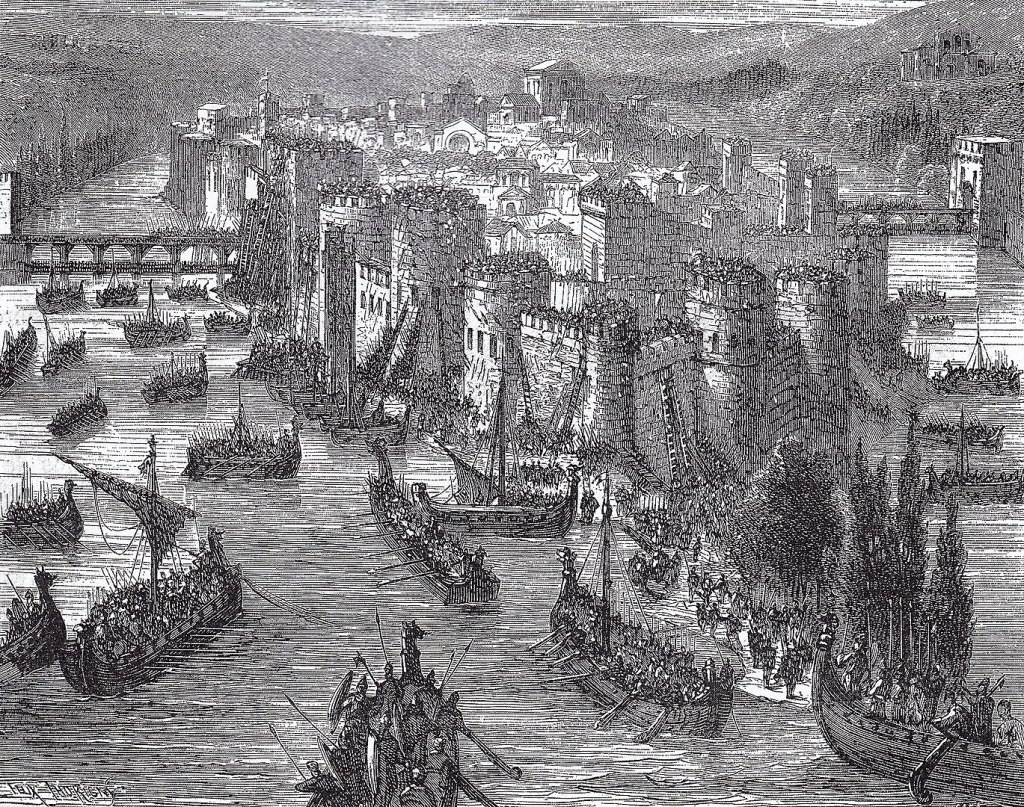
Viking Siege of Paris of 885 (Walls Were Built After Ragnar Lothbrok Sacked Paris in 845)
BOOK THREE: THE SAGA OF PRINCE HELGI ‘ARROW ODD’ ERIKSON
A Novel By Brian Howard Seibert
© Copyright by Brian Howard Seibert
WRITER’S UNCUT EDITION
(Contains Scenes of Violence and Sexuality Consistent with the Viking Period)
(May be Offensive to Some)
CHAPTER ONE
1.0 GRIM ‘HAIRY-CHEEK’ KETILSON (Circa 840 AD)
“Let us take this Saga for a ride,
Let us take it to a gallop,
Let loose the reins a bit….
Let’s see just where it takes us.”
Brian Howard Seibert
(840 AD) This Jarl of Hrafnista, this man named Grim, had the byname ‘Hairycheek’ because when he was conceived, a strange thing happened; Ketil Trout, his father, and Hrafnhild, Bruni’s daughter, went to bed together and her father spread a hide over them because he had invited some Lapps over, and during the night Hrafnhild looked out from under the hide and saw one Lapp who was very hairy. And it was at that moment of conception that Grim got his mark, his hairy cheek. Grim lived on the island of Hrafnista and was one of the most wealthy and powerful men of the Nor’Way. He was tall and strong with short cropped brown hair and he kept his hairy cheek clean shaven. He was married to a bright and beautiful woman named Lofthaena, the daughter of Lord Harald of The Vik Fjord in the east of Norway.
The summer after the death of Brother Gregory of Gardariki, Grim planned a journey to Hraegunarstead in Stavanger Fjord and then on to The Vik Fjord, where he had much property. Lofthaena wanted to go with him, but Grim was reluctant because his wife was with child. He had planned on taking his concubine wife, Aester, Brother Gregory’s voluptuous woman, whom he had married in respect of the Goth when he’d learned he had perished in the ice of the Nor’Way. Lapps had found his new ship crushed and deserted in the ice over winter and they knew the markings of Jarl Grim of Hrafnista and they returned him his dragon’s head from the forestem. They told him there were no signs of the dead, only signs and tracks of white bears and wolves where the dead had perhaps lain. So he had married the large breasted nursemaid that Brother Gregory had hauled, much to her horror, north across the Nor’Way to the northmost tip of Thule, and he had adopted her son as well.
“I will not be happy unless I go,” Lofthaena told him stubbornly.
Grim loved her dearly, so he let her come with him. She was very attractive, intelligent and well-spoken and was used to having her way. Her long blonde hair fell halfway down her tall lean body. They outfitted their two ships smartly and adorned themselves lavishly and the people of Hrafnista loved them for it and gave them a grand send-off. When they reached Stavanger they turned into the fjord and sailed up it until they beached their ships at Hraegunarstead. They were greeted by his Aunt Kraka and Jarl Brak, Ragnar’s foremost man. Ragnar himself had not been home in years, having marked himself with a spear to dedicate himself to following Odin’s calling. When Grim told his aunt that Brother Gregory had requested that his baby be raised at Hraegunarstead, she suggested that he be raised at a farm by the stead called Berurjod, just along the bay. Grim’s friend, a man called Ingjald lived there with his new wife and baby, a handsome boy called Asmund. Ingjald’s new wife was having trouble breast feeding and it was obvious that Grim’s concubine, Aester, had no such difficulties, and Ingjald was very pleased that the voluptuous woman came along with the boy. Lofthaena had seen to that.
When Ingjald asked Grim what the baby’s name was, Grim explained that there was none. Brother Gregory wanted Ragnar Lothbrok’s son, Erik ‘Bragi’, to name the boy when he next returned to Norway from Gardariki. Kraka thought the instructions very odd, so that is what they decided to call the boy until his proper naming…Odd, meaning edge.
While Grim and his wife were staying in Ragnar’s longhall, Lofthaena went into labour and gave birth to a boy. They named him Gudmund and took their baby with them when they left for The Vik, but Oddi stayed behind at Berurjod to be raised with Asmund and Aester stayed and breast fed them both, much to the relief of his mother.
Oddi grew to be a good looking boy who picked up skills very quickly and Asmund followed Oddi’s example. Oddi and Asmund became sworn brothers, brothers who’d shared the same breast. But Oddi spent much of his time at Hraegunarstead with Jarl Brak and seemed to take an interest in blacksmithing. Oddi would not play games like other children. He forged his first little arrow heads by the time he was five and seemed quite skilful at making arrows. Many arrows. And he did not take good care of them. He left them lying about on seats and benches and many people were hurt by them when they came in after dark and sat down on them. This one thing made Odd unpopular. Men told Ingjald that he should talk to Odd about this. Ingjald met with Oddi one day. “There is one thing, foster-son,” said Ingjald, “that bothers people.”
“What is that?” said Oddi.
“You do not take care of your arrows properly,” said Ingjald.
“I think you could blame me for it,” said Oddi, “if you had given me something to keep them in.”
“I shall get you whatever you want.”
“I think,” said Oddi, “that you will get me what I need, but not what I want.”
“I will get you what you want,” said Ingjald, impatiently.
“You have a black three-year-old goat,” said Oddi. “Have him killed and skinned whole with both horns and hoofs.” All was done as Oddi had asked, and he was brought the skin-bag. Then he gathered all his arrows up into it until the skin-bag was full. He had much finer arrows, and more of them, than other people, and he had a fine bow to match. He and Asmund both practised with their bows and became the finest young archers in Hraegunarstead, but, still, Oddi left his arrows lying about and the people began calling him ‘Arrow Odd’ and grew tolerant of his carelessness. When Asmund accidentally sat on one of Arrow Odd’s arrows, he was injured and couldn’t sit down for a week. “Your arrows will be the death of Asmund,” the local folk warned and Oddi had a dream that Asmund died from an arrow’s bite and from the next day on, he never left an arrow lying about.
Oddi wore a scarlet robe that Grim had sent him from Hrafnista, that came from Constantinople, and every day he wore it and he had an embroidered gold headband round his long blonde locks and he looked quite the handsome boy. He had his bow and quiver with him wherever he went. Asmund wore a brown tunic and kept his brown hair cropped short like his father, and everywhere he went he carried a short sword and cut quite a dashing figure himself. Both boys were tall for their age and surprisingly strong.
The sworn brothers were six years old when they first learned to row a boat and often rowed out from the land together in a four oared boat that Ingjald and Brak had helped them build. But they were only allowed to row it about the fjord. And the two boys practiced everything together: archery, swimming, sword play and riding, but afternoons, Oddi reserved for steel smithing with Brak. Brak had never seen a child take so quickly to steel work as Oddi. Not even his former apprentice, Erik, had started so young or progressed so quickly. One good thing had come out of Oddi’s carelessness with his arrows, besides the byname, and that was his interest in the alloys that Brak would create to prevent rusting. Oddi had often left his arrows lying about and that included when he was outside and he’d often left his arrows out in the rain and they would rust and lose their odd or edge. Brak would get certain alloys from Damascus and India that could prevent this and Oddi would borrow them from Brak to make his arrows, but Brak would never allow him to use too many alloying agents.
“The gods created rust to punish steel for the pain it inflicts upon men,” Brak would lecture him.
Oddi wanted Brak to teach him how to make Indian steel, but Brak would always tell him he was too young.
“Indian steel can be a little brittle if not made exactly right,” he would tell Oddi, “and that may suffice for armour, but not for good blades.”
One day the boys decided to row their little boat all the way to Stavanger and back, but it took them half the day to row down to the town with the current and when they started rowing back upstream against it they only made it halfway back before nightfall. They’d heard the wolves howling in the forests of the foothills at the bases of the mountains, so they huddled together under their cloaks in the middle of the fjord and slept in their boat. When they got back home the next day, there was hell to pay, but at least the boys learned from their mistake.
“We have to become stronger rowers,” Oddi explained to Asmund, and they practised even harder, but only in their end of the long fjord.
Soon after they had gotten in trouble with their boat, the boys heard rumours of an upcoming raid. Prince Erik was bringing a fleet of Nor’Way warships from the east to help his father in an attack upon a Gaul named Frank. The boys would row their four oared boat around the fjord and pretend it was a dragonship and Oddi was the captain and Asmund his foremost man and they planned to join the Prince’s Hraes’ fleet when it came from Kiev to attack Frankia.
CHAPTER TWO
2.0 THE SACK OF PARIS OF 845
“And his shield was called Hrae’s Ship’s Round,
And his followers were called the Hraes’.”
Eyvinder Skald-Despoiler; Skaldskaparmal.
It was late spring, 845 AD when Erik ‘Bragi’ Ragnarson and cousin Grim ‘Hairy-Cheek’ Ketilson came south from Hrafnista with three longships full of warriors from Halogaland and countless Nor’Way ships full of Varangians from Gardariki. The war arrow had been passed up and down the Nor’Way coast and east into the Nor’Way trade routes and all were required to respond in some way. It was a call to arms for an attack on Paris and all the chieftains of the Nor’Way and The Vik and Hraes’ Gardar and Gardariki had responded with dragonships full of fierce men bearing mortal weapons. Prince Erik had returned to Hraegunarstead from the east for the first time in many years and there was something Jarl Grim wanted to discuss with him regarding the ship Fair Faxi and young Oddi’s future. Oddi and Asmund were sitting together on the second high seat next to Brak and Grim.
“Is it about Fair Faxi?” Oddi asked.
“Yes. That and more,” Grim went on. “I have to talk to him about Brother Gregory, the Goth who brought Faxi over the crossing from the east.”
“Will you be giving Fair Faxi back to Prince Erik?”
“No son,” the Halogalander continued. “Faxi is a Nor’Way ship and will be on her way back east for the summer’s Nor’Way trading, back east with the rest of the Nor’Way ships, but I’ll be lending our Prince all my longships and my warriors for the raid on Frankia,”
“Can I come?” young Oddi asked.
“Oh no!” Grim exclaimed, laughing. “You are far too young for that,” and he grabbed Oddi up in his strong arms and gave him a great hug. Just then the bellhorn from the watchtower at the fjord’s bend began bellowing a message of ships approaching, friendlies. People began darting about and throwing on cloaks and soon all were running for the bitter green, with Grim and Oddi at the forefront.
The narrow greensward ran along the south edge of the fjord of Hraegunarstead between the mountains and the bay, a lush meadow the freemen called the bitter green. At its westernmost point stood a watchtower where a lookout monitored the mouth of the fjord for the arrival of ships and the guard was sounding a bellhorn in warning. Prince Erik’s longship was spotted sailing up the fjord toward the stead and the whole household had rushed out onto the bitter green to welcome The Prince home. Grim and Oddi watched as the ship’s bulwarks rose up out of the waters and settled back down into the waves as the oars chomped at the swells. The Prince could be made out on the foredeck as men scampered about mid-deck, gathering up the sail and unfooting the mast. As the ship passed along the shore, the crewmen at the stern waved to the crowd and the people on shore ran back along the bitter green, following the longship’s progress. Prince Erik barked out orders and the oars were raised as the longship coasted up onto the beach, scudding softly into the coarse sand. Ropes were let out and the multitude grabbed them up and hauled the ship onshore, as the Varangians stowed their oars. Erik was at the forestem, below the fierce dragon’s head, and was the first to leap to land and stand steadfast in the sand. He greeted Kraka and Brak, then gave Grim a great hug. “This is Oddi,” Grim announced and Erik shook the boy’s hand vigorously and continued greeting the folk of Hraegunarstead, many of whom he had not seen in years.
Later, in the evening, Grim had a private audience with The Prince on the high seats of the main hall. “Shortly after the fall of Gardariki,” Grim began, cradling a goblet of mead, “Brother Gregory visited us at Hrafnista, bringing the news of the tragic death of your wife, Gunwar.” Erik nodded. “He also brought his baby, the boy, Oddi, that I introduced you to this afternoon. And he gave me this,” Grim said, presenting Erik with a cross made of iron. “He said you would recognize it as being his.” Erik took up the cross, speechless. “He also brought your ship, Fair Faxi, across the ‘Way. He left the baby with Loefthana and me with instructions to have him raised here in Hraegunarstead. He also told me that he wanted you to name his son. Brother Gregory then said he had to return to Gardar late in the season because he expected the Huns to attack his Goths in the spring. I gave him a new Nor’Way ship with which to attempt such a late crossing, but he never made it. The ship was found by Sami hunters that winter, crushed and broken in the sea ice, with no sign of the crew. Young Oddi has been raised here at Hraegunarstead with the family of young Asmund ever since. The two boys are inseparable.”
Erik mulled over what Grim had told him, he stepped down from the highseat and paced back and forth as though very troubled and said, “Brother Gregory was like a blood brother to me. His son must be cared for as though he were my own; he must be kept safe at all times. I would take him back east with me, but it is far too dangerous there. He is safer being raised here with family. As far as naming goes, many years ago King Frodi’s sea king, Spear Odd, claimed he would have Odin name my son after him, just before he died by my sword…and here is Brother Gregory’s son…who has been called Arrow Odd and we shall keep it as Arrow Odd!” Tears began to well up in Prince Erik’s eyes.
“I think that is very wise,” Grim answered. “And what about your ship, Fair Faxi?”
“Since Brother Gregory brought Oddi across the Nor’Way with it, I think it only fair that we give Fair Faxi to Oddi when he is twelve. And I’ll pay you for the ship you lost. It’s the least I can do for my blood brother. I’ll try to make it back here more often, just to check up on the boy, but I shall make sure I come back here for Oddi’s twelfth birthday naming feast and his gifting of the ship.”
“That too is very wise. Old King Gotar was as sagacious in giving you the byname ‘Bragi’ as he was foolish in crossing swords with you, Cousin Erik.”
Grim ‘Hairy-Cheek’ gripped the forestem of his ship, fighting for balance as he scanned the horizon and the approaching coast. There, he was sure, was the mouth of the Seine River as his lord, King Roller, had described, a broad mouth between two headlands, one humped like a Bactrian camel and the other a silhouette of a horned recurve bow. The references were eastern, but Grim was a Varangian, a true Varangian, with many Nor’Way crossings under his belt, so the Seine was but a shadow of the Volga he was used to. He directed his longship south and led the Norwegian fleet into the main river of Frankia.
Prince Erik shook his mane of coal black hair and it danced about his shoulders showing flecks of grey as he stepped forth from the awning that was anchored, midships, to the mast. “This is it?” he asked and Grim nodded, the noon sun casting a shadow of a dragon’s head across his broad shoulders. Seventy longships followed in their wake, each casting a dragon shadow of its own upon the waters. The sails lost their wind with each turn up the river and thirty oars would pierce the waters of the Seine, then thirty more would pierce again, then thirty more till all the ships had entered that wide mouth of the River Seine. The king had left The Vik with a similar fleet a week before them and would be in Rouen by now, at the island base of King Ragnar ‘Lothbrok’ Sigurdson, father of the two Ragnarsons. King Roller and Prince Erik each brought a fleet of dragonships to support their father in his planned assault upon Paris, capital city of the Franks.
“I have to attack Paris,” Ragnar explained. “I have to capture a capital of the Holy Roman Empire before my sons conquer the Eastern Roman Empire’s Constantinople. How would I ever live it down if my sons were to capture a capital before me?”
“Aye,” were the shouts of all as they raised glasses and goblets in praise. Rouen was in ruins about them and Viking raiders sauntered down the streets as the city smouldered. But spoils had been scant, and the populace had been evacuated. Ragnar ‘Lothbrok’ had sacked the city four years earlier and it had never truly recovered. This victory was a hollow one.
“Perhaps Paris should be handled differently,” Erik suggested.
“How so?” Roller responded.
“We don’t sack the city. We occupy it and force the Franks to ransom her.”
“That’s never been done in the north!” Ragnar exclaimed. “I like it! How much should we demand?”
“Just enough so we can do it again. Four years later. Not like Rouen here.”
“I like it too,” Roller added. “But how will we keep our men from pillaging?”
“My Varangians could occupy the city. They have all been posted in Constantinople at one time or another and they know restraint and discipline.”
“Now we just have to destroy the Frankish army,” Ragnar stated, matter of factly. “Their King Charles is leading his army from Paris as we speak.”
The next day, the Norse fleets left Rouen and sailed up the Seine. Halfway to Paris they saw the Frank army, half of it on one side of the river and the other half on the other side. Prince Erik led his Varangian fleet up the right side of the Seine and his brother, King Roller, led his Norwegian fleet up the left. Ragnar ‘Lothbrok’ sailed his Viking fleet straight up the middle. The Varangians beached along the right riverbank and assembled into a wedge formation five thousand strong to engage the ten thousand strong Frankish army on an open field just beyond the river. King Roller’s fleet nosed into the sand on the left riverbank but did not disembark. King Ragnar’s smaller fleet kept sailing upriver past an island and around a bend and were soon out of sight. Once the Hraes’ Varangian troops had fully engaged the Franks in a shield wall battle, Roller led his Norwegian fleet away from the riverbank and they sailed further upstream and across river to attack the rear of the Frank army as it battled the Varangians. The Frank army on the left bank of the river watched as the two Norse armies enveloped their countrymen. Most Franks could not swim, but the few thousand that could on the left riverbank, stripped off their armour, lashed their swords about their necks and swam out into the river to help their fellow Franks on the other side.
King Ragnar’s Viking fleet soon reappeared from around the bend upriver, oars splashing with the downstream current and attacked the swimmers in the water. Prince Erik watched from behind his shield wall lines and found it difficult to ascertain which Franks were dying faster, those upon the right riverbank or those in the water. King Charles and the remaining half of his army continued to watch the slaughter on the opposite bank of the River Seine. The swimmers in the river were all gone by then, either dead and floating downstream, or, some stronger swimmers having made it back to their own riverbank stood watching while the swimmers who’d surrendered were being bent over their shields and raped by the Vikings on the ships. Then the Viking fleet beached on the right bank and joined in on the massacre. A few thousand Franks remained and they threw down their arms and surrendered to this third assault upon them from the riverbank. They, too, were bent over their shields as King Charles and his remaining army could only stand on the other side and watch.
“We should hang the captives as a sacrifice to Odin,” Ragnar started.
“There has been enough blood shed today,” Erik protested.
“That’s very Christian of you,” Roller laughed. “King Frodi once wanted to sacrifice the Sclavs to Odin at the whim of old Gotwar, that witch you spared from the House of Westmar. You came up with a test for them back then. Perhaps you can come up with a new test now.”
Prince Erik argued that only the swimmers should be tested, as they had not made it to the field of battle to be covered under the ancient Roman laws of war. Then he decided that they would tell these prisoners that any of them who would convert back to the old pagan faith would be spared and the remaining Christians would be hanged. One hundred and eleven men broke off into a group willing to convert and one hundred and twenty moved off into a group unwilling to give up Christianity. One man remained between them, unable to decide what to do.
“What is your wish?” Prince Erik asked in French.
“I have heard that King Ragnar ‘Lothbrok’ has marked himself with a spear as a sacrifice to Odin,” the Frank started, a little startled that the Viking could speak his language. “I would convert to the old religion, but I fear your king plans to sacrifice the converts to Odin, not the Christians.”
“What is your name?” Erik asked.
“I am Varrin,” the Frank answered.
“Well Varrin, my wife converted to Christianity and she died in battle staying true to her new faith.”
Varrin joined the group remaining faithful to Christ.
King Ragnar took the group of prisoners that were willing to convert onto his Viking ships and they rowed to the small island in the middle of the Seine and in sight of the remaining Frankish army he marked the hundred and eleven men with a spear and had them hanged as a sacrifice to Odin. The Norse fleets then sailed off toward Paris, leaving the stalwart Christians standing on the right riverbank, the Frankish army still standing, watching on the left and the new converts dangling in between them. The captured prisoners who had been bent over their shields were going by ship to Paris where they were to be ransomed.
The fleets arrived outside Paris on Easter Sunday and the Varangian troops approached the city without resistance while most of the citizens attended mass. They were so orderly as they marched up the riverbank and across the island city’s northern bridge bearing their captives’ Frankish shields, that the watchtower sentries mistook them for the Frankish troops of King Charles and failed to raise the alarm. The sentries were quickly dispatched and the city guard was captured and locked up. The Norwegian and Viking armies then surrounded the island city with their ships to keep the populace on the island and when the Mayor returned to city hall after mass, he found Prince Erik ‘Bragi’ and King Ragnar ‘Lothbrok’ awaiting him. They demanded seven thousand pounds of silver and gold as ransom for their capital city plus the return of all trading settlement lands that Ragnar had been deprived of years earlier.
It took King Charles several weeks to raise the ransom and the Varangian Hraes’ troops got less orderly as time wore on. A plague broke out in King Ragnar’s Viking camp outside the city and King Roller kept that camp isolated from the Norwegian camp until the affliction had run its course. Prince Erik had his men wear their gloves to prevent the outbreak from affecting his disciplined Varangians who held the city. They held Paris hostage for over a month before they got their ransom. King Roller returned to The Vik with his fleet, King Ragnar remained at one of his trading settlements on the coast of Frankia and Prince Erik returned to Stavanger Fjord to visit with Oddi before leading his Varangian Hraes’ fleet across the Baltic and back to Gardar.
Chapter 3: THE PROPHECY (Circa 852 AD) of BOOK 3: THE SAGA OF PRINCE HELGI ‘ARROW ODD’ ERIKSON shall follow on next Post or may be found under Heading of The VARANGIANS / UKRAINIANS Book Series – The True History of ‘The Great Viking Manifestation of The Middle Ages’© in Book Three: The Saga of Prince Helgi ‘Arrow Odd’ Erikson.
Note: This website is about Vikings and Varangians and the way they lived over a thousand years ago. The content is as explicit as Vikings of that time were and scenes of violence and sexuality are depicted without reservation or apology. Reader discretion is advised.
The VARANGIANS / UKRAINIANS or The Nine Books of Saxo’s Danish History Per Brian Howard Seibert
BOOK ONE: The Saga of King Ragnar ‘Lothbrok’ Sigurdson
King Ragnar ‘Lothbrok’ Sigurdson’s third wife, Princess Aslaug, was a young survivor of the Saga of the Volsungs and was a daughter of King Sigurd ‘the Dragon-Slayer’ Fafnirsbane, so this is where Ragnar’s story begins in almost all the ancient tales (except Saxo’s). In our series, we explore this tail end of the Volsungs Saga because King Sigurd appears to be the first ‘Dragon-Slayer’ and King Ragnar ‘Lothbrok’ would seem to be the second so, it is a good opportunity to postulate the origins of Fire Breathing Dragons and how they were slain. King Ragnar would lose his Zealand Denmark to the Anglish Danes of Jutland, who spoke Anglish, as did the majority of Vikings who attacked England, which spoke both Anglish and Saxon languages, sometimes mistakenly called a common Anglo-Saxon language. The Angles and Saxons of England never really did get along, as shall be demonstrated in the following books. King Ragnar assuaged the loss of Zealand by taking York or Jorvik, the City of the Boar, in Angleland and Stavanger Fjord in Thule from which he established his Nor’Way trade route into Scythia.
BOOK TWO: The Saga of Prince Erik ‘Bragi’ Ragnarson
Book Two of the Nine Book The Varangians / Ukrainians Series places The Saga of Prince Erik ‘Bragi’ Ragnarson from Book Five of The First Nine Books of the Danish History of Saxo Grammaticus (c. 1200 AD) about King Frodi ‘the Peaceful’ into its proper chronological location in history. In 1984, when I first started work on the book, I placed Prince Erik’s birth at circa 800 CE, but it has since been revised to 810 CE to better reflect the timelines of the following books in the series. Saxo had originally placed the saga at the time of Christ’s birth and later experts have placed the story at about 400 CE to correspond with the arrival of the Huns on the European scene but, when Attila was driven back to Asia, the Huns didn’t just disappear, they joined the Khazar Empire, just north of the Caspian Sea, and helped the Khazars control the western end of the famous Silk Road Trade Route. Princes Erik and Roller, both sons of Ragnar ‘Lothbrok’, sail off to Zealand to avenge their father’s loss, but Erik falls in love with Princess Gunwar, the sister of the Anglish King Frodi of Jutland and, after his successful Battle Upon the Ice, wherein he destroys the House of Westmar, Erik marries Gunwar and both brothers become King Frodi’s foremost men instead, and the story moves on to the founding of Hraes’ and Gardar Ukraine.
BOOK THREE: The Saga of Prince Helgi ‘Arrow Odd’ Erikson
Book Three, The Saga of Prince Helgi ‘Arrow Odd’ Erikson, recreates Arrow Odd’s Saga of circa 1200 AD to illustrate how Arrow Odd was Prince Helgi (Oleg in Slavic) Erikson of Kiev, by showing that their identical deaths from the bite of a snake was more than just coincidence. The book investigates the true death of Ragnar ‘Lothbrok’ by poisoned blood-snakes in York or Jorvik, the ‘City of the Boar’, and how his curse of ‘calling his young porkers to avenge the old boar’ sets up a death spiral between swine and snake that lasts for generations. The book then illustrates the famous Battle of the Berserks on Samso, where Helgi ‘Arrow Odd’ and Hjalmar ‘the Brave’ slay the twelve berserk grandsons of King Frodi on the Danish Island of Samso, setting up a death struggle that takes the Great Pagan Army of the Danes from Denmark to ravage Norway and then England and on to Helluland in Saint Brendan’s Newfoundland. A surprise cycle of vengeance manifests itself in the ‘death by snakebite’ of Helgi ‘Arrow Odd’.
BOOK FOUR: The Saga of Prince Ivar ‘the Boneless’ Erikson
Book Four, The Saga of Prince Ivar ‘the Boneless’ Erikson, reveals how Ivar ‘the Boneless’ Ragnarson was actually Prince Eyfur or Ivar (Igor in Slavic) Erikson of Kiev and then King Harde Knute ‘the First’ of Denmark. By comparing a twenty year lacuna in the reign of Prince Igor in The Hraes’ Primary Chronicle with a coinciding twenty year appearance of a King Harde Knute (Hard Knot) of Denmark in European Chronicles, Prince Igor’s punishment by sprung trees, which reportedly tore him apart, may have rather just left him a boneless and very angry young king. Loyal Danes claimed, “It was a hard knot indeed that sprung those trees,” but his conquered English subjects, not being quite as polite, called him, Ivar ‘the Boneless’. The book expands on the death curse of Ragnar ‘Lothbrok’ and the calling of ‘his young porkers to avenge the old boar’ when Ivar leaves his first son, King Gorm (Snake) ‘the Old’, to rule in Denmark and his last son, Prince Svein (Swine) ‘the Old’ to rule in Hraes’, further setting up the death spiral between the swine and snake of the ‘Lothbrok’ curse.
BOOK FIVE: The Saga of Prince Svein ‘the Old’ Ivarson
Book Five, The Saga of Prince Svein ‘the Old’ Ivarson, demonstrates how Prince Sveinald (Sviatoslav in Slavic) ‘the Brave’ of Kiev was really Prince Svein ‘the Old’ Ivarson of Kiev, who later moved to Norway and fought to become King Sweyn ‘Forkbeard’ of Denmark and England. But before being forced out of Russia, the Swine Prince sated his battle lust by crushing the Khazars and then attacking the great great grandfather of Vlad the Impaler in a bloody campaign into the ‘Heart of Darkness’ of Wallachia that seemed to herald the coming of the Four Horsemen of the Apocalypse and included the famed 666 Salute of the Army of the Impalers. The campaign was so mortifying that the fifteen thousand pounds of gold that the Emperor of Constantinople paid him to attack the Army of the Impalers seemed not nearly enough, so Prince Svein attacked the Eastern Roman Empire itself. He came close to defeating the greatest empire in the world, but lost and was forced to leave Hraes’ to his three sons. He returned to the Nor’Way and spent twelve years rebuilding Ragnar’s old trade route there.
BOOK SIX: The Saga of Grand Prince Valdamar ‘the Great’ Sveinson
Book Six, The Saga of Grand Prince Valdamar ‘the Great’ Sveinson, establishes how Grand Prince Valdamar (Vladimir in Slavic) ‘the Great’ of Kiev, expanded the Hraes’ Empire and his own family Hamingja by marrying 700 wives that he pampered in estates in and around Kiev. Unlike his father, Svein, he came to the aid of a Roman Emperor, leading six thousand picked Varangian cataphracts against Anatolian rebels, and was rewarded with the hand of Princess Anna Porphyrogennetos of Constantinople, a true Roman Princess born of the purple who could trace her bloodline back to Julius and Augustus Caesar. She was called ‘Czarina’, and after her, all Hraes’ Grand Princes were called ‘Czars’ and their offspring were earnestly sought after, matrimonially, by European royalty.
BOOK SEVEN: The Saga of King Sweyn ‘Forkbeard’ Ivarson
In The Saga of King Sweyn ‘Forkbeard’ Ivarson, Prince Svein anonymously takes the name of Sweyn ‘Forkbeard’ in Norway and befriends the Jarls of Lade in Trondheim Fjord in Norway as he expands the Nor’Way trade route of his grandfather, Ragnar ‘Lothbrok’. He had come close to defeating the Eastern Roman Empire, and still felt that he was due at least a shared throne in Constantinople. He used the gold from the Nor’Way trade to rebuild his legions and his Hraes’ cataphracts and though his brother, King Gorm ‘the Old’, was dead, his son, Sweyn’s nephew, King Harald ‘Bluetooth’ Gormson had usurped the throne of Denmark and had hired the famed Jomsvikings to attack Prince Sweyn in Norway, setting up the famous Battle of Hjorungavagr in a fjord south of Lade. King Sweyn ‘Forkbeard’ would emerge from that confrontation and then he would defeat King Olaf Tryggvason of Norway in the Battle of Svolder in 1000 AD, in an engagement precipitated over the hand of Queen Sigrid ‘the Haughty’ of Sweden. Later he attacked England in revenge for the following St. Brice’s Day Massacre of Danes in 1002 AD and he fought a protracted war with the Saxon King Aethelred ‘the Unready’ that could only be described as the harvesting of the English for sale as slaves in Baghdad and Constantinople. With the help of his son, Prince Valdamar of Kiev, and the legions and cataphracts of Hraes’, he conquered England on Christmas Day of 1013, but victory was not kind to him.
BOOK EIGHT: The Saga of King Canute ‘the Great’ Sweynson
Prince Valdamar ‘the Great’ Sveinson of Kiev, who had supported his father, King Sweyn ‘Forkbeard’ of Denmark in attacks upon England left his ‘Czar’ sons in charge of Hraes’ and took over as King Valdamar of England, but the Latin Christian English revolted against his eastern name and Orthodox Christian religion and brought King Aethelred back from exile in Normandy and Valdamar had to return to Hraes’ and gather up the legions he had already sent back after his father’s victory. His half brother was ruling in Denmark and his sons were ruling in Hraes’ so, in 1015 AD Grand Prince Valdamar ‘the Great’ of Kiev was written out of Hraes’ history and in 1016 the Latin Christian Prince Canute ‘the Great’ returned to England to reclaim his throne. He defeated Aethelred’s son, King Edmund ‘Ironside’ of England, at the Battle of Assandun to become King Canute ‘the Great’ of England and later King Knute ‘the Great’ of Denmark and Norway as well. But that is just the start of his story and later Danish Christian Kings would call his saga, and the sagas of his forefathers, The Lying Sagas of Denmark, and would set out to destroy them, claiming that, “true Christians will never read these Sagas”.
BOOK NINE: The Saga of King William ‘the Conqueror’ Robertson
The Third Danish Conquest of Angleland was seen to herald the end of the Great Viking Manifestation of the Middle Ages, but this, of course, was contested by the Vikings who were still in control of it all. Danish Varangians still ruled in Kiev and Danes still ruled the Northern Empire of Canute ‘the Great’, for the Normans were but Danish Vikings that had taken up the French language, and even Greenland and the Newfoundland were under Danish control in a Hraes’ Empire that ran from the Silk Road of Cathay in the east to the Mayan Road of Yucatan in the west. “We are all the children of Ragnar ‘Lothbrok’,” Queen Emma of Normandy often said. Out of sheer spite the Saxons of England took over the Varangian Guard of Constantinople and would continue their fight against the Normans in Southern Italy as mercenaries of the Byzantine Roman Empire. They would lose there as well, when in the Fourth Crusade of 1204, the Norman Danes would sack the City of Constantinople and hold it long enough to stop the Mongol hoards that would crush the City of Kiev. It would be Emperor Baldwin ‘the First’ of Flanders and Constantinople who would defeat the Mongol Mongke Khan in Thrace. But the Mongols would hold Hraes’ for three hundred years and this heralded the end of the Great Viking Manifestation. The Silk Road was dead awaiting Marco Polo for its revival. But the western Mayan Road would continue to operate for another hundred years until another unforeseen disaster struck. Its repercussions would be witnessed by the Spanish conquerors who followed Christopher Columbus a hundred and fifty years later in the Valley of the Mound Builders.
Conclusion:
By recreating the lives of four generations of Hraes’ Ukrainian Princes and exhibiting how each generation, in succession, later ascended to their inherited thrones in Denmark, the author proves the parallels of the dual rules of Hraes’ Ukrainian Princes and Danish Kings to be cumulatively more than just coincidence. And the author proves that the Danish Kings Harde Knute I, Gorm ‘the Old’ and Harald ‘Bluetooth’ Gormson/Sweyn ‘Forkbeard’ were not Stranger Kings, but were Danes of the Old Jelling Skioldung Fridlief/Frodi line of kings who only began their princely careers in Hraes’ and returned to their kingly duties in Denmark with a lot of Byzantine Roman ideas and heavy cavalry and cataphracts.
 SeiberTeck: 'The Varangians Series'