THE SAGA OF PRINCE HELGI ‘ARROW ODD’ ERIKSON Has Been Added to The Site Under the New Heading The VARANGIANS / UKRAINIANS Book Series – The True History of ‘The Great Viking Manifestation of Medieval Europe’© and the below Post Covers CHAPTER TWENTY ONE:
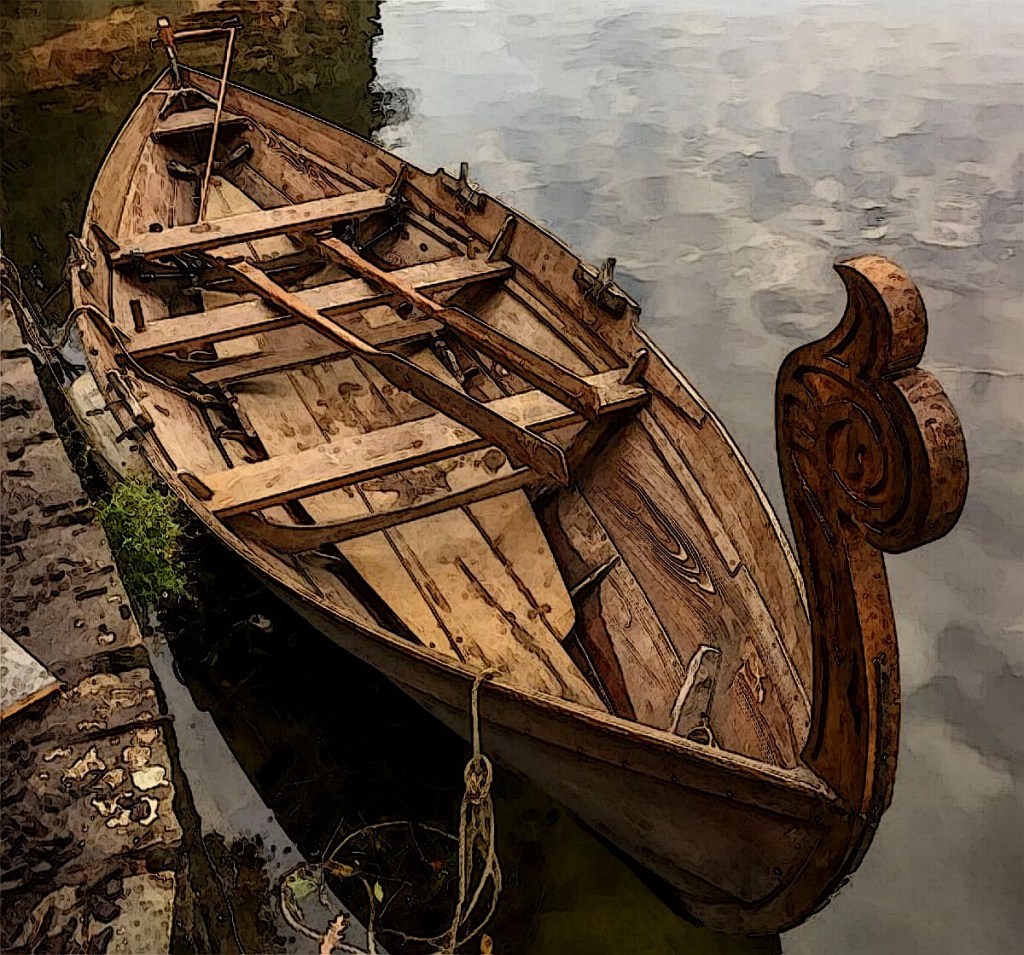
Vignir’s Personal York Boat
BOOK THREE: THE SAGA OF PRINCE HELGI ‘ARROW ODD’ ERIKSON
A Novel By Brian Howard Seibert
© Copyright by Brian Howard Seibert
WRITER’S UNCUT EDITION
(Contains Scenes of Violence and Sexuality Consistent with the Viking Period)
(May be Offensive to Some)
CHAPTER TWENTY ONE
21.0 VIGNIR (Circa 868 AD)
Claim 3.2a That Prince Helgi (Oleg) ‘Arrow Odd’s death by poisonous
snake bite was an analogy for death from the STD Syphilis, which Helgi
may have brought back with him from the Newfoundland. Once caught,
Syphilis presented rather benign first and second stages, but it was the third
unavoidable stage that appeared up to thirty years later that killed the victim,
usually by attacking the shins and lower limbs, and in Helgi’s case, one foot
in particular. This discovery added October 19th, 2023.
Brian Howard Seibert
(868 AD) Oddi was returning to Europe with his fleet and he followed Queen Alfhild’s advice to the rune, and they sailed north up between mainland Newfoundland and the New Ireland coasts and up on some cliffs of the island Oddi spotted the fortress that Ogmund ‘Eythjofsbane’ Tussock had built to watch for him. The weather was calm so he had his fleet sail one moonlit night in the shadow of the mainland coast to avoid detection and they sailed up to Slabland then headed east out to sea and soon Oddi saw birds off their port side to the north and he knew that they were flying above the Glacier land and then, as Oddi was adjusting the course of Fair Faxi using a navigational device he had acquired in Baghdad, he noticed seagulls to the north, which could only mean Iceland, and from the number of gulls, there was quite a bit of it. He told his men that they should replenish their fresh water supply, so he led his fleet north and they spotted what looked to be a large island with mountains that seemed to be belching smoke and steam. As they approached from the south, Oddi led his fleet west, looking for Floki and his ships. They had been circling west for about an hour when they saw a half dozen ships anchored in the mouth of a fjord and Oddi recognized one of the ships as belonging to the Viking, Captain Floki, who had sailed with him on his first journey to the Newfoundland. The whole Norwegian fleet swung into the fjord, which sent the anchored ships into a panic until Floki recognized Fair Faxi and told his men it had to be ‘Arrow Odd’.
Floki welcomed Oddi to Iceland and told him that he had observed seagulls to the north when they went to find Saint Brendan’s land a few years back, so he later returned to the area of the gull sightings and found this island of fire and ice and he called it Iceland. “It’s not a very inviting name,” Floki laughed, “but it sure beats calling it Fireland.” They were now in the process of establishing the first settlement on the island. Oddi visited with Floki in his longhall while his fleet topped up their fresh water supplies.
Floki then told Oddi that the Hrafnistamen hunters had really followed the walrus to Iceland. “We were hunting them so fiercely in the Orkneys,” Floki admitted, “that they fled here and we followed them and found great herds of them all along the shores. We’ve hunted them all out here and now they’ve buggered off to Glacierland and parts further north. We’re setting up a base here and we’ll be going after them.”
Walrus ivory was now called the white gold of the north and that did not bode well for the huge sea cows. “As long as all the ivory flows through the Nor’Way route,” Oddi told Floki. “Not a stick of it goes through King Frodi’s Dan’Way!”
One evening Oddi was anchored off a headland of the fjord when he saw a man rowing from the east in a boat. Whoever it was, was rowing powerfully across the open sea, and he was amazingly large in size. He rowed so hard up to Oddi’s ships that it seemed everything would be broken before him. Then he rested on his oars and asked who was in charge.
Oddi said to him, “I am Arrow Odd. Who are you?”
“I’m Vignir,” he answered. “Are you the Odd who went to Bjarmaland long ago?”
“Yes,” said Oddi, “but it wasn’t that long ago.”
“I am speechless,” said Vignir.
“Really…it wasn’t that long ago,” repeated Oddi.
“I am speechless because you are my father,” said Vignir, “and I can barely believe that you’re a father to me, for you are so small and weak looking. I’m sorry, I’m just speechless.”
“Who is your mother?” Oddi said.
“My mother is Hildigunn,” said Vignir; ‘I was born in Giantland, and raised there, but mother told me that I must find my father and begin training as a Viking, so I have been searching for you. She told me that Arrow Odd was my father, a Viking and a hero, and I was thinking he would be a real man, but now I see that you are the least of nobodies to look at, and so you will likely turn out to be.”
“You little shit,” said Oddi. “Do you think that you will do more than me? Or work greater feats than I have? But I will accept you as my son and you’re welcome to remain here with me and I will train you.”
“That I will, and I accept it,” said Vignir, “but it seems beneath me, however, to train with your men, because they more closely resemble mice than men, and it seems very likely that I will do far bigger things than you, if I live as long as you have.”
Oddi recollected how modest a giant Vignir’s grandfather had been, but then remembered that Hilder had become king and likely Vignir had been raised as a little shit of a royal. “I haven’t lived that long,” Oddi replied, then quietly asked him not to insult his men. “Consider it the first lesson in your training.”
“Vignir started to protest, but Oddi said, “Ah…ah…ah, lesson number two starts tomorrow,” and he invited his son aboard for some food. And the boy could eat like a horse, Oddi marvelled. A very large horse. A cataphract horse.
In the morning they got ready to continue their journey to Europe and Vignir asked Oddi what they would do there. Oddi said he was going to Frankia, but he really wanted to look for Ogmund ‘Eythjofsbane’. “From him, you’ll get no good, if you find him,” Vignir said, “because he is the greatest troll and monster ever created in the northern part of the world.”
“It cannot be true,” said Oddi, “that you mock my stature and my men, but you are now so scared that you dare not seek to find Ogmund?”
“No need,” said Vignir, “to taunt me with cowardice, for now I shall have to repay you for your unkind words sometime soon. But I will tell you where Ogmund is. He’s in a fjord named Skuggi on a green island, of the wastes of Helluland, with his eight tussocked lads with him. He was there waiting for you, but he came back to Giantland for some witchcraft and has just returned to Skuggi Fjord and he again is waiting for you to come out of the great hinterland. Now, you may visit him, if you want, and see how it goes, but I would advise you to let him continue waiting for you. You are safe staying here while he wastes his time waiting to spring a trap for you, way across the Atlantean Sea.”
Oddi said he wished to find him, regardless of safety. They sailed west until they passed Glacier land again, then turned south at Slabland and sailed down the coast. Then Vignir said: “Now I shall sail in my boat today, but you can follow after.” Oddi let him go his own way. Vignir was master of his one small ship. That day they saw two rocks emerge from the sea. Oddi wondered much at that. Then they sailed between the rock faces. But as day wore on, they saw a huge island and Oddi asked them to sail up to it. The island was covered with heather. Oddi asked five men to go ashore and seek water, but they had been on shore only a short while when the island sank and drowned them all. They did not see it again. When they looked back at the rocks, they saw they had vanished as well. Oddi was very surprised by this, and he asked Vignir if he knew why this was. Vignir answered, “It seems to me that you have no more sense than stature. Now I will tell you that these are two sea monsters. One is named Hafgufa, the other Lyngbak. The latter is the greatest of all whales in the world, but Hafgufa is the biggest of monsters created in the ocean. It is her nature that she swallows both men and ships and whales and all that she can reach. She stays submerged day and night together, and then she lifts up her head and nostrils, then it is never less time than the tide that she stays up. Now that sound that we sailed through was the gap between her jaws, and her nose and lower jaw were the rocks you saw in the ocean, but Lyngbak was the island that sank. Ogmund Eythjofsbane has sent these creatures out searching for you with his enchantments to work the death of you and all your men. He thought that this would have killed more men than only those that just drowned, and he meant that Hafgufa would swallow us whole. Therefore, I sailed through her mouth because I knew that she had just risen to the surface. Now we have seen through these contrivances of Ogmund, but I think that we will still suffer from him worse than any other men.”
“That’s a risk we’re going to have to take,” said Oddi.
Arrow Odd and his son, Vignir, sailed until they found the shores of Helluland and they sailed south until they found the green island that Oddi had named New Ireland. They sailed along the east side of the sound until they rowed into the fjord called Skuggi. Once they had beached their ships, the father and son went to high ground and saw the fortress at the top of some cliffs.
“We spotted this fortress when we were coming out of the hinterland,” Oddi explained. “I thought it was a fortress of King Frodi’s, so we circumvented it.”
“This is Ogmund ‘Eythjofsbane’s fortress,” Vignir said, watching the waves rolling into the fjord, warily. “He calls it Solitude and he built it to wait for you, to wait until you came out of Skrailingland. You must have someone protecting you, some witch or warlock, for you to have gotten by him. But he knows you are here now.”
Ogmund was out on the walls with his companions. He greeted Arrow Odd as though he had expected him and asked them their business.
“You know my business,” Oddi said. “I want your life.”
“My idea is better,” said Ogmund, “that we accept that we are square now.”
“No,” said Oddi, “that isn’t true. You murdered my blood brother, Thord Prow-Gleam.”
“I only did that,” said Ogmund, “because I had greater numbers slain in our prior battle. But now that your losses equal mine, we are square. Besides, you will never defeat me while I am in this fortress, but I will offer you this: either you two fight me and my companions, or we will stay in the fort.”
“If that is what you wish,” said Oddi, “I will fight you, Ogmund, and Vignir here will fight your companions.”
“That shan’t be,” said Vignir. “Now I will reward you, father, for taunting me by saying I would not dare go up against Ogmund ‘Eythjofsbane’.”
“You sound like my friend, Hjalmar the Brave, when he wanted to battle Angantyr and left me to deal with all his brothers. We’ll regret this,” said Oddi, “as I have regretted Hjalmar’s death by the bite of the berserk’s sword, Tyrfingr, ever since. I have a shirt to protect me from harm, but I know you’ll want to get your own way in this, as did Hjalmar.”
Then the battle raged and all were evenly matched. Ogmund and Vignir went hard because their age and might matched as did their weapons training. Vignir drove Ogmund so vigorously that he ran off north along the sea cliff, but Vignir chased him until he drove Ogmund down over the rocks of a grassy ledge. They were forty fathoms above sea level, and struggling mightily on the ledge, tearing up turf and stones like bone skates on snowy ice. Sea spray rose up halfway to the ledge and Vignir watched the water warily.
Oddi seemed to be doing a little better, even with the numbers going against him. He held a massive club in both hands, because iron would not bite through the magic of Ogmund’s men. He dashed all those about him with the club until he had quickly killed them all. Exhausted, but unhurt, he thanked Olvor once more for his famed shirt. Oddi then went looking for his son out along the cliff edge until he saw Vignir and Ogmund battling like demons on the grassy ledge below him. But before Oddi could get to them, Vignir moved in to finish off Ogmund with a blow and a spout of water from the great whale Lyngbak shot up from the sea and landed at his feet, causing Vignir to slip and as he fell, Ogmund crouched down over him like a beast and bit out his jugular. Vignir died as he hit the ground. Oddi stopped and put up his hands as if that action would reverse what had just occurred. Ogmund said: “I think it would have been better, Odd, if we had called it square as I asked. Now you have lost someone by me that you can never forgive, and that is something I wanted to avoid at all costs. Your death has already been foretold to you and it is not at my hands. This bodes not well for me. And your son, Vignir, is dead; a man I think would have outdone both of us in strength and valour had he but lived. He would have beaten me if I was an ordinary man and not the wraith that I am. He has crushed and broken my body and damaged everything in me, every organ, every tissue, every bone. I would be dead if it were not for my unnatural powers, but I am afraid of no one in this world except you, Arrow Odd, and from you I will get my just deserts, sooner or later, because now you have more reason to kill me.”
Oddi overcame his shock and flew into a rage, jumped down the cliff and landed on the grassy ledge. Ogmund moved quickly and dove off the ledge headfirst into the sea far below with a great splash, and he was gone.
Oddi rushed back to his ships and ordered his men to row out and search the sea thereabouts, but there was no sign of Ogmund, so they burned Vignir’s body with the fortress and sailed back to Europe almost as Queen Alfhild had previously instructed.
Chapter 22.0: TALE OF TWO CITIES of BOOK 3: THE SAGA OF PRINCE HELGI ‘ARROW ODD’ ERIKSON shall follow on next Post.
Note: This website is about Vikings and Varangians and the way they lived over a thousand years ago. The content is as explicit as Vikings of that time were and scenes of violence and sexuality are depicted without reservation or apology. Reader discretion is advised.
The VARANGIANS / UKRAINIANS or The Nine Books of Saxo’s Danish History Per Brian Howard Seibert
BOOK ONE: The Saga of King Ragnar ‘Lothbrok’ Sigurdson
King Ragnar ‘Lothbrok’ Sigurdson’s third wife, Princess Aslaug, was a young survivor of the Saga of the Volsungs and was a daughter of King Sigurd ‘the Dragon-Slayer’ Fafnirsbane, so this is where Ragnar’s story begins in almost all the ancient tales (except Saxo’s). In our series, we explore this tail end of the Volsungs Saga because King Sigurd appears to be the first ‘Dragon-Slayer’ and King Ragnar ‘Lothbrok’ would seem to be the second so, it is a good opportunity to postulate the origins of Fire Breathing Dragons and how they were slain. King Ragnar would lose his Zealand Denmark to the Anglish Danes of Jutland, who spoke Anglish, as did the majority of Vikings who attacked England, which spoke both Anglish and Saxon languages, sometimes mistakenly called a common Anglo-Saxon language. The Angles and Saxons of England never really did get along, as shall be demonstrated in the following books. King Ragnar assuaged the loss of Zealand by taking York or Jorvik, the City of the Boar, in Angleland and Stavanger Fjord in Thule from which he established his Nor’Way trade route into Scythia.
BOOK TWO: The Saga of Prince Erik ‘Bragi’ Ragnarson
Book Two of the Nine Book The Varangians / Ukrainians Series places The Saga of Prince Erik ‘Bragi’ Ragnarson from Book Five of The First Nine Books of the Danish History of Saxo Grammaticus (c. 1200 AD) about King Frodi ‘the Peaceful’ into its proper chronological location in history. In 1984, when I first started work on the book, I placed Prince Erik’s birth at circa 800 CE, but it has since been revised to 810 CE to better reflect the timelines of the following books in the series. Saxo had originally placed the saga at the time of Christ’s birth and later experts have placed the story at about 400 CE to correspond with the arrival of the Huns on the European scene but, when Attila was driven back to Asia, the Huns didn’t just disappear, they joined the Khazar Empire, just north of the Caspian Sea, and helped the Khazars control the western end of the famous Silk Road Trade Route. Princes Erik and Roller, both sons of Ragnar ‘Lothbrok’, sail off to Zealand to avenge their father’s loss, but Erik falls in love with Princess Gunwar, the sister of the Anglish King Frodi of Jutland and, after his successful Battle Upon the Ice, wherein he destroys the House of Westmar, Erik marries Gunwar and both brothers become King Frodi’s foremost men instead, and the story moves on to the founding of Hraes’ and Gardar Ukraine.
BOOK THREE: The Saga of Prince Helgi ‘Arrow Odd’ Erikson
Book Three, The Saga of Prince Helgi ‘Arrow Odd’ Erikson, recreates Arrow Odd’s Saga of circa 1200 AD to illustrate how Arrow Odd was Prince Helgi (Oleg in Slavic) Erikson of Kiev, by showing that their identical deaths from the bite of a snake was more than just coincidence. The book investigates the true death of Ragnar ‘Lothbrok’ by poisoned blood-snakes in York or Jorvik, the ‘City of the Boar’, and how his curse of ‘calling his young porkers to avenge the old boar’ sets up a death spiral between swine and snake that lasts for generations. The book then illustrates the famous Battle of the Berserks on Samso, where Helgi ‘Arrow Odd’ and Hjalmar ‘the Brave’ slay the twelve berserk grandsons of King Frodi on the Danish Island of Samso, setting up a death struggle that takes the Great Pagan Army of the Danes from Denmark to ravage Norway and then England and on to Helluland in Saint Brendan’s Newfoundland. A surprise cycle of vengeance manifests itself in the ‘death by snakebite’ of Helgi ‘Arrow Odd’.
BOOK FOUR: The Saga of Prince Ivar ‘the Boneless’ Erikson
Book Four, The Saga of Prince Ivar ‘the Boneless’ Erikson, reveals how Ivar ‘the Boneless’ Ragnarson was actually Prince Eyfur or Ivar (Igor in Slavic) Erikson of Kiev and then King Harde Knute ‘the First’ of Denmark. By comparing a twenty year lacuna in the reign of Prince Igor in The Hraes’ Primary Chronicle with a coinciding twenty year appearance of a King Harde Knute (Hard Knot) of Denmark in European Chronicles, Prince Igor’s punishment by sprung trees, which reportedly tore him apart, may have rather just left him a boneless and very angry young king. Loyal Danes claimed, “It was a hard knot indeed that sprung those trees,” but his conquered English subjects, not being quite as polite, called him, Ivar ‘the Boneless’. The book expands on the death curse of Ragnar ‘Lothbrok’ and the calling of ‘his young porkers to avenge the old boar’ when Ivar leaves his first son, King Gorm (Snake) ‘the Old’, to rule in Denmark and his last son, Prince Svein (Swine) ‘the Old’ to rule in Hraes’, further setting up the death spiral between the swine and snake of the ‘Lothbrok’ curse.
BOOK FIVE: The Saga of Prince Svein ‘the Old’ Ivarson
Book Five, The Saga of Prince Svein ‘the Old’ Ivarson, demonstrates how Prince Sveinald (Sviatoslav in Slavic) ‘the Brave’ of Kiev was really Prince Svein ‘the Old’ Ivarson of Kiev, who later moved to Norway and fought to become King Sweyn ‘Forkbeard’ of Denmark and England. But before being forced out of Russia, the Swine Prince sated his battle lust by crushing the Khazars and then attacking the great great grandfather of Vlad the Impaler in a bloody campaign into the ‘Heart of Darkness’ of Wallachia that seemed to herald the coming of the Four Horsemen of the Apocalypse and included the famed 666 Salute of the Army of the Impalers. The campaign was so mortifying that the fifteen thousand pounds of gold that the Emperor of Constantinople paid him to attack the Army of the Impalers seemed not nearly enough, so Prince Svein attacked the Eastern Roman Empire itself. He came close to defeating the greatest empire in the world, but lost and was forced to leave Hraes’ to his three sons. He returned to the Nor’Way and spent twelve years rebuilding Ragnar’s old trade route there.
BOOK SIX: The Saga of Grand Prince Valdamar ‘the Great’ Sveinson
Book Six, The Saga of Grand Prince Valdamar ‘the Great’ Sveinson, establishes how Grand Prince Valdamar (Vladimir in Slavic) ‘the Great’ of Kiev, expanded the Hraes’ Empire and his own family Hamingja by marrying 700 wives that he pampered in estates in and around Kiev. Unlike his father, Svein, he came to the aid of a Roman Emperor, leading six thousand picked Varangian cataphracts against Anatolian rebels, and was rewarded with the hand of Princess Anna Porphyrogennetos of Constantinople, a true Roman Princess born of the purple who could trace her bloodline back to Julius and Augustus Caesar. She was called ‘Czarina’, and after her, all Hraes’ Grand Princes were called ‘Czars’ and their offspring were earnestly sought after, matrimonially, by European royalty.
BOOK SEVEN: The Saga of King Sweyn ‘Forkbeard’ Ivarson
In The Saga of King Sweyn ‘Forkbeard’ Ivarson, Prince Svein anonymously takes the name of Sweyn ‘Forkbeard’ in Norway and befriends the Jarls of Lade in Trondheim Fjord in Norway as he expands the Nor’Way trade route of his grandfather, Ragnar ‘Lothbrok’. He had come close to defeating the Eastern Roman Empire, and still felt that he was due at least a shared throne in Constantinople. He used the gold from the Nor’Way trade to rebuild his legions and his Hraes’ cataphracts and though his brother, King Gorm ‘the Old’, was dead, his son, Sweyn’s nephew, King Harald ‘Bluetooth’ Gormson had usurped the throne of Denmark and had hired the famed Jomsvikings to attack Prince Sweyn in Norway, setting up the famous Battle of Hjorungavagr in a fjord south of Lade. King Sweyn ‘Forkbeard’ would emerge from that confrontation and then he would defeat King Olaf Tryggvason of Norway in the Battle of Svolder in 1000 AD, in an engagement precipitated over the hand of Queen Sigrid ‘the Haughty’ of Sweden. Later he attacked England in revenge for the following St. Brice’s Day Massacre of Danes in 1002 AD and he fought a protracted war with the Saxon King Aethelred ‘the Unready’ that could only be described as the harvesting of the English for sale as slaves in Baghdad and Constantinople. With the help of his son, Prince Valdamar of Kiev, and the legions and cataphracts of Hraes’, he conquered England on Christmas Day of 1013, but victory was not kind to him.
BOOK EIGHT: The Saga of King Canute ‘the Great’ Sweynson
Prince Valdamar ‘the Great’ Sveinson of Kiev, who had supported his father, King Sweyn ‘Forkbeard’ of Denmark in attacks upon England left his ‘Czar’ sons in charge of Hraes’ and took over as King Valdamar of England, but the Latin Christian English revolted against his eastern name and Orthodox Christian religion and brought King Aethelred back from exile in Normandy and Valdamar had to return to Hraes’ and gather up the legions he had already sent back after his father’s victory. His half brother was ruling in Denmark and his sons were ruling in Hraes’ so, in 1015 AD Grand Prince Valdamar ‘the Great’ of Kiev was written out of Hraes’ history and in 1016 the Latin Christian Prince Canute ‘the Great’ returned to England to reclaim his throne. He defeated Aethelred’s son, King Edmund ‘Ironside’ of England, at the Battle of Assandun to become King Canute ‘the Great’ of England and later King Knute ‘the Great’ of Denmark and Norway as well. But that is just the start of his story and later Danish Christian Kings would call his saga, and the sagas of his forefathers, The Lying Sagas of Denmark, and would set out to destroy them, claiming that, “true Christians will never read these Sagas”.
BOOK NINE: The Saga of King William ‘the Conqueror’ Robertson
The Third Danish Conquest of Angleland was seen to herald the end of the Great Viking Manifestation of the Middle Ages, but this, of course, was contested by the Vikings who were still in control of it all. Danish Varangians still ruled in Kiev and Danes still ruled the Northern Empire of Canute ‘the Great’, for the Normans were but Danish Vikings that had taken up the French language, and even Greenland and the Newfoundland were under Danish control in a Hraes’ Empire that ran from the Silk Road of Cathay in the east to the Mayan Road of Yucatan in the west. “We are all the children of Ragnar ‘Lothbrok’,” Queen Emma of Normandy often said. Out of sheer spite the Saxons of England took over the Varangian Guard of Constantinople and would continue their fight against the Normans in Southern Italy as mercenaries of the Byzantine Roman Empire. They would lose there as well, when in the Fourth Crusade of 1204, the Norman Danes would sack the City of Constantinople and hold it long enough to stop the Mongol hoards that would crush the City of Kiev. It would be Emperor Baldwin ‘the First’ of Flanders and Constantinople who would defeat the Mongol Mongke Khan in Thrace. But the Mongols would hold Hraes’ for three hundred years and this heralded the end of the Great Viking Manifestation. The Silk Road was dead awaiting Marco Polo for its revival. But the western Mayan Road would continue to operate for another hundred years until another unforeseen disaster struck. Its repercussions would be witnessed by the Spanish conquerors who followed Christopher Columbus a hundred and fifty years later in the Valley of the Mound Builders.
Conclusion:
By recreating the lives of four generations of Hraes’ Ukrainian Princes and exhibiting how each generation, in succession, later ascended to their inherited thrones in Denmark, the author proves the parallels of the dual rules of Hraes’ Ukrainian Princes and Danish Kings to be cumulatively more than just coincidence. And the author proves that the Danish Kings Harde Knute I, Gorm ‘the Old’ and Harald ‘Bluetooth’ Gormson/Sweyn ‘Forkbeard’ were not Stranger Kings, but were Danes of the Old Jelling Skioldung Fridlief/Frodi line of kings who only began their princely careers in Hraes’ and returned to their kingly duties in Denmark with a lot of Byzantine Roman ideas and heavy cavalry and cataphracts.
 SeiberTeck: 'The Varangians Series'