THE SAGA OF PRINCE HELGI ‘ARROW ODD’ ERIKSON Has Been Added to The Site Under the New Heading The VARANGIANS / UKRAINIANS Book Series – The True History of ‘The Great Viking Manifestation of Medieval Europe’© and the below Post Covers CHAPTER TWENTY FOUR & FIVE:
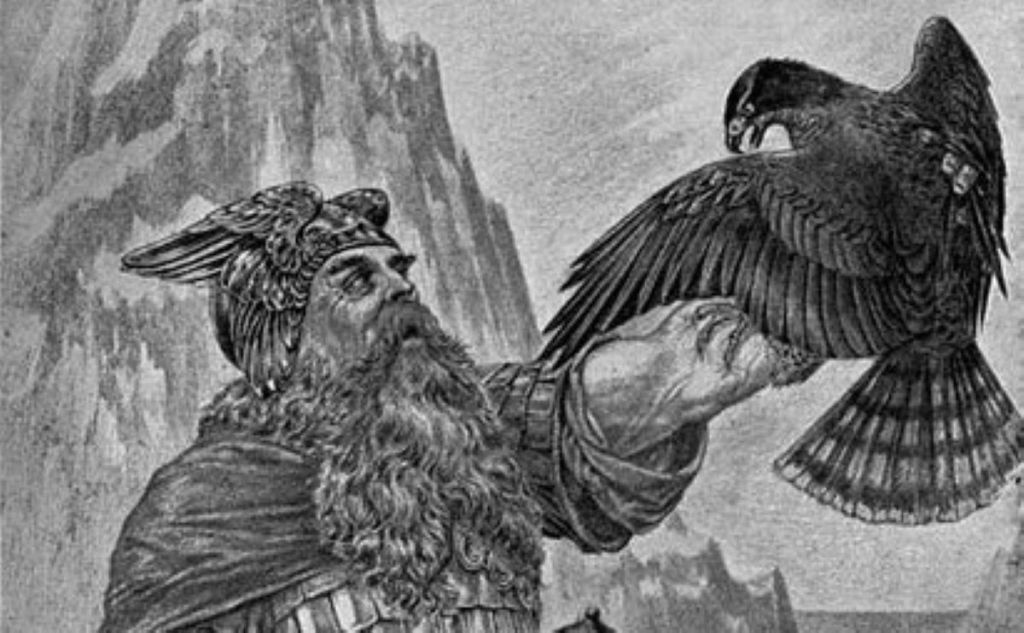
Geirrod ‘the Giant’ captures Loki ‘the Falcon’ from Norse Mythology
BOOK THREE: THE SAGA OF PRINCE HELGI ‘ARROW ODD’ ERIKSON
A Novel By Brian Howard Seibert
© Copyright by Brian Howard Seibert
WRITER’S UNCUT EDITION
(Contains Scenes of Violence and Sexuality Consistent with the Viking Period)
(May be Offensive to Some)
CHAPTER TWENTY FOUR
24.0 GEIRROD THE GIANT AND OGMUND (Circa 875 AD)
Ogmund ‘Eythjofsbane’ Tussock may have remained in Angleland
as Guthrum ‘Athelstan’ of The Danelaw in East Anglia. He may even
have occupied the very kingdom that Arrow Odd and his band of brothers
had earlier captured in East Angleland.
Brian Howard Seibert
(875 AD) One day in Frankia Oddi walked to the edge of a forest. He was tired, so, he sat down under a big oak tree and, as he leaned back against it, he saw a man in a blue-flecked cloak walking by with high shoes, gold emblazoned gloves and a reed in his hand. He was average height and gentlemanly in looks, but he had a lowered hood that covered his face. Oddi could just make out a big moustache and long beard, both of them red. He turned to where Oddi sat and greeted him by name. Oddi welcomed him and asked who he might be. He said he was Grani, called Raudgrani, then he said, “I know all about you, Arrow Odd. It seems to me that, since you are a great Viking and an accomplished man, you have few followers, and travel rather like a pauper, and it is bad that a man like you should be so reduced.”
“It is true,” Oddi said, “that I have not been a leader of men in a while.”
“Will you swear an oath of brotherhood with me?” Raudgrani said.
“It’s hard to deny such an offer,” said Oddi, “and I will take it up.”
“You are not yet totally luckless,” said Raudgrani, “for I know of two champions in the east of this country and they have twelve ships. They are sworn brothers; one comes from out of Denmark and is called Gardar, and the other, Sirnir, comes out of Gautland. I know of no better men on this side of the Baltic and I will bring you into brotherhood with them, yet you’ll have the most say of all of us, although you’ll find that following my advice will be most helpful. But where would you want to sail if this is arranged as I have now said?”
“I would like to find a killer named Ogmund ‘Eythjofsbane’ Tussock, so if that could be arranged while we are raiding…”
“Stop, stop,” said Raudgrani. “You don’t want to find him, because he is not a man of humankind, this Ogmund, and if you meet him again, you will get far worse from him than before, so just put that idea out of your mind.”
“All I wish to do is avenge my son, Vignir, and my blood brother, Thord, and I shall never give up until I do.”
“I’ll tell you,” said Raudgrani, “how Ogmund was born. Then you’ll see there is no chance that he will be killed by mortal men. It is said that Prince Erik ruled all of the Nor’Way when you made your Viking raid into Bjarmaland, and you will remember what damage you did to the giants there before you left. You half blinded their king and you fully blinded his daughter and killed his wife who had just given birth to a son. Once you had gone, they felt bitter about what you had dealt them with your Gusir’s Gift arrows and they wanted revenge, if they could get it. And this was how they got it, they had the boy sprinkled with water and gave him the name Ogmund. He was unlike most mortal men from an early age, as you’d expect from his birth, and when Ogmund was three years old, he was sent to Finmark, and he studied all kinds of magic and sorcery, and when he was fully trained, he went home to Bjarmaland. He was then seven years old and as big as a full grown man, very powerful and hard to deal with. His looks had not improved while he was with the Lapps, because he was both black and blue, with his hair long and black, and a tussock hanging down over the eyes where a forelock should be. He was called Ogmund Tussock. The giants meant to send him to meet you and slay you; although they knew that much would be needed to bring about your death. They strengthened Ogmund with witchcraft, so that no normal iron could bite him and they sacrificed to him and altered him so that he was no longer a mortal man.
“Eythjof was the name of a Viking. He was the greatest of berserks and an unparalleled hero, and he never had fewer than eighteen ships when raiding. He never spent time on land and stayed out on the sea, winter and hot summer. Everyone was scared of him wherever he went. He attacked Bjarmaland often and forced them to pay tribute. That’s when Ogmund got his eight comrades, and they all dressed in thick black woolen cloaks, and no iron bit them. They were named thus: Hak and Haki, Tindall and Toki, Finn and Fjosni, Tjosni and Torn. Then Ogmund joined up with Eythjof, and they went to war together. Ogmund was ten years old. He was with Eythjof for five winters. Eythjof was so fond of him that he could not refuse him anything, and for his sake he freed Bjarmaland from tribute. Ogmund rewarded Eythjof no better than to kill him while he slept in his bed and then he concealed the murder. It was easy to do because Eythjof had planned to make him his adopted son. He left Eythjof’s men to do as they pleased, but Ogmund kept two of their ships, fully crewed by his eight comrades and only the finest of Eythjof’s men. He then became Ogmund ‘Eythjofsbane’ Tussock and that same summer he attacked you at Tronuvagar and Ogmund was then just fifteen years old. He hated getting no vengeance against you, and so he murdered Thord ‘Prow-Gleam’, your sworn brother. Then he went to meet the giantess, his step-mother, who was Grimhild when she was with humans. But often she used her witchcraft to transmute herself into a finngalkin. Then, she looks human as far as her head, but like an animal further down and has remarkably large claws and a tremendous tail, and with it she kills both humans and livestock, animals and dragons. Ogmund coaxed her to get you, and now she lives in the forests with animals and has reached the north of England and is looking for you. Now I have told you plainly of Ogmund.”
“I can see,” said Odd, “why most men find him hard to fight, if he is as you say, but I still want to meet him.”
“He is worse now, though,” Raudgrani said. “He is more wraith now than man, so I think that he won’t be killed by humans. But let’s go down to the ships first,” and so they did. And when they came to the sea, Odd saw where many ships floated. They went aboard. Odd saw two men who stood out from the rest. They stood up and greeted Raudgrani as their blood brother. He sat down between them and told Odd to sit. Raudgrani said, “Here’s a man who you sworn brothers will have heard told of, called Arrow Odd. I wish that he be sworn into our blood brotherhood; he shall be the one to lead us, because he is most experienced in warfare.”
Sirnir asked: “Is he the Odd who went to Bjarmaland?”
“Yes,” said Raudgrani.
“Then we shall benefit,” said Sirnir, “if he is sworn in as our brother.”
“I like the idea,” said Gardar. They bound themselves with the mixing of blood and promises. Then Raudgrani asked where Oddi meant to go. “Let us sail to Angleland,” said Oddi, “but first I must tell my Uncle Rollo and my Michelle that I will be raiding over the summer.” Once that was done they sailed across the Britain Sea and they put up awnings over their ships and they sent raiding parties out into Sussex for a while.
One day fine day, Sirnir and Gardar went ashore to shoot and throw weights and play sports with a leather ball. Many men joined them in these activities, but Oddi stayed on his ship. Raudgrani was nowhere to be seen. The weather was very warm, and the blood brothers and many others went swimming in a nearby lake. There was a forest by the lake and they saw an incredibly large animal come out of the woods. It had a human head with immense fangs and its tail was both long and stout and its claws were remarkably large. It had a sword in each claw and both were large and gleaming in the sunlight. When this finngalkin came at the men, she howled menacingly and killed five men in the first attack. She cut down two of them with her swords, a third she bit with her teeth and two she struck with her tail. Within a few minutes, she had killed sixty men. Gardar grabbed his sword and dashed out naked against the finngalkin and he struck her with a blow so hard that it smashed one of the swords from her claw and way out into the lake, but she hit him with the other sword, and he fell, injured. Then, as she jumped on top of him, Sirnir rushed in with his sword that never failed, named Snidil, best of all blades, and he struck the beast, and knocked the second sword into the water. The finngalkin then trampled him until he was unconscious. Men who escaped ran to the ships and told Oddi that the foster-brothers and many others had been killed and said that no one could stand against the beast. “Please, Odd,” they cried, “save us and sail away from this place as quickly as possible.”
“That would be a great shame,” said Oddi. “To flee and not avenge my sworn brothers, such valiant heroes? I’ll never do it.” He took his quiver and went ashore and when he had gone but a short way, he heard a frightening noise. A few steps more and Oddi spotted the finngalkin. It was an ugly and bestial looking being, but certainly not as large as his men had claimed. He put one of Gusir’s Gifts to the bowstring and shot it into the eye of the monster and out the back of her head. The finngalkin charged so fast that Oddi could not use the bow. It clawed at his chest so hard that he fell on his back, but the shirt kept him from being killed. Swiftly he drew his sword while rolling to the side of her and cut off the beast’s thick tail when it was going to strike him. He kept one hand up so she could not bite at him as she ran toward the woods screaming horribly. Oddi then shot another of Gusir’s Gifts. It hit the beast square in the back, right in the heart and through the breast and the finngalkin fell forward quite dead. Many people ran up to the monster then and hacked and hewed, those who had not dared come close before. The beast was struck asunder. Oddi suspected that the brute was a transformed witch, a shape shifter, and he burned the remains so it could not be revived by magic and he had the sworn brothers taken to Fair Faxi to be healed.
They found Raudgrani and the survivors left Angleland and overwintered in Denmark. Raudgrani knew that by staying in King Frodi’s Denmark, Arrow Odd was hoping that Ogmund ‘Eythjofsbane’ Tussock would feel compelled to attack him there, but Ogmund never showed. It may have been because Oddi spent much of the winter season in Rouen and in Dub-Lin. With spring came raiding, so he and Gardar and Sirnir went to war and as they were getting ready to sail, Raudgrani joined them. He asked Oddi where he wanted to go and Oddi said he wanted to search for Ogmund ‘Eythjofsbane’ Tussock.
“It seems to me that you search for sorrow,” said Raudgrani. “Every time you come up against him you lose those dear to you. It’s unlikely that Ogmund has changed since you parted. But I know where he has gone and I can tell you if you’re interested.” Oddi nodded. “He went east to the giant Geirrod in Geirrodargard and has married his daughter, Geirrid, and both are the worst of trolls, and I advise you not to go there.” Oddi said he was going anyway.
Then they readied their ships to go east, the sworn brothers, and when they reached Geirrodargard, they saw a man fishing in a boat. It was Ogmund ‘Eythjofsbane’ Tussock and he wore a shaggy cape. When he had escaped from Oddi, he travelled east and he became the son-in-law of Geirrod the giant, and he claimed tribute from all the kings of the Baltic such that they would each year send him their beards and moustaches. Ogmund had used them to make the cape that he wore. Oddi and his men headed for the boat, but Ogmund retreated, rowing strongly. The sworn brothers jumped into a boat and rowed rapidly after him, but Tussock rowed so powerfully that the blood brothers could not gain on him. Then Ogmund ran ashore and Oddi was chasing after him, followed by Sirnir, then Gardar, all after Ogmund. But when Ogmund saw them catching up, he spoke, and recited:
“I pray to Geirrod for the gods’ favour,
greatest of warriors, grant me assistance
and my wife quickly to others,
I need now all the aid they can give.”
Geirrod soon showed up with his people, and there were fifty of them in all. Gardar and the rest caught up and then began the greatest of battles. Geirrod hit hard, and in minutes had killed fifteen men. Oddi pulled out one of Gusir’s Gifts and nocked it on the bowstring and shot. It hit Geirrod in the chest and came out at the shoulders, but Geirrod kept coming and he killed three more men before he fell, dead. Geirrid was also a threat because she killed eighteen men in a short time. Gardar turned to her and they traded blows, but Gardar lost his life in the exchange. When Oddi saw it, he was furious. So, he nocked another one of Gusir’s Gifts and shot it into the right armpit of Geirrid and it came out the left. The shot didn’t seem to do anything. She rushed headlong into battle and killed five men in no time. Oddi then shot another of Gusir’s Gifts. It went into her stomach and out one thigh; she died after that hit.
Ogmund, too, was hard in battle, having killed thirty men in a short time before Sirnir turned on him with the sword, Snidel, and they fought hard, and Sirnir was soon wounded. Oddi saw Sirnir giving ground, so he turned that way, but Ogmund saw him and fled in disarray. Sirnir and Oddi went after him and both of them were running very fast. Ogmund was still wearing his fine cape, but when they were almost upon him, Ogmund threw down the cloak and recited:
“Now must I cast away my cloak,
which was made of kings’ beards,
and embroidered with moustaches,
I am grieved to give it up,
But they chase me at full pelt,
Odd and Sirnir, from the battle.”
Now that Ogmund had a lighter load, he pulled away. Oddi steeled himself and ran quicker than Sirnir and, when Ogmund saw that, he turned towards him, and they fought. They were grabbing and punching frantically; Oddi was not as powerful as Ogmund, but Ogmund could not knock him off his feet. Then Sirnir came up with his sword, Snidil, and tried to strike at Ogmund, but when Ogmund saw it he turned and thrust Oddi between them. Then Sirnir held back the stroke and so it went again, that Ogmund used Oddi as a shield and Sirnir had to hold back his strokes. Then Oddi braced both feet against a very solid boulder and grabbed Ogmund’s wrists so hard that he was forced to his knees and Sirnir hacked at Ogmund who had no opportunity to parry the blow with Odd. The stroke hit him on the buttocks and took a chunk out. Sirnir cut so great a slab out of Ogmund’s backside that no mule could carry more. Ogmund was so pained that he sank down into the earth where he was. But Odd was determined to stop his escape and grabbed his beard with both hands with so much force that he tore it from him, beard and skin down to the bone, and much of his face with both cheeks and right on up his forehead to his tussock, and they parted their ways as the ground opened up for Ogmund and the boulder held for Odd. But Oddi kept what he held, dripping with gore as the earth closed above the head of Ogmund and he disappeared into the underworld.
Odd and Sirnir went back to their ships, but they had lost many men and the greatest sorrow was the loss of Gardar. Raudgrani was also gone, and Odd and Sirnir never learned what happened to him during the battle. It was true that he seldom faced danger, but some of the men saw him struggling with giants. He had always given the best advice and never more so than with his last warning, but the sworn brothers never saw Raudgrani again. Men think he may have actually been Odin. The sworn brothers both overwintered in Rouen, since Denmark reminded them too much of their losses.
CHAPTER TWENTY FIVE
25.0 THE BARKMAN (Circa 880 AD)
“Venom-filled snake shall sting you
From below the skull of Faxi.”
The adder will bite from below your foot,
When you are terribly old, my lord.”
From The Saga of Arrow Odd
(880 AD) Oddi and Sirnir were again overwintering in Rouen, but as winter dragged on, Oddi became very depressed. He kept revisiting the tragedies that he had suffered at the hands of Ogmund Tussock. He no longer wanted to risk his blood brother’s life in his fight with Ogmund, because, as Raudgrani had said, all those close to him wound up dead. He thought his friends had suffered losses enough already. He formed a plan to steal away one night in Fair Faxi and to explore the Nor’Way once again. It would be wise for him to check on his Nor’Way trading operations and ensure that walrus ivory was being properly tithed and that slaves were not being traded. He had his quiver on his back and his sword at his side and a few trusted crewmen. But before leaving Rouen he visited his Uncle Roller to tell him where he was headed.
“Have you told Prince Erik yet that I now know for certain that you are his son?” Roller asked.
“No, I haven’t,” Oddi replied. And when the duke began shaking his head, he added, “How can I tell the richest man in the world that I am for certain his son based on the conversations you have had with the spirit of his dead wife, Gunwar, after the two of you have made out? He’ll think that I’m after his estate and worse, that you’re focking his wife.”
“It’s not as bad as that,” Roller answered, looking down at his boots, “after all, she is a ghost. And she only visits me when she’s saving your ass, so it’s not my fault.”
“I know,” Oddi admitted. “I’ll tell The Prince that I am for sure his son when I’m in the east. I also want to look up Gudrun and Sigrid while I’m there. Are they still in the east with their father?”
“I found out that your girlfriend, Gudrun, and her sister, Sigrid, were really into the Freedom Movement and I told their father about it when he came back from trading that fall and he got all pissed off at them and moved them all to his Hraes’ trading station in Polotsk the next spring.”
“What was he pissed off about?”
“I think they admitted that they were in the Freedom Movement and Polotsk was right on King Frodi’s slave route, so he was making a lot of gold off the trade they were trying to stop. I also heard a rumour that both girls were in the way, knocked up, but it was just a rumour.”
“Why didn’t you tell me?”
“Like I said, it was just a rumour…a rumour their father was busy quashing. I just assumed you knew about it. Besides, you were off in Ireland getting married to Princess Olvor. I visited Dub-Lin last year and little Hraegunhild is going to be a beauty,” Roller said, trying to change the subject.
“I can’t go to Polotsk,” Oddi complained. “Frodi’ll have my head.”
“Well, if you’re looking up illegitimate children,” the duke began, “you could visit Princess Blaeja in York. Hraegunhild is growing up and I’m told she is quite the little cutie. York is much closer than Polotsk and you’re not as likely to lose your head. You might even get some.”
“I was going to visit Princess Blaeja on my way east anyway. I promised her I would ask Kraka about Ragnar’s curse.”
“And what did your grandmother tell you?”
“Not good news, I’m afraid,” Oddi answered. “The curse was a challenge for his sons to avenge him, but it applies to grandsons as well, and great grandsons. And Kraka called me Bjorn when I said goodbye…Bjorn Ironshirt.”
“Oh…that was me. Brother Gregory told Grim that he had a preference for your name to be Helgi, but that Erik should name you. I told Kraka that Erik had promised King Bjorn of the Barrows that he would name his son after him, so we’ve taken to calling you Bjorn of the Ironshirt because you wear your armour all the time and it drives her crazy.”
“It’s not really iron,” Oddi said. “It’s a Roman scale armour made of linen glued over wood, so it floats and it’s warm and it’s stronger. It only has ring-mail under the armpits and down the sides a bit where it laces up,” and Oddi raised his right arm and tapped the rings with his left hand. “I could never wear it all day if it was all iron.”
“Bjorn Ironside, then?” Roller offered. “I’d like you to go by that name while you are lying low in Frankia. Helgi is too close to your real name.”
“My mother named me Helgi. It is my real name.”
“Exactly. Much too close.”
“What am I going to tell Blaeja?” Oddi asked. “You’re okay by the sons of Ragnar, but watch out for the grandsons?”
“Well, if the curse is an ongoing challenge, you have to warn her.”
“I guess,” Oddi said, taking it all in. “I’ll tell her.”
“Is there anything else?” Roller asked. “Out with it. No secrets.”
“When I go up the Nor’Way, I have to visit Hildigunn in Giantland to tell her that our son, Vignir, is dead; killed by Ogmund Tussock.”
“That’s a tough one,” Roller said.
“And now I have to go to Polotsk and see if Gudrun and Sigrid were pregnant when they were dragged out of Norway.”
“You can’t go there. It’s too dangerous.”
“I can’t go now, but I have to check sometime, for Asmund. If it was Sigrid who was pregnant, then that will be Asmund’s child. And that child would be the only connection I have left with him.”
“And if Gudrun was with child you’ll have an even stronger connection because the two babies mothers are sisters.”
“Is there anyone else you may have fathered children with?”
“When I was in the Newfoundland the first time, I stayed with a native tribe that lived along the great Gitchee river inland. When King Frodi chased me up that river the second time I was there, I asked the King of that native tribe for help and his daughter showed me a handsome little boy and she said it was ours.”
“And did they help you?”
“I wouldn’t be here if they hadn’t. And she was pregnant again when I left her the last time as well.”
“So that’s it?” Roller asked. “Any other troubles? Any other news?”
“I think so. I haven’t killed anyone lately. Ohh…except for four assassins in Aquitane. But I told Sister Saint Charles about those thugs. They murdered some Bishop she knew and I avenged the Bishop, so she was pretty happy about that.”
“Did Brak get you your load of Stavanger swords for Bjarmaland?”
“He did. He hammered them all out here in Rouen. You know…he never gets old.”
“I know. He’s an Alchemist like your father. Is there anything else?” Roller asked. “Remember, no secrets.”
Oddi shuffled his feet a bit. “When I go to York, Blaeja will be checking me for lesions for a disease I picked up in the Valley of the Mound Builders. A crotch-rot infection, a new type from the Newfoundland. It seems to have gone away, but she says she may have found a diagnosis from some ancient scroll.”
“That’s even tougher,” Roller said. “Let me know how it goes.”
Then Oddi was off to Dub-Lin to visit with Queen Olvor and their daughter, Hraegunhild, followed by a stopover in York to visit with Princess Blaeja and their daughter Hraegunhild. While sailing through the Orkneys Oddi picked up a load of Narwhal tusks, a new type of ivory in the north that was twice as strong as Walrus and even elephant ivory. The Narwhal tusks grew straight out of the heads of the Narwhals and were long and narrow and spiraled to a point like a unicorn’s horn, and some of them were almost ten feet in length, nature’s veritable javelins.
Fair Faxi was bobbing in the waters of the River Foss just outside Princess Blaeja’s castle. “I checked with Kraka,” Oddi started, “and she said she thinks that Ragnar’s curse might be perpetual, carrying over to grandsons and great-grandsons.” He got out of bed and got dressed, peeking out from under the awnings.
“So you tell me this the morning after we’ve made love all night long?”
“I’m one grandson you don’t have to worry about.”
“You’re the only grandson that keeps plundering me,” she jested.
“Only with your permission, my love. Besides, look at the beautiful daughter we’ve been blessed with.”
Only after she had inspected Oddi’s magnificent cock had she given her permission the night before, for after that she had to give Oddi her diagnosis and tell her Viking husband that he had likely contracted Syphilis in the Newfoundland. It was a disease no longer known of in Europe, by she had found some old scrolls that referenced it as being contagious in ancient times only when sores were present and deadly only in the very later stages of life. Oddi nad laughed that off, saying, ‘Witch Heid has predicted my death by the bite of a poisonous snake crawling out from the skull of a horse, Faxi, well before the poison of this Syphilis will get me!’
“She is beautiful,” Blaeja said wistfully, sitting up in bed. “Where are you off to next?”
“I’ll be visiting Grim in Hrafnista, then I’ll be doing a bit of trading in Bjarmaland. “Shall I visit on my way back through?”
“Please do,” Princess Blaeja answered. “Maybe I’ll have a son waiting for you this time.” For a Christian, Princess Blaeja took Ragnar Lothbrok’s pagan curse very seriously. She had Hraegunhild under her arm and they both waved bye to Oddi as he sailed Fair Faxi down the River Foss to where it forked into the River Ouse. Blaeja rubbed her belly warmly with her free hand. “Ragnar”, she whispered to herself.
“What mommy?” Hraegunhild asked.
“Nothing,” Blaeja answered, then she knelt down and faced her daughter. “I was just wondering if you wanted a little brother.” Eventually the River Ouse would fork into the Humber and take Oddi to the North Sea.
Oddi sat becalmed on the North Sea at the mouth of the Humber and he relaxed and warmed himself in the hot summer sun; he was in no rush he told himself, but finally, he stood up, looked to the north, and spread out his arms. He soon found a slight breeze at his back and Fair Faxi’s sail barked a bit, like a dog that knew it was going somewhere soon with its master. Oddi didn’t want to overuse this gift that the men of Hrafnista were blessed with, but too much sun wasn’t good either. He visited with his foster-father Grim at his stead on Hrafnista, where he found Gudmund and Sigurd, who had grown tired of Aquitane and Christianity in general and had rejoined the ranks of the Hrafnistamen. Then he raised his arms again, as those men often did, and he summoned Fair Faxi a strong Nor’Way storm that took her all the way past Varanger Fjord and Kandalaks Bay to the mouth of the Northern Dvina.
Oddi and his men traded with the Bjarmians once more; sharp steel swords with tonstone pommels for blades of silver with pommels of gold. Then they set up camp on Varg Island and Oddi left his men there and he swam under cliffs that took him into a cave to Giantland. He carried with him gifts and some of his son’s personal belongings, and he found Hilder in his kingdom and he found Hildigunn and he told them both what had happened to young Vignir. Hilder was angry and Hildigunn cried.
“Ogmund Tussock shall pay for this crime!” Hilder shouted. “Nothing good has come out of Geirrod the Giant’s line.”
“We all loved Vignir so much,” Hildigunn cried. And in private she professed her undying love for Oddi. “I know that I gave you your freedom,” she started, “and gave you my love unconditionally, but please spend some time with my father and please, once again, play with me.”
At evening-time King Hilder showed Oddi to his room and when the reed torches were extinguished in the palace, Oddi tip-toed his way into Hildigunn’s room and lifted the bedclothes from her. She asked who was there, and Oddi told her it was him and he wanted to play. “What do you want?” she said. “I want to water my steed at your wine-well,” he said. “Do you think it will be possible, my pip?” she said; “it is not used to the sort of springhouse that I have.” “I’ll lead it there,” he said, “and push it deep, if it does not want to drink.” “Where is your foal, sweetheart?” she said. “My steed is between my legs, my love,” he replied, “and you may touch him, but quietly, since he is very skittish.” She took hold of his steed by the mane and stroked it and said, “It is a nimble foal, but rather straight at the neck.” “His head is not very well placed,” he said, “but his neck curves better when he has had something to drink.” “See to it all, now,” she said. “Lie as it pleases you,” he said, “and keep calm.” He now watered the foal rather generously, so that it dove in completely. The princess was very startled at that, so that she could hardly speak. “Aren’t you going to drown the foal?” she said. “He shall have as much as he can take,” he said, “since he is often unruly when he is not able to drink when he wants to.” He continued as long as he wanted, and then rested. The princess wondered where the wetness had come from, which she had in her cleft, since the whole bed was a lather underneath her. She said, “Could it be that your foal has drunk more than is good for him, and has vomited up more than he has drunk?” “Something is wrong with him,” he said, “since he is now as soft as an eel.” “He must be ale-sick,” she said, “like some drunkard.” “That is certain,” he said. They enjoyed themselves now as they wished, and the princess was sometimes on top, and sometimes underneath, and she said that she had never ridden such an easy-going foal as this one. After a lot of enjoyable play, she asked him to sleep with her and ease her pain.
Oddi spent a week in Giantland, sailing with Hilder and playing games with Hildigunn. He told them of his plans to anonymously patrol the Nor’Way to ensure that there was no slave transport being carried out on it and to regulate the trade of Walrus ivory along the route. He told them that he would also be searching for Ogmund in his travels, but that Ogmund was foremost man for King Frodi, the most powerful king in the world. Ogmund sheltered under his king’s authority so it would be difficult to confront him without being discovered. So, Hilder and his daughter offered to provide Oddi with some Giantland magic. Hildigunn made him a masked helm of birch bark and overclothes of the bark to go with it and she stitched them up with spirit thread so that they fit over his Roman plate-mail shirt and his gold headband. They had the bark costume steeped in magic elixirs and blessed by dwarves. “When you wear the bark over your clothes,” Hilder started, “even your own father will not recognize you. But you will not stand out as a stranger either. You will seem as though someone who belongs, yet is of no importance. Wear it in your travels along the Nor’Way and even Ogmund will not know who you are.”
Oddi bid the giants farewell and promised to stop in often during his patrols. When Oddi returned to Varg Island he had his men pack up their awnings and gear into Fair Faxi and they resumed sailing up the Northern Dvina. When they came upon merchant ships, Oddi would introduce himself as a Hraes’ Way Ranger and would ask the captain of the fleet for his Hraes’ pass, a velum scroll provided by the Hraes’ Trading Company that detailed merchandise that was to be traded and tithe rates required for that particular product. The pass also forbade the trade or transport of slaves on the Nor’Way as per the trade treaty that Prince Erik Bragi Ragnarson had negotiated with the local Hraes’ Slav peoples that lived along the way. King Frodi had torn up the treaty when he took back the Southern Way, the Danepar, but Prince Erik adhered to it for his Nor’Way trade. And the bark costume Oddi wore seemed to be working, because he recognized many of the captains he was checking on, but none of them recognized him. He patrolled up and down the Nor’Way anonymously, making sure that the Hraes’ sanctioned traders and merchants plied the ‘Way safely. As the early trading season was ending, Oddi had his men sail south and they kept sailing until they saw the farms and settlements around Gardariki. A great farm stood nearby, but there was a smaller farm closer by. Oddi thought he would try the smaller farm and he saw a man there chopping wood. The man was short with white-hair and he welcomed Oddi and asked him his name. “My name is Barkman,” Oddi said gruffly, “and what is your name?”
He said he was called Jolf. “Would you like to stay the night?” the man asked.
“I would,” said Barkman.
“The large farm next over will accommodate your ship and your men if you wish,” the old man said, so Oddi signaled his men to row over there. Now he followed the man into his house where his wife sat alone on a chair.
“We have a visitor,” said the old man, “and you shall entertain him, as I have much work to do.”
The old woman grumbled and said that he often offered people hospitality, but never had anything to offer his guests. The man got back to work and the woman sat with Oddi. In the evening, when Jolf came in, there was a table set with just one dish in the center, but on the side Barkman sat at, he had put down a good knife. Two rings were on the handle, one gold, the other silver. When Jolf saw it, he reached for the knife and examined it.
“You have a good knife, Barkman,” said Jolf. “How did you come by this little treasure?”
Barkman said: “When I was a youth, we made salt by the ocean, but one day a ship was wrecked nearby. It broke to pieces on a reef offshore, and the men were washed up onto the beach and they were either dead or very weak, so we quickly finished them off, and I got this knife as my share of the plunder. But if you, Jolf, have any use for it, then I will give you the knife.”
“Well, thank you, and may fortune bless you,” said the man and he showed the woman his knife. “This is a good one,” he said, “much better than the one I had before,” and he passed the woman his old knife. They shared their supper, and then went to sleep, and Oddi slept all through the night and into morning and did not wake until Jolf was away working. When he got up, he asked the old woman if she’d rather he ate breakfast elsewhere. The old woman told him that Jolf wanted him to stay in his home.
It was almost noon when Jolf returned and Barkman was on his feet. Then the table was laid. There was a dish on it and the old man put down three arrows with stone heads. These were large arrows and well-wrought, so Barkman thought he had seen that kind of arrow somewhere before. He took one up and looked at it. “This arrow is well made,” he said.
“If you think,” said the old man, “you like them, then I will give them to you.”
Barkman smiled at him and said, “I like them. These are arrows from Giantland. Is there a reason I should carry these stone arrows from Giantland in my quiver with me?”
“You never know, Odd,” the old man cautioned, “when you might need them. I know that you are called Arrow Odd and are the son of Grim Hairy-Cheek from north in Hrafnista. I know, too, that you have three arrows called Gusir’s Gifts, and they may fail you when you go against the magic of Ogmund Tussock, but these stone arrows are impervious to his powers.”
“Since you know that my name is Odd, and also that I have the arrows called Gusir’s Gifts, it could be,” said Oddi, “that you are right in what you said before. I may need these arrows so, I shall accept them,” and he put them in his quiver. “Should I be thanking King Hilder for them?”
“Let us just say that your bark suit still works and that I was expecting you.”
Oddi laughed and said, “Perhaps it’s time to give this bark a bite. What do you have for a king in this land?”
“We have a very fair king,” said the old man, “and he is called Olmar.”
“Who are the noblest men with him?” said Oddi.
“There are two foremost men,” said Jolf, “one called Sigurd, and the other Sjolf. They are the chief men of the king, and the best of all fighters.”
“Does the king have children?” Oddi asked.
“He has a beautiful daughter named Silkisif.”
“Is she very beautiful?” Oddi asked further.
“Yes,” said the old man, “there is no one as beautiful in Gardariki or any other place.”
“How would they receive me, if I went there and did not tell them who I am?”
“I won’t tell them,” said the man. So they went to the royal longhall, but the old man stopped outside it and refused to go in.
“Why do you stop?” asked Oddi.
“Because,” Jolf said, “If I go inside, I will be beaten.”
“Because they’re royals?” asked Oddi. “We shall go in together, and I will protect you,” and Barkman grabbed him by the arm and they entered the hall. When the king’s retainers saw the old man, they moved in to stop him, but Barkman pushed them out of the way. They barged into the main hall and came up to the king. The old man greeted the king humbly and the king received him and asked whom he had brought along.
“I can’t tell you,” said Jolf, “but he may.”
“My name is Barkman,” Oddi said.
“Who are you?” asked the king.
“I am called Barkman,” Oddi repeated. “I am old and addled and I have lived outside in the forest much of my life and I ask you for winter lodgings.”
The king inquired, “Are you at all skilled?”
“No,” he said, “because I am clumsier than most.”
“Will you work a little?” asked the king.
“I do not work, since I am incapable of work,” said Barkman.
“Then it doesn’t look promising for you here,” said the king. “I have made a vow to take in only skilled men. But we are progressive here in Gardariki and we maintain a poor house for the bereft.”
“Nothing I ever do,” said Barkman, “seems to benefit anyone.”
“Well, you certainly don’t look bereft. You must know how to collect game for hunters,” said the king. “Perhaps I will go hunting sometime.”
“I can do both,” Barkman answered. “I can hunt and collect game. Where do you want me to sit?”
“You should sit far down the back benches there, between the freemen and the slaves,” said the king. Barkman led the old man out of the hall, then went to a bench among the slaves. There were two brothers nearby and they introduced themselves as Ottar and Ingjald. “Come over here, Barkman and you shall have the bench between us,” so Oddi joined the freemen. They sat close on either side and made sure he felt at home. They quietly asked him about other lands he had visited. He hung up his quiver and birchbark staff on pegs above his bench but he kept his club under his feet. They asked him to put away the quiver, as it seemed to only attract attention, but Barkman said he would never let it be taken away from him, and he went nowhere unless he had it with him. They offered him bribes to take off his bark outer clothes and offered to give him good clothes, but he refused.
“I can’t do that,” Barkman said, “because I have never worn anything else, and hopefully always will.”
Barkman usually sat at the end of his bench and had a few drinks after supper, then stretched out on his bench, pulled a fur blanket over himself and went to sleep. So it went until the men began to go hunting in late summer. One evening Ingjald said, “We must get up early tomorrow morning.”
“Why is that?” Barkman asked. Ingjald told him they were all going hunting. Then they all went to sleep early that evening, but in the morning the brothers rose and tried to wake Barkman but he was fast asleep, and he did not wake up until almost every man who was going hunting was gone. Barkman woke and asked, “What’s happening, is everybody getting ready?”
Ingjald answered, “Ready and gone. We tried to wake you all morning. We’ll never shoot any animals today.”
Then Barkman asked, “Are they good hunters, this Sjolf and Sigurd?” as he got dressed.
“They are the best,” said Ingjald as they left the longhall. “No one can compete against them.”
Soon they came to a mountain, and a parcel of deer ran past them, and the brothers drew their bows, and they shot at the deer but missed every time. Then Barkman said, “I have never seen anyone shoot as badly as you two. Why are you so poor at it?”
Ottar said, “We have already told you that we are clumsier than most,” and Ingjald added, “We were late getting ready this morning and now all the animals we’ll see are those already stirred up by others.”
Barkman said: “I do not believe that I could be worse than you, now give a bow and I will try.” And so they did. He nocked an arrow and drew the bow but it snapped in half. They passed Oddi the second bow and they told him not to break it, but he pulled the arrow to the tip and that bow snapped into two pieces. “Now you’ve done it,” Ottar said, and Ingjald added, “It is unlikely that we will shoot any deer today.”
“Things have not gone well,” Barkman agreed. “But with the draw weights on your bows, it’s unlikely we would have killed any, anyway. But do you think my bark staff will work as a bow? And are you not curious about the type of arrows I might have in my quiver?”
“Yes,” they chirped. “Show us.”
“Then spread out your thick cloaks, and I will empty it out.” So, they took off their cloaks and laid them on the grass and Barkman dumped the quiver’s contents onto the cloaks and it turned out to have been full of arrows. Then he took his walking staff and began peeling the birch bark away and underneath they saw a fine yew bow with golden trim and a silken string dangled from one end. He bent the powerful bow across his back and hooked the string’s free loop to the other tip. The brothers could see it was a very powerful bow. Barkman nocked an arrow to the string and drew his bow and shot the arrow far over the heads of the men at the hunt and he hit a deer. So, that’s what he did all day, shooting at the deer that Sigurd and Sjolf were going after. He shot all his arrows except six, the stone arrows he got from the old man, and Gusir’s Gifts. He did not miss a deer that day, and the brothers ran and fetched his game, and great was their enjoyment watching his display of shooting skill.
In the evening, when the hunters all came home, all the men’s arrows were brought before the king, and each man identified his arrow marks, and the king noted how many deer each man had killed over the course of the day. Ottar and Ingjald said, “Go up there, Barkman, and get your arrows off the table before the king.”
“You two do it,” he said, “and say you both own the arrows.”
“They won’t believe us,” they replied. “The king knows how badly we shoot.”
“Then we’ll all go together,” he said. So they went before the king and Barkman said, “We claim these arrows with our marking upon them.” The king looked at him and praised his archery. “Yes, sire,” he said, “because we often shoot animals to eat.” And after that they went to their benches and ate and drank.
One evening, after the king had gone to bed, Sigurd and Sjolf went over with horns to offer a drink to the brothers, Ottar and Ingjald, and they asked them to take the horns and drink from them. And when they’d finished, they came with another two, and offered them to the brothers. Then Sjolf asked, “Does he always lie down so early at his bench?”
“Yes,” Ottar said. “He thinks it wiser than drinking himself senseless like we do.”
Then Sjolf asked, “Is he really a good archer?”
“Yes,” Ingjald answered, “It is a gift. He has many talents.”
“Do you think he can outshoot the both of us?” Sigurd asked.
“I reckon he can outshoot anybody in Gardariki,” Ingjald replied. “He shoots much farther and straighter than anyone we have ever seen.”
“We must wager on it,” said Sjolf, “and we will bet a bracelet worth half a mark against your two rings of equal weight.” So, it was agreed that the king would be there with his daughter to see their shooting, and they were to hold the bracelets and rings and give them to whoever the winner was. The next morning, when the brothers woke up, they apologized to Barkman for making the wager. “The bet seems risky to me,” he said, “because even though I can shoot deer in the field, it is quite another thing to shoot in competition against such great archers, but I will try my best since you have staked all your wealth on this bet.”
First the men had drinks, and afterwards the people went out, and then the king wanted to see the shooting. Sigurd went first and shot as far as he could, and a spear was stabbed into the ground where his arrow had landed, and then a courtier went up to it placed a gold chess piece on the butt of the spear, and Sjolf shot and hit the rook, knocking it off the spear, and it seemed to everyone that this was excellent shooting and he said that Barkman need not bother trying to beat that shot, as the courtier replaced the rook. “Good luck often alters bad,” said Barkman, “so I must try.” Barkman nocked one of Gusir’s Gifts and stood where Sigurd had stood and he shot straight up in the air, so that the arrow remained out of sight for a long time, but when it came back down, it went straight through the center of the rook and into the spear shaft so that the chess piece did not move.
“The shot last time was great,” said the king, “but this shot was much better, and I can say truthfully that I have never seen such fine shooting.” Now Barkman took another Gusir’s Gift and shot it so far that no one could see where it came down, and it was agreed by all that he had won the match. Then Princess Silkisif awarded the brothers the bracelet and rings. They offered the bracelet to Barkman, but he told the brothers to keep it. A few days later, the king had gone away on business, and Sigurd and Sjolf went with a horn each and offered them to Ottar and Ingjald, which they drank. Then they brought them another two. Then Sjolf said, “Still Barkman lies at his bench there and doesn’t drink.”
“He is better mannered than us in everything,” said Ingjald.
“I think,” said Sjolf, “that he has rarely ever mixed with noble men, and he has lain often out in the woods like a poor man without entertainments, but does he swim well?”
“We’re sure he is good at all sports,” Ottar replied, “and we think that he is a very good swimmer.”
“Can he swim better than both of us?”
“We think that he is a better swimmer,” said Ottar.
“We will make a bet on it,” said Sjolf, “and we will stake another bracelet worth a mark, but you shall stake two rings, a mark apiece in weight.”
It was again agreed that the king and his daughter should see their swimming contest, and all was set up as it was the first time. In the morning, when they woke up, news of their bet had gone round the benches of the hall.
“People are saying,” Barkman started, “that you accepted another bet last night?”
“Yes,” the brothers replied and they told him all about the bet.
“Now I think it looks even riskier than before,” said Barkman, “for I am no great swimmer and it’s a long time since I’ve been in cold water. Have you wagered much silver?”
“Yes,” they said, “but you don’t have to swim unless you wish to. It would serve us right if we had to pay for our own foolishness.”
“That shan’t be,” said Barkman. “I’ll try my best, since you treat me with honour and respect, and the king and Princess Silkisif will certainly see me go for a swim.”
The king and his daughter were invited to judge the swimming competition and the people went to the water, a big lake nearby. When they came to the beach, the king and his retinue sat down and relaxed and the competitors went swimming in suitable clothes, but Barkman wore the guise that he was accustomed to. Sjolf and Sigurd swam at him when they came from the shore and they tried to push him under but the bark he was wearing was buoyant and he would pop back up. They held him under for a long time, but their strength waned and he popped back up and they took a rest. They tried to double up on him a second time, but he reached out for them and took them by the scruff in each hand and forced them underwater and held them down so long that it seemed unlikely that they would come up again. He let them up for air then took them under a second time and held them longer, and then for a third time he held them under for so long that no one thought that they would come back up alive. But he let them up and out of their nostrils spouted the royal blood of these nobles and it seemed that they would need help back on land so the Barkman took them and cast them ashore. Then he went on swimming and put on a show of games and tricks, and the royal retinue was glad to watch the display of swimming. Later, he went ashore to meet the royals and the king said, “You are a better atheling than the rest, both at shooting and swimming.”
“You have seen my skills,” said Barkman, “and my name is Odd, if you would like to know, but I will not tell you anything about my family.” Princess Silkisif gave him the bracelet and rings and said she admired his skills. Then they went home. The brothers said that Oddi should have all the rings, but he refused and told them to keep them as he passed them over. The king seemed very anxious about who the man, this Odd, in bark might be.
One day, a man named Erik returned to Gardariki from Novgorod, and the king had great respect for him. He was an older man and he had fostered the king’s daughter. The king talked to him about the Barkman, but he said he did not know him and thought it likely that Odd came from a noble family. It happened again, when the king had gone to bed, that Sjolf and Sigurd went up to the brothers and they brought two horns, and they drank from them. Then Sjolf said, “Does Odd ‘the Great’ sleep?”
“Yes,” Ottar replied. “It is more sensible than drinking yourself witless like we do.”
“That could be because he is more used to sleeping in forests with lakes than to drinking with people in halls, or is he a great drinker as well?”
“Yes,” Ingjald said. “He is a fine drinker of meads and ales.”
“Would he be a better drinker than us both?” Sjolf asked.
“It seems to us,” said Ottar, “that he could drink more than all of us.”
“We must wager on it,” said Sjolf, “and we’ll bet this gold bracelet, which stands at twelve ounces, but you shall stake your own heads.” The brothers drank some more and the glittering gold caught up their eyes and they bound the wager with the noble warriors just as they had in the past.
The next morning, Oddi saw the sheepish looks of his friends and asked what was said and they told him. “Now you’ve really made a mindless bet,” said Oddi, “and you’ve increased the stakes and now risk your heads, but it is not certain that I shall be the greater drinker though I am bigger than those two, but I will take them on in a drinking match.” Then the king was told about the drinking competition, the bragarful, and that the king and his daughter were invited to sit in and judge, and Erik, her foster father as well.
Sigurd and Sjolf went up to Odd and said, “Here is a horn,” and poetry came to Sigurd’s lips:
“Odd, you’ve never split mail coats in battle
when helmed warriors, in Odin’s fetters fled;
while battle sweat flowed, and fire razed the town,
when our king won, victorious over the Wends.”
Sjolf brought him another horn, and told him to drink it and recited:
“Odd, we didn’t see you at the sword clash,
we dealt the king’s forces death on a plate;
I took sword cuts, six and eight,
while you were begging your food from boors.”
Then they returned to their benches, but Oddi got up and went before Sigurd, bringing him a horn and another to Sjolf, and he recited a verse to each of them before he went away:
“I shall serve to you my sweet nith song
Sigurd and Sjolf, on benches too long,
you both need word-mead for your fine poetry,
a couple of pansies the pair of you be.
You were, Sjolf, yet on kitchen floor
whelp lacking deeds, undaring doer
while in far-off Aquitane
four assassins I had slain.”
They drank from their horns as Oddi went to sit down. Then they went over to Odd, and Sjolf gave him a round, then laid this verse down:
“You, Oddi, have been with beggars before
Getting scraps and tidbits from the table,
While I all alone bore from Ulfsfell
my hacked shield in my hand.”
Sigurd bore him another horn and recited this:
“Odd, we saw you not out there with the Greeks,
fighting Saracens with battle reddened swords;
we made the hard din of Odin,
we felled fighters, in the red folk flame.”
Oddi now drank from the horns as they went to sit down. Then Oddi rose and went with his horns to each of them and he recited thus:
“You were giggling, Sjolf, with all the girls,
while keen flames swept the fort in dancing swirls;
we slew the hard Hadding there,
and Olvir’s life we did lay bare.
You, Sigurd, lay in the lady’s sweet vice,
while we battled hard the Bjarmians twice;
warlike heroes with hawk like minds,
while you slumbered in the hall, closing the blinds.”
Oddi went back to his bench, and they drank from the horns, and everybody thought it a great entertainment and were giving it a good hearing. After that they went before Odd and offered him two horns. Then Sjolf said:
“Odd, we saw you not on Atalsfjalli,
when the fen-fire we had gathered;
we the berserks bound up there,
of the king’s troop many a warrior was killed.”
Oddi drank from the horns, and they sat down. Then Oddi brought them horns and said:
“Sjolf, we saw you not, where all was wet
ring-mail byrnies washed in battle sweat;
spears dug deep in chain-mail sarks,
but in the king’s hall you’d rather lark.
Sigurd, we saw you not, when we cleared decks
of six high-pooped ships off of Haukaness;
we saw you not in Angleland’s west,
when Skolli and I ransacked a king’s nest.”
Oddi sat down and they brought him horns but no poetry. He drank of them, but they settled down. Then Oddi brought them horns and recited this:
“Sjolf, we saw you not, when we reddened our brands
sharp on the Earl off Laeso Island;
but you stayed there at home, torn between,
the cuddlesome calf and the slave maiden.
Sigurd, we saw you not, on Zealand where I slew
the battle-hard brothers, Brand and four more too:
Agnar and Asmund, and Alf and Ingjald;
but you in the hall the king’s tall tale skald.
Oddi sat at his bench and they brought him two horns. Oddi drank both and he brought them two horns and then recited this:
“Sjolf, we saw you not south at Skane,
where noble Kings knocked helms in the rain;
dabbled in blood, we became ankle deep;
I was slaying men, passing out battle sleep.
Sigurd, we saw you not at Svia Skerries,
when we took Halfdan’s fleet of slaver ferries;
where sword hacked upon battle-hewn shield,
And Sotti fell too, both refusing to yield.”
Now Oddi sat down and they brought him the horns and he drank them back before they sat down. Oddi then brought them the horns and he said:
“We sailed our ash-ship through Elfar Sound,
content and happy, at Tronuvagar;
there was Ogmund Eythjofs Bane,
tardy to flee, with two ships.
Then we showered linden shields
with hard stones and sharp swords;
Only three of us lived and nine of them.
Captive rogue, why so quiet now?”
Oddi then sat at his bench and they brought him two horns. He drank both down and offered them two more and said this:
“Sigurd, we saw you not on Samsey Island,
when we received strokes from Hjorvard;
two of us, but twelve of them;
I seized victory, you sat quietly.
I went over Gautland grim in mind
seven days I went, until I met Saemund;
I took then, before I travelled,
Eighteen people’s lives away,
but you took, reeling your way
through the blackness of night, a slave girl to bed.”
Cheering rang in the hall as Oddi sang, and they drank from their horns, but Oddi sat down. The king’s men basked in the tales, immersed in the verses. They brought Oddi two more horns, and he finished both quickly. Then Oddi stood up and went to them and he saw that the drink had the best of them. He gave them the horns and recited this:
“You will never be thought worthy,
Sigurd and Sjolf, company for a king;
I think of Hjalmar, Hjalmar ‘the Brave’,
who swung his sharp sword more briskly than any.
Thord forced his way forward and broke shield walls,
when we were in conflict, that heroic thane;
we laid Halfdan low upon the deck,
and all of his fellows and allies.
We were together, Asmund, often in childhood
sworn brothers together many a time;
I often bore in battle a spear,
where kings clashed in the fray.
We smote the Saxons and raided the Swedes,
Ireland and England and once Scotland
Frisians and Franks and Flemings too;
I smote them all I was like a plague.
I’ll list them now all of them;
those fierce warriors who followed me there;
never again will we ever see
such brave warriors go into battle.
Now I’ve listed all the deeds,
That so long ago we had done;
Rich in victories, we returned to our homes
to sit in our highseats; so now let Sjolf speak.”
After that Oddi sat at his bench, but Sjolf and Sigurd fell back on their benches and quietly fell asleep. Done with their drinking, they now began snoring, but Oddi kept going for a long time. Then all retired and slept the night. In the morning when the king came to his highseat, Oddi and his companions were already outside. He went at once to the water to wash. The brothers saw that the bark cuff was torn on one of his hands and there was a red silken sleeve and red gold rings on the arm, and they were not narrow. And then they ripped off his bark. He did not try to stop this, and underneath he was clad in a scarlet robe of velvet, and his hair lay down to the shoulders. He had a golden band on his forehead and he was the most handsome of all men. They took his hands and led him into the longhall to the highseat of the king and said: “It seems that we did not fully appreciate whom we have had here in our care.”
“It may be,” said the king, “and who is this man who has so hidden his identity from us?”
“I am named Odd, which I told you months ago, foster-son of Grim Hairy-Cheek of Hrafnista from the northern Nor’Way.”
“Are you the Odd who travelled to Bjarmaland a long time ago?”
“It was not so long ago that I was there.”
“It seems not so strange now that my nobles did badly with you in all sports.” The king now stood up and welcomed Oddi and invited him to sit on the highseat with him.
Oddi sat with King Hraerauld and asked him, “Are you also known as King Olmar?”
“That is my Slavic name, when I was king of Kiev many years ago.”
“And you are the grandfather of Prince Erik?”
“Yes. It took me many years to learn that,” King Olmar admitted. “Probably more years than it should have, but he is my grandson by my daughter, Princess Boddi.”
“Then perhaps you know if Prince Erik fathered the son of Princess Gunwar; was he here in Gardariki with her, or was he locked up in Constantinople?”
“He was here,” Olmar reassured Oddi, suddenly showing a marked interest. “She was pregnant with Helgi, that’s what she wanted the baby named, before the Prince went to Constantinople for aid. And the Romans turned on him, imprisoning him in a dungeon in the Emperor’s palace.”
“So there is no chance that Brother Gregory may have fathered the child?”
“Certainly not!” King Olmar exclaimed looking about his highseat hall. “Brother Gregory took the child up the Nor’Way to be raised in the west, but they all died in the Nor’Way crossing. We had Sami witnesses. Brother Gregory was Prince Erik’s best friend. He was duty sworn to take his son to King Roller of Norway, but they never made it. It was a great loss. The baby was never found but the Sami said there were wolf tracks out on the ice where the ship was found icebound. Many of the men had been dragged off by wolves and eaten, and, no doubt, that was the baby’s fate as well. We never told Prince Erik that Brother Gregory had been tasked with taking little Helgi to the west. It would have destroyed him. We told him that both the wet-nurse and baby went missing during the fall of Gardariki, that she had taken him. He searched and searched for her, but looking was better than knowing, hope was better than fate.”
“What if I told you that Brother Gregory made it to the west and died on his return to the Eastern Realm? And that he left a baby in the west that he passed off as being his own? And that the Prince had paid for the upbringing of that child in the west, believing him to be the orphaned son of Brother Gregory, and that I am that son.”
“But Brother Gregory had no son,” King Olmar said slowly. “You are Helgi?” Tears came to the old king’s eyes as he realized just who it was that was sitting with him. “We must tell Prince Erik.”
“I’m afraid to,” Oddi admitted. “He suspects I am his son but he doesn’t want to admit it because of the Curse of Faxi,” and Oddi explained to the king about how Prince Erik had borne the curse for much of his life, that ‘Venom-filled snake shall sting you from below the skull of Faxi’, “but when the same witch repeated the curse for me at my naming, The Prince suspected that I was his son and that the curse had really been meant for me. He is afraid that if he acknowledges me, he will be precipitating my death by snake bite.”
“And understandably so,” King Olmar said, “but it must be done. I spent years knowing Erik was my son, but not believing, not saying. My own mind tricked me, lied to me.” It was the curse of Homo Sapiens. The Giants, Homo Neanderthalis could not, but the next evolution of Homo Erectus had become very proficient at doing just that…lying to others and themselves until even they believed their own untruths.
They sent word to The Prince’s palace in Gardariki that he was required at the highseat hall of King Hraerauld and when he came they changed their seats and Oddi sat next to the king, and Prince Erik moved from his usual place to a high stool before the king, and the three talked for a long time in low hushed tones. After the talk, Prince Erik and King Hraerauld showed much respect to Oddi, and they valued no man more than him.
In the fall, Nor’Way ships began returning from their trade missions to Constantinople and Baghdad and parts further east, a few at first and then by the hundreds. It was time for Oddi to don his birch bark threads once again and begin patrolling the Nor’Way. He had a last long talk with his father, Prince Erik, and he bid farewell to his great grandfather, King ‘Hraerauld’ Olmar, and a fond farewell to his grand-aunt, Princess Silkisif, who was far younger than he. The brothers, Ingjald and Ottar, accompanied him through the streets of Gardariki and he caught a ship at the docks that took him down the Kuban River to the farm of Jolf and his wife. He bid them goodbye and rejoined his men at the large farm next over. His men hadn’t been idle over the summer. They had been busy selling their Bjarmian silver swords for silver Dirhams and gold Byzants and then using the money to buy silks and spices for trade in Frankia. But they got the best prices for Oddi’s Narwhal tusks which became known as the white gold of the north. Oddi’s sea steed, Fair Faxi, took them to the mouth of the Kuban then north across the Sea of Azov and into the mouth of the Don River. He checked the Hraes’ passes of the merchants he passed as he sailed up the Don and made sure that they had paid their tithes for the silks and the spices and the silver and the gold they were taking back north to trade in their homelands.
Oddi established a checkpoint at the Don-Volga portage and inspected passes for ships pulling into the portage quays and also ships that were continuing up the Don into the Hraes’ hinterland. When the last of the Nor’Way ships arrived at the portage, Fair Faxi followed them across to the Volga and to Hawknista with a quick stopover in Giantland.
King Hilder was angry with Oddi. “You were playing with Hildigunn again,” the giant complained. “She is in the way again and due in the spring, just in time for your spring trade.”
Oddi apologized to the king but told him he hoped it would help her get over the loss of their son, Vignir. “I hope it does too,” Hilder admitted. “But you’re so puny. She calls you her little pip. I just don’t see how you two can even make it work. Your father must have blessed you.”
He spent another week in Giantland and he played with Hildigunn some more. “Your steed sure likes getting his fill of water,” she jested, as Oddi felt the bump of her belly.
“My father, Prince Erik,” Oddi began, “claims you will have to find a giant to marry someday. He says it’s not good for your race if we continue to have half-trolls. Your race will die out.”
“How does he know this?” Hildigunn asked.
“He knows everything…he has visions. The past, the present, the future, none of the three norns is a stranger to him. The men of Hrafnista are related to us…to the Hraes’, and the Hrafnista men are all half-trolls or quarter-trolls and they’re proud of it. They command the winds and waves and are stronger than other men. But my father says the interbreeding tends towards stronger men and not weaker giants.”
“Our Vignir was strong,” she argued.
“Strong compared to me!” he laughed. “But not compared to your father, Hilder.”
“That’s quite true,” she admitted.
Oddi visited with Grim in Hrafnista on his way back to Frankia and stopped in at York to visit Princess Blaeja and her daughter Hraegunhild and then stopped in Dub-Lin along the way to visit with Queen Olvor and her daughter Hraegunhild.
Chapter 26.0: THE SIEGE OF PARIS OF 885 of BOOK 3: THE SAGA OF PRINCE HELGI ‘ARROW ODD’ ERIKSON shall follow on next Post.
Note: This website is about Vikings and Varangians and the way they lived over a thousand years ago. The content is as explicit as Vikings of that time were and scenes of violence and sexuality are depicted without reservation or apology. Reader discretion is advised.
The VARANGIANS / UKRAINIANS or The Nine Books of Saxo’s Danish History Per Brian Howard Seibert
BOOK ONE: The Saga of King Ragnar ‘Lothbrok’ Sigurdson
King Ragnar ‘Lothbrok’ Sigurdson’s third wife, Princess Aslaug, was a young survivor of the Saga of the Volsungs and was a daughter of King Sigurd ‘the Dragon-Slayer’ Fafnirsbane, so this is where Ragnar’s story begins in almost all the ancient tales (except Saxo’s). In our series, we explore this tail end of the Volsungs Saga because King Sigurd appears to be the first ‘Dragon-Slayer’ and King Ragnar ‘Lothbrok’ would seem to be the second so, it is a good opportunity to postulate the origins of Fire Breathing Dragons and how they were slain. King Ragnar would lose his Zealand Denmark to the Anglish Danes of Jutland, who spoke Anglish, as did the majority of Vikings who attacked England, which spoke both Anglish and Saxon languages, sometimes mistakenly called a common Anglo-Saxon language. The Angles and Saxons of England never really did get along, as shall be demonstrated in the following books. King Ragnar assuaged the loss of Zealand by taking York or Jorvik, the City of the Boar, in Angleland and Stavanger Fjord in Thule from which he established his Nor’Way trade route into Scythia.
BOOK TWO: The Saga of Prince Erik ‘Bragi’ Ragnarson
Book Two of the Nine Book The Varangians / Ukrainians Series places The Saga of Prince Erik ‘Bragi’ Ragnarson from Book Five of The First Nine Books of the Danish History of Saxo Grammaticus (c. 1200 AD) about King Frodi ‘the Peaceful’ into its proper chronological location in history. In 1984, when I first started work on the book, I placed Prince Erik’s birth at circa 800 CE, but it has since been revised to 810 CE to better reflect the timelines of the following books in the series. Saxo had originally placed the saga at the time of Christ’s birth and later experts have placed the story at about 400 CE to correspond with the arrival of the Huns on the European scene but, when Attila was driven back to Asia, the Huns didn’t just disappear, they joined the Khazar Empire, just north of the Caspian Sea, and helped the Khazars control the western end of the famous Silk Road Trade Route. Princes Erik and Roller, both sons of Ragnar ‘Lothbrok’, sail off to Zealand to avenge their father’s loss, but Erik falls in love with Princess Gunwar, the sister of the Anglish King Frodi of Jutland and, after his successful Battle Upon the Ice, wherein he destroys the House of Westmar, Erik marries Gunwar and both brothers become King Frodi’s foremost men instead, and the story moves on to the founding of Hraes’ and Gardar Ukraine.
BOOK THREE: The Saga of Prince Helgi ‘Arrow Odd’ Erikson
Book Three, The Saga of Prince Helgi ‘Arrow Odd’ Erikson, recreates Arrow Odd’s Saga of circa 1200 AD to illustrate how Arrow Odd was Prince Helgi (Oleg in Slavic) Erikson of Kiev, by showing that their identical deaths from the bite of a snake was more than just coincidence. The book investigates the true death of Ragnar ‘Lothbrok’ by poisoned blood-snakes in York or Jorvik, the ‘City of the Boar’, and how his curse of ‘calling his young porkers to avenge the old boar’ sets up a death spiral between swine and snake that lasts for generations. The book then illustrates the famous Battle of the Berserks on Samso, where Helgi ‘Arrow Odd’ and Hjalmar ‘the Brave’ slay the twelve berserk grandsons of King Frodi on the Danish Island of Samso, setting up a death struggle that takes the Great Pagan Army of the Danes from Denmark to ravage Norway and then England and on to Helluland in Saint Brendan’s Newfoundland. A surprise cycle of vengeance manifests itself in the ‘death by snakebite’ of Helgi ‘Arrow Odd’.
BOOK FOUR: The Saga of Prince Ivar ‘the Boneless’ Erikson
Book Four, The Saga of Prince Ivar ‘the Boneless’ Erikson, reveals how Ivar ‘the Boneless’ Ragnarson was actually Prince Eyfur or Ivar (Igor in Slavic) Erikson of Kiev and then King Harde Knute ‘the First’ of Denmark. By comparing a twenty year lacuna in the reign of Prince Igor in The Hraes’ Primary Chronicle with a coinciding twenty year appearance of a King Harde Knute (Hard Knot) of Denmark in European Chronicles, Prince Igor’s punishment by sprung trees, which reportedly tore him apart, may have rather just left him a boneless and very angry young king. Loyal Danes claimed, “It was a hard knot indeed that sprung those trees,” but his conquered English subjects, not being quite as polite, called him, Ivar ‘the Boneless’. The book expands on the death curse of Ragnar ‘Lothbrok’ and the calling of ‘his young porkers to avenge the old boar’ when Ivar leaves his first son, King Gorm (Snake) ‘the Old’, to rule in Denmark and his last son, Prince Svein (Swine) ‘the Old’ to rule in Hraes’, further setting up the death spiral between the swine and snake of the ‘Lothbrok’ curse.
BOOK FIVE: The Saga of Prince Svein ‘the Old’ Ivarson
Book Five, The Saga of Prince Svein ‘the Old’ Ivarson, demonstrates how Prince Sveinald (Sviatoslav in Slavic) ‘the Brave’ of Kiev was really Prince Svein ‘the Old’ Ivarson of Kiev, who later moved to Norway and fought to become King Sweyn ‘Forkbeard’ of Denmark and England. But before being forced out of Russia, the Swine Prince sated his battle lust by crushing the Khazars and then attacking the great great grandfather of Vlad the Impaler in a bloody campaign into the ‘Heart of Darkness’ of Wallachia that seemed to herald the coming of the Four Horsemen of the Apocalypse and included the famed 666 Salute of the Army of the Impalers. The campaign was so mortifying that the fifteen thousand pounds of gold that the Emperor of Constantinople paid him to attack the Army of the Impalers seemed not nearly enough, so Prince Svein attacked the Eastern Roman Empire itself. He came close to defeating the greatest empire in the world, but lost and was forced to leave Hraes’ to his three sons. He returned to the Nor’Way and spent twelve years rebuilding Ragnar’s old trade route there.
BOOK SIX: The Saga of Grand Prince Valdamar ‘the Great’ Sveinson
Book Six, The Saga of Grand Prince Valdamar ‘the Great’ Sveinson, establishes how Grand Prince Valdamar (Vladimir in Slavic) ‘the Great’ of Kiev, expanded the Hraes’ Empire and his own family Hamingja by marrying 700 wives that he pampered in estates in and around Kiev. Unlike his father, Svein, he came to the aid of a Roman Emperor, leading six thousand picked Varangian cataphracts against Anatolian rebels, and was rewarded with the hand of Princess Anna Porphyrogennetos of Constantinople, a true Roman Princess born of the purple who could trace her bloodline back to Julius and Augustus Caesar. She was called ‘Czarina’, and after her, all Hraes’ Grand Princes were called ‘Czars’ and their offspring were earnestly sought after, matrimonially, by European royalty.
BOOK SEVEN: The Saga of King Sweyn ‘Forkbeard’ Ivarson
In The Saga of King Sweyn ‘Forkbeard’ Ivarson, Prince Svein anonymously takes the name of Sweyn ‘Forkbeard’ in Norway and befriends the Jarls of Lade in Trondheim Fjord in Norway as he expands the Nor’Way trade route of his grandfather, Ragnar ‘Lothbrok’. He had come close to defeating the Eastern Roman Empire, and still felt that he was due at least a shared throne in Constantinople. He used the gold from the Nor’Way trade to rebuild his legions and his Hraes’ cataphracts and though his brother, King Gorm ‘the Old’, was dead, his son, Sweyn’s nephew, King Harald ‘Bluetooth’ Gormson had usurped the throne of Denmark and had hired the famed Jomsvikings to attack Prince Sweyn in Norway, setting up the famous Battle of Hjorungavagr in a fjord south of Lade. King Sweyn ‘Forkbeard’ would emerge from that confrontation and then he would defeat King Olaf Tryggvason of Norway in the Battle of Svolder in 1000 AD, in an engagement precipitated over the hand of Queen Sigrid ‘the Haughty’ of Sweden. Later he attacked England in revenge for the following St. Brice’s Day Massacre of Danes in 1002 AD and he fought a protracted war with the Saxon King Aethelred ‘the Unready’ that could only be described as the harvesting of the English for sale as slaves in Baghdad and Constantinople. With the help of his son, Prince Valdamar of Kiev, and the legions and cataphracts of Hraes’, he conquered England on Christmas Day of 1013, but victory was not kind to him.
BOOK EIGHT: The Saga of King Canute ‘the Great’ Sweynson
Prince Valdamar ‘the Great’ Sveinson of Kiev, who had supported his father, King Sweyn ‘Forkbeard’ of Denmark in attacks upon England left his ‘Czar’ sons in charge of Hraes’ and took over as King Valdamar of England, but the Latin Christian English revolted against his eastern name and Orthodox Christian religion and brought King Aethelred back from exile in Normandy and Valdamar had to return to Hraes’ and gather up the legions he had already sent back after his father’s victory. His half brother was ruling in Denmark and his sons were ruling in Hraes’ so, in 1015 AD Grand Prince Valdamar ‘the Great’ of Kiev was written out of Hraes’ history and in 1016 the Latin Christian Prince Canute ‘the Great’ returned to England to reclaim his throne. He defeated Aethelred’s son, King Edmund ‘Ironside’ of England, at the Battle of Assandun to become King Canute ‘the Great’ of England and later King Knute ‘the Great’ of Denmark and Norway as well. But that is just the start of his story and later Danish Christian Kings would call his saga, and the sagas of his forefathers, The Lying Sagas of Denmark, and would set out to destroy them, claiming that, “true Christians will never read these Sagas”.
BOOK NINE: The Saga of King William ‘the Conqueror’ Robertson
The Third Danish Conquest of Angleland was seen to herald the end of the Great Viking Manifestation of the Middle Ages, but this, of course, was contested by the Vikings who were still in control of it all. Danish Varangians still ruled in Kiev and Danes still ruled the Northern Empire of Canute ‘the Great’, for the Normans were but Danish Vikings that had taken up the French language, and even Greenland and the Newfoundland were under Danish control in a Hraes’ Empire that ran from the Silk Road of Cathay in the east to the Mayan Road of Yucatan in the west. “We are all the children of Ragnar ‘Lothbrok’,” Queen Emma of Normandy often said. Out of sheer spite the Saxons of England took over the Varangian Guard of Constantinople and would continue their fight against the Normans in Southern Italy as mercenaries of the Byzantine Roman Empire. They would lose there as well, when in the Fourth Crusade of 1204, the Norman Danes would sack the City of Constantinople and hold it long enough to stop the Mongol hoards that would crush the City of Kiev. It would be Emperor Baldwin ‘the First’ of Flanders and Constantinople who would defeat the Mongol Mongke Khan in Thrace. But the Mongols would hold Hraes’ for three hundred years and this heralded the end of the Great Viking Manifestation. The Silk Road was dead awaiting Marco Polo for its revival. But the western Mayan Road would continue to operate for another hundred years until another unforeseen disaster struck. Its repercussions would be witnessed by the Spanish conquerors who followed Christopher Columbus a hundred and fifty years later in the Valley of the Mound Builders.
Conclusion:
By recreating the lives of four generations of Hraes’ Ukrainian Princes and exhibiting how each generation, in succession, later ascended to their inherited thrones in Denmark, the author proves the parallels of the dual rules of Hraes’ Ukrainian Princes and Danish Kings to be cumulatively more than just coincidence. And the author proves that the Danish Kings Harde Knute I, Gorm ‘the Old’ and Harald ‘Bluetooth’ Gormson/Sweyn ‘Forkbeard’ were not Stranger Kings, but were Danes of the Old Jelling Skioldung Fridlief/Frodi line of kings who only began their princely careers in Hraes’ and returned to their kingly duties in Denmark with a lot of Byzantine Roman ideas and heavy cavalry and cataphracts.
 SeiberTeck: 'The Varangians Series'