THE SAGA OF PRINCE HELGI ‘ARROW ODD’ ERIKSON Has Been Added to The Site Under the New Heading The VARANGIANS / UKRAINIANS Book Series – The True History of ‘The Great Viking Manifestation of Medieval Europe’© and the below Post Covers CHAPTER TWENTY SIX:
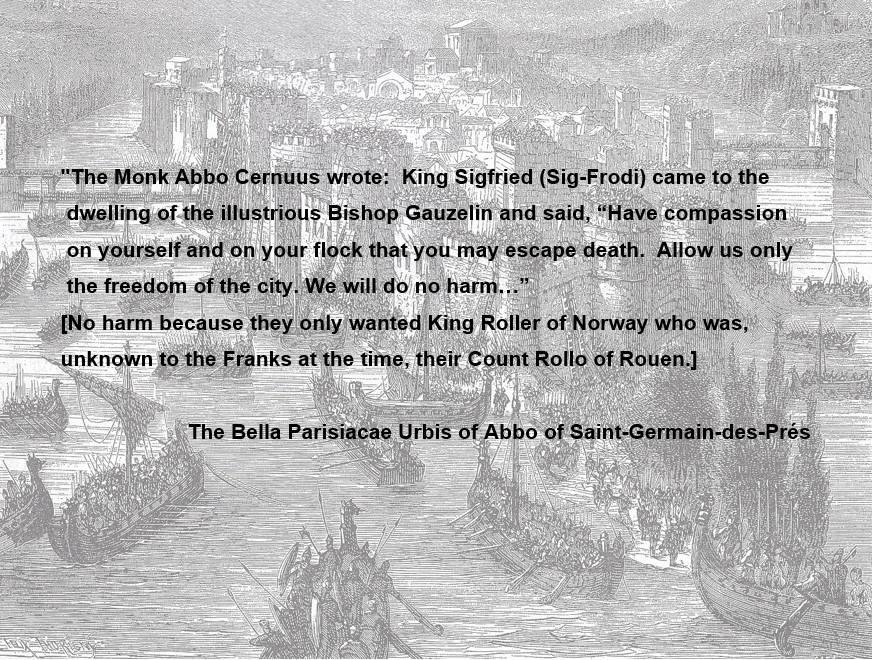
The Viking Siege of Paris of 885 by Eriz with Urbis of Abbo Quote
BOOK THREE: THE SAGA OF PRINCE HELGI ‘ARROW ODD’ ERIKSON
A Novel By Brian Howard Seibert
© Copyright by Brian Howard Seibert
WRITER’S UNCUT EDITION
(Contains Scenes of Violence and Sexuality Consistent with the Viking Period)
(May be Offensive to Some)
CHAPTER TWENTY SIX
26.0 THE SIEGE OF PARIS OF 885
“The Monk Abbo Cernuus wrote: King Sigfried (Sig-Frodi) came to the
dwelling of the illustrious Bishop Gauzelin and said, “Have compassion
on yourself and on your flock that you may escape death. Allow us only
the freedom of the city. We will do no harm…”
[No harm because they only wanted King Roller of Norway who was,
unknown to the Franks at the time, their Count Rollo of Rouen.]
The Bella Parisiacae Urbis of Abbo of Saint-Germain-des-Prés
(883 AD) Arrow Odd had laid low for many years, mostly working the Nor’Way trade route anonymously as The Barkman and overwintering in Rouen with his Uncle Roller while visiting with his wives in Ireland and Angleland. On a planned visit to Dub-Lin to meet up with both Queen Olvor and Princess Blaeja, Olvor informed Oddi that Blaeja was having difficulties with a new handmaiden and had begged off on leaving York at the last minute and sent a messenger with apologies instead. Oddi spent a few weeks visiting with his wife and daughter in Ireland and then told her he had planned some business in Angleland anyway and would sail to York and see what was up with Princess Blaeja and find out what kind of a problem a handmaiden could be posing. It did not take Oddi too much time to work through their problem and he resolved it for them so well that he spent the rest of the winter with the two of them and began his annual walrus and narwhal hunt in the Orkneys Faroes and Iceland in the very early spring.
While in York he had sent men with messages to London to set up a meeting with King Alfred of Wessex and after the ivory hunt Prince Oddi and his fleet sailed south between Ireland and England and beached their ships in Southampton. Oddi took a company of stalwart warriors to Winchester and met with King Alfred in his palace there. He introduced himself as Ottar or Ohthere and was welcomed by the first English monarch. He told Alfred of his wish to open a Hraes’ Trading Company post in both London and Southampton and he described the Hraes’ Nor’Way trade route to the king. Alfred, in turn, described a pledge he had made regarding a siege of London in which he had pledged to send an embassy to India to make offerings to Saint Thomas there. He planned on sending the embassy via Rome, but now wished to send a backup embassy via the Nor’Way if possible. Oddi told him it was very possible as his fleet would be sailing up the Nor’Way next and would be taking their walrus and narwhal ivory through Biarmia and south to Baghdad where a certain Captain Sindbad could take the embassy further south and east to Sind and India for their pilgrimage.
The two royals came to an agreement and sealed their deal with gifts, Oddi presenting King Alfred with two walrus and narwhal tusks and Alfred gifting Ohthere with two manuscript books by Orosius, the second copy going to Prince Erik ‘Bragi’ of Tmutorokan. A young cleric named Sigehelm headed up the embassy that took the Nor’Way route and the embassy was expected to return in two trading seasons. To keep a low profile, Prince Oddi gave control of the Southampton Hraes’ Trading post set up to Queen Olvor and the London start up to Princess Blaeja. Arrow Odd anonymously checked up on his queen and princess and their new English operations when he returned from his Barkman duties in the Nor’Way trading. Although he had years earlier assisted King Alfred in defeating Guthrum by slaying his powerful sister in East Anglia, Ogmund was known to visit his Danelaw holdings from time to time and that could be very dangerous for Oddi. He quickly returned to safety and overwintering in Rouen with his uncle, Count Roller.
(884 AD) In early spring Arrow Odd once more visited his wives in Dub-Lin and noted that Princess Blaeja had her maid in hand and under control and then he led the walrus hunt and once again worked the Nor’Way trade route anonymously as The Barkman. In Baghdad Captain Sindbad returned the young cleric Sigehelm and his embassy safely into Oddi’s custody bearing much wealth and accolades and The Barkman took the English noble and his party back to Southampton and they returned to their king in Winchester. Oddi spent some time in Southampton visiting with Queen Olvor in her new Hraes’ Trading Station there and Princess Blaeja joined them there and went through the progress made with their London operation. Oddi then took his trading fleet across the English Channel and up the Seine.
When he arrived in Rouen in the late fall, his Uncle Roller had bad news. A certain Prince Alf of Kiev, son of King Frodi, had led a small fleet of Danish ships into Frankia over the summer and may have learned something about who was operating the Hraes’ Trading Company stations there. It would lead to more ships snooping about and they would eventually be found out.
(885 AD) Arrow Odd had been able to lay low for many years, but King Roller of Norway had a profile that was harder to hide. The Great Kagan of Kiev, King Frodi, eventually learned that the treasonous former King of Norway was to officially become Duke of Normandy of the Holy Roman Empire, and was being given lands and titles in exchange for protecting the northern coasts of Frankia from attack by other Vikings. So, King Frodi put together a fleet of three hundred ships, half from Kievan Hraes’, led by his son, Alf, and the rest from Denmark and the Anglish Danelaw, and he planned to attack Count Roller and drive his Norman troops south from Flanders to Rouen.
“Our position here is indefensible,” Count Rollo explained to his lieutenants. “We’ll have to stall King Frodi and Prince Alf while we evacuate the city. They are here for slaves for their eastern trade.” Later he told Oddi, “He’s after my head now…unless you’ve got something to tell me.”
“Wasn’t me,” Oddi replied. “I’ve been keeping my head down. I think King Frodi finally figured out who the famed Duke Rollo actually is.”
“It’s still Count Rollo,” his Uncle Roller corrected him, “I’ve gone by Duke Rollo sometimes because that is what most Franks call me, but I won’t be officially Duke Rollo until they break Normandy away from Flanders and officially assign me my lands and title. Meanwhile, we have to keep the Franks thinking this is just another Viking raid. They’re already calling King Frodi by the name Sigfried and his son, Alfgeir. We do not want to correct that. I could lose my Dukedom before I have even been awarded it.”
The Great Kagan of Kiev sent Prince Alf forth from Liere with a small fleet to scout out Flanders and Frisia several times, then entered the mouth of the Seine with his armada of three hundred ships. Predictably, King Frodi followed the Hun practices for handling hosts and set up proper supply lines, giving Count Rollo plenty of time to save the citizens of Frankia as he retreated towards Paris. Prince Alf and his troops entered Rouen and, finding it abandoned, burned the city to the ground. King Frodi didn’t even leave his longship; he just sat in it and watched. The Great Heathen Army continued rowing up the Seine towards Paris.
The Normans, as the followers of Count Rollo were called, withdrew to Paris with a fleet of one hundred ships full of the citizens of Rouen and sought the protection of the Franks, who were suspicious and thought the Normans were attacking them, so they barred the gates to the city. Fortunately, Count Rollo knew their defences and had his men drag their ships around one of the low bridges blocking the river that flowed around the island city. Count Oddo of Paris only had two hundred troops with which to defend the city, so he could not pursue them, but he immediately started building twin wooden towers at the far ends of each bridge so they would not be able to portage around so easily on the way back. He did not know, at that point, that the Normans were being pursued by King Frodi and the Danish Hraes’, but, at least, now he would not be surprised by them. The Normans had tried to offer aid, but the Franks were too suspicious, so Count Rollo warned them of the coming fleet and carried on upstream with their refugees. Some of their larger ships could not be portaged, so they left them anchored on the Seine, leading King Frodi, on his arrival, to believe the Normans were taking shelter in the city. He laid siege to Paris. But the Franks had built high walls and ramparts around Paris after Ragnar ‘Lothbrok‘s sacking of the city decades earlier and now Paris could not be stormed. King Frodi lost many men trying to scale the city’s grey stone walls, and it did not seem to matter how many Franks he killed in attacks, they were always replaced by fresher tougher fighters. It was a mystery to the Danes, but it was not surprising that Count Oddo, on losing half his men, suddenly became more accepting of Count Rollo’s Norman aid. The siege was meant to keep the Parisians within, so it was quite easy, under cover of darkness, to sneak in Normans from without. Once the Normans had settled their refugees in several cities upstream of Paris, they returned and Count Rollo and Oddi wintered in Paris defending its walls while King Frodi and Prince Alf spent the cold winter in tents, outside the walls, trying to get in. It was during the defence of Paris that Count Oddo, in the name of their king, made Roller the Duke of Normandy and Count of Rouen. Duke Rollo jested that, had he known he would end up being the Count of Rouen, he would never have allowed King Frodi to sack the city.
By spring the Danes became unnerved by the fact that Count Oddo’s two hundred men still held the city even though the Danes had killed at least four hundred of them. When a Frankish relief army arrived from Saxony, King Frodi’s troops wasted no time in destroying it, yet the defenders of Paris never seemed to have their numbers diminish no matter how many fell in attacks. King Frodi even fired the ships the Normans had left on the Seine and drove them under the wooden bridge and burned part of it, isolating twelve Franks who were defending the twin towers Oddo had built the previous fall. Frodi demanded the twelve men surrender, but they couldn’t, for they were actually men of Normandy and Frodi would have killed them as traitors once he learned that they spoke not French, but Norse, so they fought like heroes, preferring to die in battle than be hanged, and they held the towers for many days as the people of Paris watched supportively. Finally King Frodi ordered the towers burned and three survivors came out of each tower as it blazed and they joined together on the remnant of the bridge and fought the Danes to the death in the waning winter light and their twin shadows could be seen falling one by one by one in the sunset. With the towers and the bridge burned, it seemed as though Paris would fall, but the citizens were bolstered by the stirring show of courage their daring dozen ‘Franks’ had displayed and even the most fearful took to the walls in defense. Even Duke Rollo was inspired and he dressed up a dozen men to look just like the twelve from the towers and he had them paraded around the stone towers at the Paris end of the bridge and this really unnerved the Danes. The next morning, they were gone and Count Oddo and Duke Rollo were the heroes of Frankia.
Oddi knew that King Sig-Frodi would never let Duke Rollo rule in Normandy unscathed, so he decided to follow the advice Queen Olvor had given him years before and he became determined to kill King Frodi.
Chapter 27.0: HAVE SWORD – WILL TRAVEL of BOOK 3: THE SAGA OF PRINCE HELGI ‘ARROW ODD’ ERIKSON shall follow on next Post.
Note: This website is about Vikings and Varangians and the way they lived over a thousand years ago. The content is as explicit as Vikings of that time were and scenes of violence and sexuality are depicted without reservation or apology. Reader discretion is advised.
The VARANGIANS / UKRAINIANS or The Nine Books of Saxo’s Danish History Per Brian Howard Seibert
BOOK ONE: The Saga of King Ragnar ‘Lothbrok’ Sigurdson
King Ragnar ‘Lothbrok’ Sigurdson’s third wife, Princess Aslaug, was a young survivor of the Saga of the Volsungs and was a daughter of King Sigurd ‘the Dragon-Slayer’ Fafnirsbane, so this is where Ragnar’s story begins in almost all the ancient tales (except Saxo’s). In our series, we explore this tail end of the Volsungs Saga because King Sigurd appears to be the first ‘Dragon-Slayer’ and King Ragnar ‘Lothbrok’ would seem to be the second so, it is a good opportunity to postulate the origins of Fire Breathing Dragons and how they were slain. King Ragnar would lose his Zealand Denmark to the Anglish Danes of Jutland, who spoke Anglish, as did the majority of Vikings who attacked England, which spoke both Anglish and Saxon languages, sometimes mistakenly called a common Anglo-Saxon language. The Angles and Saxons of England never really did get along, as shall be demonstrated in the following books. King Ragnar assuaged the loss of Zealand by taking York or Jorvik, the City of the Boar, in Angleland and Stavanger Fjord in Thule from which he established his Nor’Way trade route into Scythia.
BOOK TWO: The Saga of Prince Erik ‘Bragi’ Ragnarson
Book Two of the Nine Book The Varangians / Ukrainians Series places The Saga of Prince Erik ‘Bragi’ Ragnarson from Book Five of The First Nine Books of the Danish History of Saxo Grammaticus (c. 1200 AD) about King Frodi ‘the Peaceful’ into its proper chronological location in history. In 1984, when I first started work on the book, I placed Prince Erik’s birth at circa 800 CE, but it has since been revised to 810 CE to better reflect the timelines of the following books in the series. Saxo had originally placed the saga at the time of Christ’s birth and later experts have placed the story at about 400 CE to correspond with the arrival of the Huns on the European scene but, when Attila was driven back to Asia, the Huns didn’t just disappear, they joined the Khazar Empire, just north of the Caspian Sea, and helped the Khazars control the western end of the famous Silk Road Trade Route. Princes Erik and Roller, both sons of Ragnar ‘Lothbrok’, sail off to Zealand to avenge their father’s loss, but Erik falls in love with Princess Gunwar, the sister of the Anglish King Frodi of Jutland and, after his successful Battle Upon the Ice, wherein he destroys the House of Westmar, Erik marries Gunwar and both brothers become King Frodi’s foremost men instead, and the story moves on to the founding of Hraes’ and Gardar Ukraine.
BOOK THREE: The Saga of Prince Helgi ‘Arrow Odd’ Erikson
Book Three, The Saga of Prince Helgi ‘Arrow Odd’ Erikson, recreates Arrow Odd’s Saga of circa 1200 AD to illustrate how Arrow Odd was Prince Helgi (Oleg in Slavic) Erikson of Kiev, by showing that their identical deaths from the bite of a snake was more than just coincidence. The book investigates the true death of Ragnar ‘Lothbrok’ by poisoned blood-snakes in York or Jorvik, the ‘City of the Boar’, and how his curse of ‘calling his young porkers to avenge the old boar’ sets up a death spiral between swine and snake that lasts for generations. The book then illustrates the famous Battle of the Berserks on Samso, where Helgi ‘Arrow Odd’ and Hjalmar ‘the Brave’ slay the twelve berserk grandsons of King Frodi on the Danish Island of Samso, setting up a death struggle that takes the Great Pagan Army of the Danes from Denmark to ravage Norway and then England and on to Helluland in Saint Brendan’s Newfoundland. A surprise cycle of vengeance manifests itself in the ‘death by snakebite’ of Helgi ‘Arrow Odd’.
BOOK FOUR: The Saga of Prince Ivar ‘the Boneless’ Erikson
Book Four, The Saga of Prince Ivar ‘the Boneless’ Erikson, reveals how Ivar ‘the Boneless’ Ragnarson was actually Prince Eyfur or Ivar (Igor in Slavic) Erikson of Kiev and then King Harde Knute ‘the First’ of Denmark. By comparing a twenty year lacuna in the reign of Prince Igor in The Hraes’ Primary Chronicle with a coinciding twenty year appearance of a King Harde Knute (Hard Knot) of Denmark in European Chronicles, Prince Igor’s punishment by sprung trees, which reportedly tore him apart, may have rather just left him a boneless and very angry young king. Loyal Danes claimed, “It was a hard knot indeed that sprung those trees,” but his conquered English subjects, not being quite as polite, called him, Ivar ‘the Boneless’. The book expands on the death curse of Ragnar ‘Lothbrok’ and the calling of ‘his young porkers to avenge the old boar’ when Ivar leaves his first son, King Gorm (Snake) ‘the Old’, to rule in Denmark and his last son, Prince Svein (Swine) ‘the Old’ to rule in Hraes’, further setting up the death spiral between the swine and snake of the ‘Lothbrok’ curse.
BOOK FIVE: The Saga of Prince Svein ‘the Old’ Ivarson
Book Five, The Saga of Prince Svein ‘the Old’ Ivarson, demonstrates how Prince Sveinald (Sviatoslav in Slavic) ‘the Brave’ of Kiev was really Prince Svein ‘the Old’ Ivarson of Kiev, who later moved to Norway and fought to become King Sweyn ‘Forkbeard’ of Denmark and England. But before being forced out of Russia, the Swine Prince sated his battle lust by crushing the Khazars and then attacking the great great grandfather of Vlad the Impaler in a bloody campaign into the ‘Heart of Darkness’ of Wallachia that seemed to herald the coming of the Four Horsemen of the Apocalypse and included the famed 666 Salute of the Army of the Impalers. The campaign was so mortifying that the fifteen thousand pounds of gold that the Emperor of Constantinople paid him to attack the Army of the Impalers seemed not nearly enough, so Prince Svein attacked the Eastern Roman Empire itself. He came close to defeating the greatest empire in the world, but lost and was forced to leave Hraes’ to his three sons. He returned to the Nor’Way and spent twelve years rebuilding Ragnar’s old trade route there.
BOOK SIX: The Saga of Grand Prince Valdamar ‘the Great’ Sveinson
Book Six, The Saga of Grand Prince Valdamar ‘the Great’ Sveinson, establishes how Grand Prince Valdamar (Vladimir in Slavic) ‘the Great’ of Kiev, expanded the Hraes’ Empire and his own family Hamingja by marrying 700 wives that he pampered in estates in and around Kiev. Unlike his father, Svein, he came to the aid of a Roman Emperor, leading six thousand picked Varangian cataphracts against Anatolian rebels, and was rewarded with the hand of Princess Anna Porphyrogennetos of Constantinople, a true Roman Princess born of the purple who could trace her bloodline back to Julius and Augustus Caesar. She was called ‘Czarina’, and after her, all Hraes’ Grand Princes were called ‘Czars’ and their offspring were earnestly sought after, matrimonially, by European royalty.
BOOK SEVEN: The Saga of King Sweyn ‘Forkbeard’ Ivarson
In The Saga of King Sweyn ‘Forkbeard’ Ivarson, Prince Svein anonymously takes the name of Sweyn ‘Forkbeard’ in Norway and befriends the Jarls of Lade in Trondheim Fjord in Norway as he expands the Nor’Way trade route of his grandfather, Ragnar ‘Lothbrok’. He had come close to defeating the Eastern Roman Empire, and still felt that he was due at least a shared throne in Constantinople. He used the gold from the Nor’Way trade to rebuild his legions and his Hraes’ cataphracts and though his brother, King Gorm ‘the Old’, was dead, his son, Sweyn’s nephew, King Harald ‘Bluetooth’ Gormson had usurped the throne of Denmark and had hired the famed Jomsvikings to attack Prince Sweyn in Norway, setting up the famous Battle of Hjorungavagr in a fjord south of Lade. King Sweyn ‘Forkbeard’ would emerge from that confrontation and then he would defeat King Olaf Tryggvason of Norway in the Battle of Svolder in 1000 AD, in an engagement precipitated over the hand of Queen Sigrid ‘the Haughty’ of Sweden. Later he attacked England in revenge for the following St. Brice’s Day Massacre of Danes in 1002 AD and he fought a protracted war with the Saxon King Aethelred ‘the Unready’ that could only be described as the harvesting of the English for sale as slaves in Baghdad and Constantinople. With the help of his son, Prince Valdamar of Kiev, and the legions and cataphracts of Hraes’, he conquered England on Christmas Day of 1013, but victory was not kind to him.
BOOK EIGHT: The Saga of King Canute ‘the Great’ Sweynson
Prince Valdamar ‘the Great’ Sveinson of Kiev, who had supported his father, King Sweyn ‘Forkbeard’ of Denmark in attacks upon England left his ‘Czar’ sons in charge of Hraes’ and took over as King Valdamar of England, but the Latin Christian English revolted against his eastern name and Orthodox Christian religion and brought King Aethelred back from exile in Normandy and Valdamar had to return to Hraes’ and gather up the legions he had already sent back after his father’s victory. His half brother was ruling in Denmark and his sons were ruling in Hraes’ so, in 1015 AD Grand Prince Valdamar ‘the Great’ of Kiev was written out of Hraes’ history and in 1016 the Latin Christian Prince Canute ‘the Great’ returned to England to reclaim his throne. He defeated Aethelred’s son, King Edmund ‘Ironside’ of England, at the Battle of Assandun to become King Canute ‘the Great’ of England and later King Knute ‘the Great’ of Denmark and Norway as well. But that is just the start of his story and later Danish Christian Kings would call his saga, and the sagas of his forefathers, The Lying Sagas of Denmark, and would set out to destroy them, claiming that, “true Christians will never read these Sagas”.
BOOK NINE: The Saga of King William ‘the Conqueror’ Robertson
The Third Danish Conquest of Angleland was seen to herald the end of the Great Viking Manifestation of the Middle Ages, but this, of course, was contested by the Vikings who were still in control of it all. Danish Varangians still ruled in Kiev and Danes still ruled the Northern Empire of Canute ‘the Great’, for the Normans were but Danish Vikings that had taken up the French language, and even Greenland and the Newfoundland were under Danish control in a Hraes’ Empire that ran from the Silk Road of Cathay in the east to the Mayan Road of Yucatan in the west. “We are all the children of Ragnar ‘Lothbrok’,” Queen Emma of Normandy often said. Out of sheer spite the Saxons of England took over the Varangian Guard of Constantinople and would continue their fight against the Normans in Southern Italy as mercenaries of the Byzantine Roman Empire. They would lose there as well, when in the Fourth Crusade of 1204, the Norman Danes would sack the City of Constantinople and hold it long enough to stop the Mongol hoards that would crush the City of Kiev. It would be Emperor Baldwin ‘the First’ of Flanders and Constantinople who would defeat the Mongol Mongke Khan in Thrace. But the Mongols would hold Hraes’ for three hundred years and this heralded the end of the Great Viking Manifestation. The Silk Road was dead awaiting Marco Polo for its revival. But the western Mayan Road would continue to operate for another hundred years until another unforeseen disaster struck. Its repercussions would be witnessed by the Spanish conquerors who followed Christopher Columbus a hundred and fifty years later in the Valley of the Mound Builders.
Conclusion:
By recreating the lives of four generations of Hraes’ Ukrainian Princes and exhibiting how each generation, in succession, later ascended to their inherited thrones in Denmark, the author proves the parallels of the dual rules of Hraes’ Ukrainian Princes and Danish Kings to be cumulatively more than just coincidence. And the author proves that the Danish Kings Harde Knute I, Gorm ‘the Old’ and Harald ‘Bluetooth’ Gormson/Sweyn ‘Forkbeard’ were not Stranger Kings, but were Danes of the Old Jelling Skioldung Fridlief/Frodi line of kings who only began their princely careers in Hraes’ and returned to their kingly duties in Denmark with a lot of Byzantine Roman ideas and heavy cavalry and cataphracts.
 SeiberTeck: 'The Varangians Series'