THE SAGA OF PRINCE HELGI ‘ARROW ODD’ ERIKSON Has Been Added to The Site Under the New Heading The VARANGIANS / UKRAINIANS Book Series – The True History of ‘The Great Viking Manifestation of Medieval Europe’© and the below Post Covers CHAPTER TWENTY SEVEN:
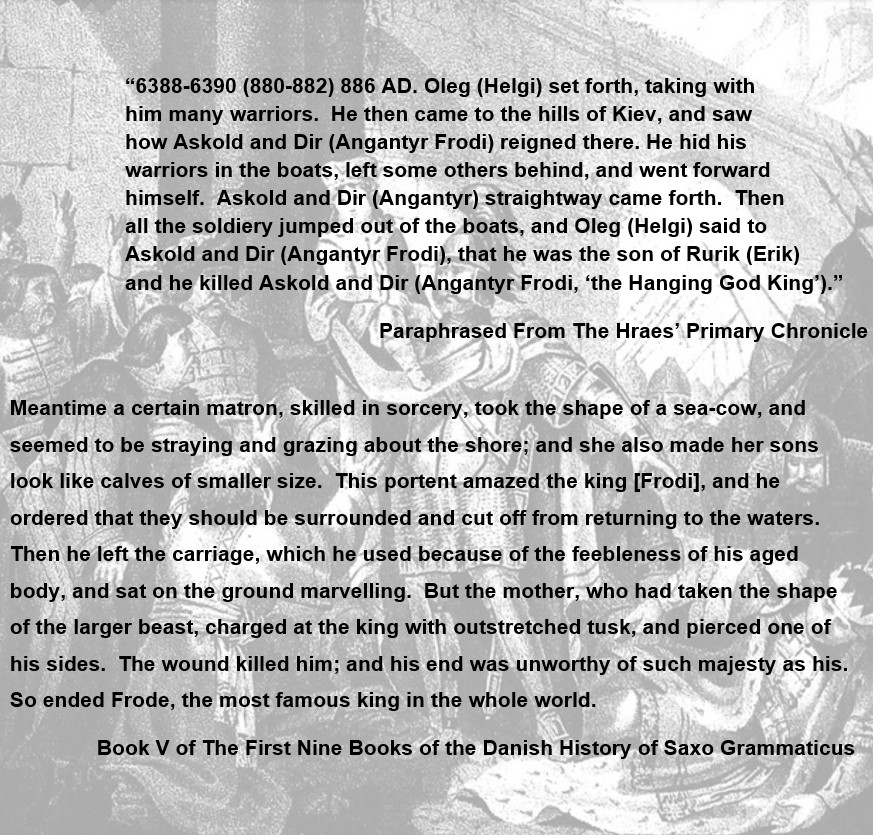
The Slaying of King Frodi by Arrow Odd in The Primary Chronicle and The Danish History of Saxo
BOOK THREE: THE SAGA OF PRINCE HELGI ‘ARROW ODD’ ERIKSON
A Novel By Brian Howard Seibert
© Copyright by Brian Howard Seibert
WRITER’S UNCUT EDITION
(Contains Scenes of Violence and Sexuality Consistent with the Viking Period)
(May be Offensive to Some)
CHAPTER TWENTY SEVEN
27.0 HAVE SWORD — WILL TRAVEL (Circa 886)
“Blade with whom I’ve lived, blade with whom I’ll die.
Serve right and justice one last time, one last try.
Seek one last heart of evil, still one last life of pain.
Cut well old friend and then farewell, till we meet again.
Sir Orrin Neville-Smythe, The Flight of Dragons (Paladin)
(886 AD) Arrow Odd called out the cadence of the rowing by stout young Danes from the new Duchy of Normandy as Fair Faxi slipped away from the mouth of the Seine and entered the English Channel. They were picked men, stalwart warriors chosen for a mission in the east, and their backs bowed as their oars bit into the dark heavy waves of the open sea. Sailing east and then north, they slipped past the land of the Angles and Jutes undetected, then sailed down the coast of Gotland and entered the Baltic. With a good eastern wind, they sailed quickly across that sea and entered the mouth of the Dvina River and the land of the Lithuanians.
Oddi stopped at Polotsk and found Gudrun working at her father’s Hraes’ Trading Company station there. He learned that both sisters had been pregnant when their father took them out of Norway to the east and that both Oddi and Asmund had sons living in Polotsk. He told Gudrun that he would be back for her, but if he didn’t make it back, he wanted both sisters and their sons to meet him in Gardariki as soon as she could. He told her that the Southern Way was soon to be slave free. After leaving Gudrun, Oddi donned his ‘Barkman’ suit. He had heard rumours that Warlock Ogmund Tussock was in the Danelaw of England posing as Guthrum again, but he wasn’t sure and wanted to keep the warlock from detecting his approach to Kiev if he had returned to Hraes’.
When they came to the Dnieper Portage, they unfooted Fair Faxi’s mast and, posing as ivory traders, paid the local Slav porters in silver to portage their ship and its load of walrus and narwhal ivory to the tributary of the Dnieper. It was yet early spring; the weather was cold and wet; patches of snow remained upon the ground in shaded riverbank areas. Soon they came upon a trading station consisting of several longhalls in a clearing by the riverbank, along with a large stable for horses, warehouses for the storage of furs, rans for the keeping of slaves and a number of boat sheds for the repair of ships and monoxylan. This was the jumping off point for Southern Way trade and the Dan Par river route to Kiev, King Frodi’s Konogard.
Oddi and his crew set off in Fair Faxi and, within hours, his company had passed from the territory of the Radimichi to the lands of the Dregovichi. The sun was yet high in the east and a steady breeze blew from the north, adding its power, to the speed of the current and the efforts of the rowers, driving the vessel south towards the Scythian Sea. When they moved into Drevjane territory, the river slowed and widened and fishermen worked their nets from the shores. In the land of the Poljane, the river slowed even more and the wind died down so the Normans rowed even harder.
A week of this found Oddi and his men at the main quay of Kiev, the Ferry Quay, and Oddi showed everyone his valuable load of walrus and narwhal ivory tusks and he said they came bearing gifts and he sent the ferryman to fetch his king. The ferryman returned with a small retinue of guards from King Frodi’s longhall and they asked who it was that had business with their king. Oddi told them that they were ivory traders and had gifts for their king as his eleven men set about unloading the Narwhal tusks and stacking them at the head of the quay. Then King Frodi came out of his longhall and exited his city gate at the head of another dozen guards led by a giant that looked like Ogmund ‘Eythjofsbane’ Tussock, but Oddi could not tell because he had strapped on a heavy black iron Vanir helmet that had but a horizontal slit for the eyes and a number of vertical slits below it for breathing. Then Oddi recognized his movements and Ogmund recognized the same and they both rushed forth to meet each other. Oddi and Ogmund stopped dead in their tracks and then began circling each other.
“I challenge you to personal combat,” Ogmund shouted, waving back his men. “Catch your breath. I don’t want excuses!”
“I don’t need a break,” Oddi shouted back. “Bring on your battle!”
“Rest,” Ogmund demanded. “I must tell you why I’m going to kill you.”
King Frodi took a seat upon a bench that a courtier rushed out from the hall and placed in front of his personal howe at the head of the main quay.
“You’re going to try to kill me because I slew the twelve berserker grandsons of King Frodi!”
“That is the part I am being paid for,” Ogmund growled, glancing back at his king. “But the part I am doing for free, including the killing of Thord ‘Prow Gleam’ with an arrow, is payment for what you did with Gusir’s Gifts in Bjarmaland so many years ago.”
Oddi stopped circling an instant, then started again.
“You shot my sister through the eyes and you killed my mother and wounded my father in Giantland. I am half giant,” Ogmund growled and he straightened up and looked much taller than Oddi remembered. “I hunched down when we last fought because I didn’t want you to run away. Here you can’t run,” and he flexed his muscles and looked even more a giant. “My mother was on an embassy to the dwarfs and was left for dead by King Gorm when your Arthor led him to the land of the dwarfs and sacked their city. Giants fell during that battle. Your father saw their armour and weapons when he visited the ruins and he thought they were props.”
“What else does your prescience tell you?”
“Besides the fact that you are going to die here today, I can tell you that you are called Arrow Odd because all your true friends die from the bite of an arrow.”
“I have complained about that,” Oddi said, still circling and catching his breath, “but my best friend, Hjalmar died from the bite of the famed sword Tyrfingr.”
“The sword forged by your father,” Ogmund started, “the ruler of the Nor’Way, Erik ‘Bragi’ Ragnarson. It is a starstone blade forged from a falling star that Erik thought was an arrow of the gods as he watched it descend from the heavens. And that arrow of the gods bit Hjalmar sixteen times before he died of its poison.”
“And the starstone blade rests in Angantyr’s howe. I know because I put it there. So, what sword do you propose to kill me with, for I am my own best friend now,” and Oddi hiked up his shield and lunged at Ogmund with a stroke so quick, the giant barely avoided it. Oddi stepped back into the circle they were pacing and blocked a vicious set of blows with his shield before whacking back at Ogmund’s shield with a blow of his own. Oddi realized that Ogmund thought he had come to kill him, not King Frodi, and he decided to use that to his advantage. They circled each other trading blows for a while and then King Frodi gave Ogmund a look of impatience as he sat on his bench. Ogmund attacked once more with renewed vigour and managed to lock up shield arms with Oddi. He then used his greater size to spin Oddi about and throw back towards the quay, but Oddi used his imparted momentum to land and bounce back up next to the stack of narwhal tusks and he grabbed the topmost tusk and he hurled it straight towards King Frodi, as he sat and watched, and the ivory tusk pierced the old monarch through the heart, bowling him over his bench stone dead. Ogmund dashed after Oddi but tripped over the bench and flew headfirst into a huge wooden post and the heavy helmet snapped his neck with a loud crack. All watching were stunned as the giant died with a huge grunt and Oddi, satisfied that Ogmund was dead, led his men defensively down the quay towards Fair Faxi. Then Frodi’s troops surrounded their dead king and his dead giant and watched in dismay as the giant’s hands moved and grabbed the iron helmet and twisted it, popping the neck back into place with a grinding crack.
The soldiers grabbed at their amulets and said prayers to both Odin and Thor, as Oddi led his men running back down the quay to his ship. They had already started rowing before the stunned guards started throwing their spears. Ogmund sat up against the post and watched through his helmet slit as two men at the rudder blocked the flying shafts with their shields and the rowers bent their oars in the waters of the Dnieper. Spears were followed by arrows and rowing back upriver would have been fatally slow. Oddi could not return to his uncle in Normandy, so he would visit his father in Tmutorokan.
First, they came upon a rapid called Essoupi, meaning Do Not Sleep in the native Slav, a narrow rushing cataract broken by jagged rocks that caused the water to veritably roar. There were local Poljane guides along the river that were paid to help merchants unload their ships and draft the vessels through a narrow channel by the right riverbank.
The second cataract, called Ostrovouniprach by the Slavs and Oulvorsi by the Norsemen, both meaning Island Rapid, was similar to the first and was traversed in a like manner. The third rapid was called Gelandri which the Poljanes explained as meaning Noise of the Rapid and it, too, was coursed in a similar fashion.
The fourth of the seven rapids, the largest, was called Neasit by the Slavs and Aeifor by the Danes, because pelicans nested out in the rocks of the cataracts. Here, there was no safe passage along the banks, and the Normans had to haul Fair Faxi out of the water and drag the ship six miles around the torrent. The fifth cataract was called Voulniprach in Slavic and Varouforos in Norse because it forms a large lake. It was traversed in the same manner as the first, as was the sixth rapid, called Veroutzi and Leanti in the Slav and Norse tongues, meaning the Boiling of the Water.
The seventh and last rapid, called Naprezi or Stroukoun, meaning Little Rapid, was reached just upstream of the Ford of Vrar, a wide and shallow ford susceptible to attack on horseback. The Stroukoun Rapid was navigable and gave the Normans little trouble and the Ford of Vrar was peaceful and they camped on the Island of Saint Gregory. Exiting the Dnieper into the Scythian Sea, Oddi and his men sailed wide around the Cherson peninsula and along the Sea of Azov until they reached Tmutorokan.
At the mouth of the Kuban River, before the Sea of Azov, of gleaming gold and glittering marble, sat Gardariki. Prince Erik had been busy building this tribute to his wife, Princess Gunwar. It was no longer a trading settlement, but a small city of high stone walls, paved streets and marble faced concrete buildings. As Oddi approached in his Nor’Way ship, he marvelled at how much the riverward side of the city resembled Paris, the Walled Island City, but on the landward side the walls seemed even greater: taller, wider and brighter, glittering of white marble.
Many quays thrust out into the river and between every two quays there was a gate with twin towers built into the wall. Sentries ran out to the ends of quays and waved them on past dozens of docks. There was a great gate in the center of the riverside wall and the sentries waved Oddi in. Standing atop the near tower of the gate was Prince Erik in baggy red velvet trousers and a white silk shirt with elaborate red silk piping.
“Hoi, Oddi, my son!” Erik shouted. “I thought you were staying with your uncle, Count Roller, in Flanders.”
“It is called Normandy now, father,” Oddi shouted, leaping from the ship to the dock, “and Count Roller is now Duke Rollo.” As his men tied the ship off, he headed for the tower. “I thought I might visit with you and take care of some business on the way here.” By the time Oddi had entered the great gate, Erik had skipped down the stone stairs of the tower. “Last year King Frodi attacked Count Roller and the army of the Franks. We stopped him at the gates of Paris. He withdrew to Liere, and then back to Konogard.” Then Oddi whispered, “I paid him a visit on the way here and killed him near the main quay in Kiev.”
“King Frodi is dead?” Erik whispered, stopping suddenly. “The Southern Way shall die with him. Come. We must make preparations. I no longer have friends in Kiev. Like Ragnar in The Vik, I have only spies now. We must take steps to protect the Nor’Way. But first, you’ve never seen Gardariki as my son. It has changed so much since you were last here as a merchant warrior. Let me show you your mother’s city…the place of your birth.”
Erik led Oddi down the street that ran from the main gate on the river to the front gate facing the Don Heath to the northeast. “This is the tower your mother stood upon as she watched the Hun army approach just days after your birth.” They climbed the stone stairs of the tower and looked out through castellations over the plain. “That is where your mother, Princess Gunwar, fell at the hands of her nephew, Prince Hlod.” There were a few travellers on the road running across the plain, but there was a stillness in the air and faint echoes of battles fought there. “Are you sure he is dead?” Erik asked in a low tone.
“Quite sure,” Oddi answered. “I pierced him through the heart with an ivory narwhal tusk. It was quick and sudden, a fatal strike.”
“It is good that it was quick,” The Prince said. “He was bad, but we had good times too, and I still love his sister, your mother, though she be two decades gone now.”
“We tried to lay low, father,” Oddi said, “but he came after your brother, Roller, Duke Rollo of Normandy. His growing fame became hard to hide.”
“King Roller,” Erik corrected. “He is still the rightful King of Norway, to my mind at least, not that usurper, Harold Fairhair, that Frodi instilled after crushing Norway.”
“Yes, of course,” Oddi agreed. “King Frodi must have learned of where your brother was ruling, because he sent Prince Alf with a small fleet to scout out Flanders and Frisia several times then returned with King Frodi and an armada of three hundred ships and attacked us in Rouen. We withdrew with a fleet of one hundred ships to Paris and sought the protection of the Franks, but they were suspicious and thought we were attacking them. So, we portaged around Paris and planned to hunker down in Melun to watch the siege. Count Oddo of Paris only had two hundred men to hold the walls, but he still refused our help. I don’t think he trusted us. I don’t think, at that point, he knew we were being pursued by King Frodi of Gardar. We warned them of the size of the coming fleet, then carried on upstream. King Frodi laid siege to Paris, but the Franks had built high walls and ramparts after your father’s sacking of the city decades ago and now Paris could not be stormed. King Frodi lost many men trying to scale those grey stone walls and Count Oddo, after losing half his men, suddenly became more accepting of our aid. The siege was meant to keep the Parisians within, so it was quite easy for us, under cover of darkness, to sneak in from without. Your brother as Count Rollo and I as Bjorn ‘Ironsides’ wintered in Paris defending its walls while King ‘Sigfried’ and Prince ‘Alfgeir’ spent the winter in tents outside the walls trying to get in. It was during the defence of Paris that Count Oddo made your brother Duke Rollo of Normandy and Count of Rouen.
“In the spring a Frankish army arrived from Saxony, but King Frodi’s warriors wasted no time in destroying it. Yet our defenders of Paris never seemed to be depleted, no matter how many fell in attacks. We kept sneaking in fresh Vikings from Melun. Finally, King Frodi left and your brother, Duke Rollo, and Count Oddo were the heroes of Frankia. But I knew that King Frodi would never let your brother rule in Normandy unscathed, so I became determined to kill him, and I’ve done just that.”
“Prince Alf is in Denmark,” Erik started, “but he’ll return to Konogard to establish order. The local Slav tribes are near revolt and only their fear of King Frodi has kept them in check. If the Slavs overthrow Alf, they’ll shut down the Southern Way. They are fully against the slave trade that is carried out through it, since they make up most of the slaves.”
“I can’t condone the slave trade myself. I swore an oath to my friend, Hjalmar, that I would never force someone unwillingly onto any ship under my command.”
“Your mother was so dead set against it, she became a Christian. It was many years after her death that I learned for sure that Princess Gunwar actually founded the Freedom Movement that is so prevalent in Sweden now, ironically, using gold I made off of the slave trade.”
“But you freed Sister Saint Charles from slavery so many years ago,” Oddi started.
“There was nothing noble in my actions at that time,” Erik explained. “She became determined to teach me Latin and French so she could try to explain that I could get a mark of silver for her from Bishop Prudentius of Troyes. She had no idea that I could already read the Runes and had learned Latin from Brak, my foster father, or that I was very adept at learning spoken languages, yet she became determined to teach me Greek, as well, so she could earn her freedom. It was her determination that made me free her. And the Greek she taught me saved my life in Constantinople more than once. After your mother died, I banned all slave trade on the Nor’Way out of respect for her beliefs. That was the finale of my falling out with King Frodi. My falling out was always there, but it really got started when he murdered Queen Alfhild. Then he left your mother to deal with Prince Hlod alone. But the Slavs were the Menja that ground his gold for him.”
“I’m glad. I could not break faith with Hjalmar at this point in my life.”
“Now, Prince Alf won’t be feared near as much as his father was, so I would expect an uprising as soon as he takes over in Gardar. We must try and establish new trade agreements with Constantinople and Baghdad for Southern Way trade. It must go through us. As long as the Slavs control the Southern Way, everything will go through the Nor’Way.”
Oddi wondered what the Prince of Gardariki meant by ‘us’. He had been worried that his father would turn him away, or worse after slaying their king, but instead he seemed to be including him in future plans.
“I need you to represent me in Baghdad,” Erik started, “while I go visit the Romans in Constantinople, that is, if you don’t mind working with me for a while instead of with your uncle.”
“I would be honoured,” Oddi responded.
“Great!” Erik said. “Now, how about a tour of the city?”
Oddi stared out across the plain as they left the tower.
“The Khazar Quarter is on the left in the southeast quadrant and they maintain a Jewish Temple there,” Erik started as they walked back down the broad main street that formed the short axis of the city.
“You allow Khazars within your city walls?” Oddi asked, incredulously.
“The Romans said, ‘Keep your friends close, your enemies closer’, so I have placed the Khazar Quarter across from the Muslim Quarter so they can watch each other. The Khazars are playing a big part in the success of the Nor’Way and I intend to make sure that they are given opportunities to earn their fair share of the profits.”
Unconvinced, Oddi asked, “Wouldn’t it be better to just destroy Atil Khazaran?”
Erik pulled Oddi closer and quietly said, “Atil Khazaran must never fall. The fortress city holds back the Hordes of the Asian Steppes. I have had visions of what will happen to us if the Khazars fall,” and he shook his head grimly. Changing the subject, Erik said, “The Muslim Quarter is run by the Caliphate of Baghdad and has the largest Mosque in Europe. Their merchants are our connection with Indian trade as well as Middle East and African traffic. The African trade is picking up the slack in the shortage of slaves that is being caused by our new policies. And Nigerian Alchemists’ Schools have been monitoring the abuse of black slaves in Baghdad. That is one of the issues you must address with the Caliphate when you are there.”
“In the name of Hjalmar, I shall do my best. King Roller showed me a picture of you in Baghdad,” Oddi added. “He called it a silver oil emulsion exposure.”
“He still has that! I’m glad.”
“He treasures the picture. I promised Sister Saint Charles that I would try to have an exposure created of myself in Jerusalem.”
“I’ll put you in contact with those Alchemists in Baghdad and the Khazars have a Jewish Embassy in Jerusalem. They’ll assist you there.” Then Erik carried on with the tour. “The Quarter of the Alchemists’ Guilds is on our right in the northeast and the Roman Quarter is in the northwest with a huge Christian Cathedral. The palace is on the hill at the northern tip of the city and there is a Hall dedicated to Odin on the left and our own stone Christian Church that your mother sponsored. Our Hraes’ and Varangians are interspersed throughout the city in various sections of all quarters, surprisingly, often based on which of the various religions they choose to follow. Oh yes, there is also an Oriental Temple and a Zoroastrian Church in the Alchemists’ Quarter should you be a follower of Buddha, Confucius or Zarathustra.”
“I’m really not that religious,” Oddi replied. “But I would like to see the stone church my mother built.”
“You take after your father,” Erik replied, laughing. “The church is on the way to the palace,” he continued as they turned onto the main avenue that formed the long axis of the city’s quadrants. “Your mother is buried there.” The stone cobbles of the avenue ran for a mile north to the palace square and a mile and a half south to a castellated wall. Under a copse of trees in the center of the intersection were several chariots with paired teams of horses.
“This chariot is a fourth century Roman original,” Erik started, “that I’ve had fully reconditioned, and this one is an Egyptian copy, and this is a Scythian reconstruction. There is a shop in Constantinople that specializes in antiquities and the teams are all Arabians, the same breeds that the Emperor uses in the Hippodrome.” Erik stepped upon the Roman rig and held out a hand for Oddi to join him. The Roman unit had a smoother ride.
“Your streets have no names,” Oddi commented as he climbed aboard.
“The main street and avenue are the ordinates and all addresses are coordinates using positive and negative numbers. It’s a new Indian thing. Kind of like Roman numerals where a one before the five gives you a four and a one after the five gives you a six. So, the numbers to the left of the centre ordinate are negative and to the right are positive.”
“I think I get it,” Oddi lied. ‘But the ride to the stone church was pretty smooth’, he thought.
“This is it,” Erik said, drawing the chariot up to the stone steps of the church. “We call it Gunwaran.”
“God’s House,” Oddi mouthed the words.
“We rebuilt it on the original site after the Huns destroyed it. We built stone and mortar foundation walls and filled in the cavity with rubble and poured a concrete floor, then we built stone and mortar walls with leaded glass windows and doors….hope you like the colours of the glass….your mother picked them out for the original church and some of the colours cost a fortune. The roof is of clay ochre oak trusses covered by slate tiles. I had a dream that if I poured the concrete floor with steel rods cast into it, the concrete floor could span the foundations without a rubble fill. And if it could span the foundations to form a floor, it could span the walls to form a roof. But a flat roof would take some getting used to. A dome, an arch, a barrel vault or a gable truss I can trust, but a flat concrete roof…makes me nervous. Still…in my dream those same steel bars in the concrete walls of Constantinople could someday save that city from a new iron weapon that belches smoke and fires great iron balls further and faster than catapults. But that’s a story for another day.”
“What was she like…my mother?”
“She was the love of my life.” Erik started. “She was tall, with long blonde hair and blue hazel eyes touched by Odin. You remind me of her.” Erik fought back tears as he hugged his son. “Your mother was my anchor in this sea of troubles we call life,” he said, as he stepped back and admired Gunwar’s baby. They sat in the pews of the church for a long time, two pagan non-believers, while Erik told Oddi stories about his mother, from tales of princes’ heads lining the walls of her bedchamber to stories of witches offering poisoned brews. “She wasn’t my first love though,” Erik concluded. “Princess Alfhild was first. I was infatuated with her, but she would settle for no less than a full blooded king. King Frodi, the man who took her life. It is good that you killed him.” The story reminded Oddi of Hjalmar and Ingibjorg’s forbidden love and its tragic consequences.
As Erik carried on showing his guest the City of Gardariki, it occurred to Oddi that the whole city was patterned after the Island City of Paris. When he suggested this to his father, Erik explained that the north side of the Isle of Paris matched the west side of Gardariki, but Paris was much wider. He was planning to eventually double the city’s width to match Paris and then cut a channel so the Kuban River would flow all around it.
While Erik made preparations for the embassies to Constantinople and Baghdad, news was filtering into Gardariki from his spies in Konogard that King Frodi was alive and well.
“Are you sure you killed him?” Erik asked Oddi.
“I pierced him through the heart. He was dead before he hit the ground.”
“Are you sure it was him?”
“He wore a mask, but as he fell it dislodged and I saw his face quite clearly. He had deep vertical slashes over his entire countenance and they were quite red and enflamed.”
“That’s him alright. He strangled Queen Alfhild to death and in her death throes she used her fingernails to tear up his face. An infection set upon him, some say Alfhild’s spirit sent it, and when it flares up Frodi wears…wore…a mask.”
Further reports detailed King Frodi riding throughout his kingdom in his royal carriage, making the tribute rounds. It was weeks before they received word from spies that it was the masked corpse of King Frodi that was making the rounds. His foremost man and lieutenants, fearing an uprising of the Slav populace, devised this ruse to maintain the Peace of Frodi until his son, Prince Alf, could be crowned king. Once all were reassured that King Frodi truly was dead, Oddi felt comfortable in parting for Baghdad early, as he still wanted to include a pilgrimage to Jerusalem in his plans.
Prince Alf left Liere for Konogard in the spring at the head of the Danish merchant contingent traversing the Southern Way. He could tell the trip would be different as soon as they had crossed the Baltic and entered the mouth of the Dvina River. The few Sclavs that were left in the land were on edge and the Lithuanians were gathered in riverbank settlements, showing no fear of the Danes. The Hraes’ stations along the Dvina-Dnieper Surazh-Smolensk portage were undermanned and poorly supplied. The Radimichi along the Dnieper seemed overly aggressive and the Drevjane looked to be preparing for war. Only the Poljane around Kiev seemed to be following normal daily routines, but probably because they were being more closely monitored by their Danish overlords.
As soon as Prince Alf had arrived in Konogard, he had King Frodi’s body preserved, then placed into a carriage and his mask was put on and the carriage was paraded around Kiev behind Prince Alf’s retinue to quash the rumour circulating through the people that their feared king was dead. This quelled any thoughts of rebellion that the Slav peoples along the Dnieper River may have had, but it didn’t calm the various groups living further north along the Dvina. They essentially choked off the Southern Way trade. Prince Alf was secretly crowned king and he ordered Prince Arngrim of Novgorod to put down the northern revolt. Prince Arngrim led a local force from Holmgard to relieve the portage stations at Smolensk but received little help from Kiev and was met by rebellious warriors of the Krivichi, Radimichi and Dregovichi and he and his troops were slaughtered before they could even get to Smolensk. King Alf contented himself with controlling the Dnieper end of the Southern Way and cut deals with the northern groups to maintain the trade of slaves from Ireland, Angleland and Scandinavia. All the northern Hraes’ trading stations and forts fell that spring. Vadim the Brave, the rebel that was supposedly killed in Staraya Russa years before, came out of hiding and the Slavs threw off the yoke of slavery and each tribe set up its own independent state and they began to live as they had before the coming of the Hraes’ and the coming of the Khazars before them. Only Novgorod remained unscathed in the north as Princess Eyfura bribed the few Ests in that land to remain loyal, but her situation was very precarious as she grieved the loss of her husband and she blamed her brother, King Alf, for his death.
Nor’Way trade via the Northern Dvina and Volga Rivers carried on as usual over the spring and even increased as the season progressed. Furs and ivory and amber and tonstone flowed south, but no slaves. This did not impact the trade agreements with Constantinople, but it caused panic in the slave markets of Baghdad, but no matter how fervently the Caliphate pleaded for thralls, Oddi personally refused them access, but he soon learned that African slave traders were picking up the additional slack. Still, longships of the Gardariki navy patrolled the Nor’Way river routes to ensure that Scandinavian slaves were not being smuggled through by Norwegian merchants. Over the summer one of these patrolling longships met up with a small fleet from Novgorod led by Princess Eyfura. She was leading her people to the relative safety of Tmutorokan.
“She looks just like her mother,” Erik thought as he welcomed her to Gardariki. “Princess Eyfura,” he started. “Our city is your city. Please….welcome.”
“Thank you, Prince Erik,” she replied quite regally. “Thank you for making my people feel so welcome.”
“Do you mind if I join you?” Princess Gunwar asked as she joined Duke Rollo in bed. “I see you have done quite well for yourself, since my brother tried to kill you. Hero of Paris! Did you ever tell them it was you he was after and not them?”
He hadn’t seen her spirit for what seemed an eternity. “Mais, non. It did not come up.”
“My son killed him, you know.”
“He may have mentioned that he intended to do just that.”
“My sole surviving child has killed my only brother,” she started. “We are quite the family, you know. And now Erik is in love, so you needn’t feel guilty about sleeping with your brother’s wife.”
“The spirit of my brother’s wife…so who is he in love with?”
“Princess Eyfura, Queen Alfhild’s daughter. She’s the spitting image of her mother. How could he help but fall in love with her?”
“We are quite the family,” he agreed. He would still have a lot of explaining to do when he met his brother in Valhall. He pulled the spirit of Gunwar near and he kissed her warmly. A lot of explaining.
Chapter 28.0: KING ALF ‘THE OLD’ FRODISON of BOOK 3: THE SAGA OF PRINCE HELGI ‘ARROW ODD’ ERIKSON shall follow on next Post.
Note: This website is about Vikings and Varangians and the way they lived over a thousand years ago. The content is as explicit as Vikings of that time were and scenes of violence and sexuality are depicted without reservation or apology. Reader discretion is advised.
The VARANGIANS / UKRAINIANS or The Nine Books of Saxo’s Danish History Per Brian Howard Seibert
BOOK ONE: The Saga of King Ragnar ‘Lothbrok’ Sigurdson
King Ragnar ‘Lothbrok’ Sigurdson’s third wife, Princess Aslaug, was a young survivor of the Saga of the Volsungs and was a daughter of King Sigurd ‘the Dragon-Slayer’ Fafnirsbane, so this is where Ragnar’s story begins in almost all the ancient tales (except Saxo’s). In our series, we explore this tail end of the Volsungs Saga because King Sigurd appears to be the first ‘Dragon-Slayer’ and King Ragnar ‘Lothbrok’ would seem to be the second so, it is a good opportunity to postulate the origins of Fire Breathing Dragons and how they were slain. King Ragnar would lose his Zealand Denmark to the Anglish Danes of Jutland, who spoke Anglish, as did the majority of Vikings who attacked England, which spoke both Anglish and Saxon languages, sometimes mistakenly called a common Anglo-Saxon language. The Angles and Saxons of England never really did get along, as shall be demonstrated in the following books. King Ragnar assuaged the loss of Zealand by taking York or Jorvik, the City of the Boar, in Angleland and Stavanger Fjord in Thule from which he established his Nor’Way trade route into Scythia.
BOOK TWO: The Saga of Prince Erik ‘Bragi’ Ragnarson
Book Two of the Nine Book The Varangians / Ukrainians Series places The Saga of Prince Erik ‘Bragi’ Ragnarson from Book Five of The First Nine Books of the Danish History of Saxo Grammaticus (c. 1200 AD) about King Frodi ‘the Peaceful’ into its proper chronological location in history. In 1984, when I first started work on the book, I placed Prince Erik’s birth at circa 800 CE, but it has since been revised to 810 CE to better reflect the timelines of the following books in the series. Saxo had originally placed the saga at the time of Christ’s birth and later experts have placed the story at about 400 CE to correspond with the arrival of the Huns on the European scene but, when Attila was driven back to Asia, the Huns didn’t just disappear, they joined the Khazar Empire, just north of the Caspian Sea, and helped the Khazars control the western end of the famous Silk Road Trade Route. Princes Erik and Roller, both sons of Ragnar ‘Lothbrok’, sail off to Zealand to avenge their father’s loss, but Erik falls in love with Princess Gunwar, the sister of the Anglish King Frodi of Jutland and, after his successful Battle Upon the Ice, wherein he destroys the House of Westmar, Erik marries Gunwar and both brothers become King Frodi’s foremost men instead, and the story moves on to the founding of Hraes’ and Gardar Ukraine.
BOOK THREE: The Saga of Prince Helgi ‘Arrow Odd’ Erikson
Book Three, The Saga of Prince Helgi ‘Arrow Odd’ Erikson, recreates Arrow Odd’s Saga of circa 1200 AD to illustrate how Arrow Odd was Prince Helgi (Oleg in Slavic) Erikson of Kiev, by showing that their identical deaths from the bite of a snake was more than just coincidence. The book investigates the true death of Ragnar ‘Lothbrok’ by poisoned blood-snakes in York or Jorvik, the ‘City of the Boar’, and how his curse of ‘calling his young porkers to avenge the old boar’ sets up a death spiral between swine and snake that lasts for generations. The book then illustrates the famous Battle of the Berserks on Samso, where Helgi ‘Arrow Odd’ and Hjalmar ‘the Brave’ slay the twelve berserk grandsons of King Frodi on the Danish Island of Samso, setting up a death struggle that takes the Great Pagan Army of the Danes from Denmark to ravage Norway and then England and on to Helluland in Saint Brendan’s Newfoundland. A surprise cycle of vengeance manifests itself in the ‘death by snakebite’ of Helgi ‘Arrow Odd’.
BOOK FOUR: The Saga of Prince Ivar ‘the Boneless’ Erikson
Book Four, The Saga of Prince Ivar ‘the Boneless’ Erikson, reveals how Ivar ‘the Boneless’ Ragnarson was actually Prince Eyfur or Ivar (Igor in Slavic) Erikson of Kiev and then King Harde Knute ‘the First’ of Denmark. By comparing a twenty year lacuna in the reign of Prince Igor in The Hraes’ Primary Chronicle with a coinciding twenty year appearance of a King Harde Knute (Hard Knot) of Denmark in European Chronicles, Prince Igor’s punishment by sprung trees, which reportedly tore him apart, may have rather just left him a boneless and very angry young king. Loyal Danes claimed, “It was a hard knot indeed that sprung those trees,” but his conquered English subjects, not being quite as polite, called him, Ivar ‘the Boneless’. The book expands on the death curse of Ragnar ‘Lothbrok’ and the calling of ‘his young porkers to avenge the old boar’ when Ivar leaves his first son, King Gorm (Snake) ‘the Old’, to rule in Denmark and his last son, Prince Svein (Swine) ‘the Old’ to rule in Hraes’, further setting up the death spiral between the swine and snake of the ‘Lothbrok’ curse.
BOOK FIVE: The Saga of Prince Svein ‘the Old’ Ivarson
Book Five, The Saga of Prince Svein ‘the Old’ Ivarson, demonstrates how Prince Sveinald (Sviatoslav in Slavic) ‘the Brave’ of Kiev was really Prince Svein ‘the Old’ Ivarson of Kiev, who later moved to Norway and fought to become King Sweyn ‘Forkbeard’ of Denmark and England. But before being forced out of Russia, the Swine Prince sated his battle lust by crushing the Khazars and then attacking the great great grandfather of Vlad the Impaler in a bloody campaign into the ‘Heart of Darkness’ of Wallachia that seemed to herald the coming of the Four Horsemen of the Apocalypse and included the famed 666 Salute of the Army of the Impalers. The campaign was so mortifying that the fifteen thousand pounds of gold that the Emperor of Constantinople paid him to attack the Army of the Impalers seemed not nearly enough, so Prince Svein attacked the Eastern Roman Empire itself. He came close to defeating the greatest empire in the world, but lost and was forced to leave Hraes’ to his three sons. He returned to the Nor’Way and spent twelve years rebuilding Ragnar’s old trade route there.
BOOK SIX: The Saga of Grand Prince Valdamar ‘the Great’ Sveinson
Book Six, The Saga of Grand Prince Valdamar ‘the Great’ Sveinson, establishes how Grand Prince Valdamar (Vladimir in Slavic) ‘the Great’ of Kiev, expanded the Hraes’ Empire and his own family Hamingja by marrying 700 wives that he pampered in estates in and around Kiev. Unlike his father, Svein, he came to the aid of a Roman Emperor, leading six thousand picked Varangian cataphracts against Anatolian rebels, and was rewarded with the hand of Princess Anna Porphyrogennetos of Constantinople, a true Roman Princess born of the purple who could trace her bloodline back to Julius and Augustus Caesar. She was called ‘Czarina’, and after her, all Hraes’ Grand Princes were called ‘Czars’ and their offspring were earnestly sought after, matrimonially, by European royalty.
BOOK SEVEN: The Saga of King Sweyn ‘Forkbeard’ Ivarson
In The Saga of King Sweyn ‘Forkbeard’ Ivarson, Prince Svein anonymously takes the name of Sweyn ‘Forkbeard’ in Norway and befriends the Jarls of Lade in Trondheim Fjord in Norway as he expands the Nor’Way trade route of his grandfather, Ragnar ‘Lothbrok’. He had come close to defeating the Eastern Roman Empire, and still felt that he was due at least a shared throne in Constantinople. He used the gold from the Nor’Way trade to rebuild his legions and his Hraes’ cataphracts and though his brother, King Gorm ‘the Old’, was dead, his son, Sweyn’s nephew, King Harald ‘Bluetooth’ Gormson had usurped the throne of Denmark and had hired the famed Jomsvikings to attack Prince Sweyn in Norway, setting up the famous Battle of Hjorungavagr in a fjord south of Lade. King Sweyn ‘Forkbeard’ would emerge from that confrontation and then he would defeat King Olaf Tryggvason of Norway in the Battle of Svolder in 1000 AD, in an engagement precipitated over the hand of Queen Sigrid ‘the Haughty’ of Sweden. Later he attacked England in revenge for the following St. Brice’s Day Massacre of Danes in 1002 AD and he fought a protracted war with the Saxon King Aethelred ‘the Unready’ that could only be described as the harvesting of the English for sale as slaves in Baghdad and Constantinople. With the help of his son, Prince Valdamar of Kiev, and the legions and cataphracts of Hraes’, he conquered England on Christmas Day of 1013, but victory was not kind to him.
BOOK EIGHT: The Saga of King Canute ‘the Great’ Sweynson
Prince Valdamar ‘the Great’ Sveinson of Kiev, who had supported his father, King Sweyn ‘Forkbeard’ of Denmark in attacks upon England left his ‘Czar’ sons in charge of Hraes’ and took over as King Valdamar of England, but the Latin Christian English revolted against his eastern name and Orthodox Christian religion and brought King Aethelred back from exile in Normandy and Valdamar had to return to Hraes’ and gather up the legions he had already sent back after his father’s victory. His half brother was ruling in Denmark and his sons were ruling in Hraes’ so, in 1015 AD Grand Prince Valdamar ‘the Great’ of Kiev was written out of Hraes’ history and in 1016 the Latin Christian Prince Canute ‘the Great’ returned to England to reclaim his throne. He defeated Aethelred’s son, King Edmund ‘Ironside’ of England, at the Battle of Assandun to become King Canute ‘the Great’ of England and later King Knute ‘the Great’ of Denmark and Norway as well. But that is just the start of his story and later Danish Christian Kings would call his saga, and the sagas of his forefathers, The Lying Sagas of Denmark, and would set out to destroy them, claiming that, “true Christians will never read these Sagas”.
BOOK NINE: The Saga of King William ‘the Conqueror’ Robertson
The Third Danish Conquest of Angleland was seen to herald the end of the Great Viking Manifestation of the Middle Ages, but this, of course, was contested by the Vikings who were still in control of it all. Danish Varangians still ruled in Kiev and Danes still ruled the Northern Empire of Canute ‘the Great’, for the Normans were but Danish Vikings that had taken up the French language, and even Greenland and the Newfoundland were under Danish control in a Hraes’ Empire that ran from the Silk Road of Cathay in the east to the Mayan Road of Yucatan in the west. “We are all the children of Ragnar ‘Lothbrok’,” Queen Emma of Normandy often said. Out of sheer spite the Saxons of England took over the Varangian Guard of Constantinople and would continue their fight against the Normans in Southern Italy as mercenaries of the Byzantine Roman Empire. They would lose there as well, when in the Fourth Crusade of 1204, the Norman Danes would sack the City of Constantinople and hold it long enough to stop the Mongol hoards that would crush the City of Kiev. It would be Emperor Baldwin ‘the First’ of Flanders and Constantinople who would defeat the Mongol Mongke Khan in Thrace. But the Mongols would hold Hraes’ for three hundred years and this heralded the end of the Great Viking Manifestation. The Silk Road was dead awaiting Marco Polo for its revival. But the western Mayan Road would continue to operate for another hundred years until another unforeseen disaster struck. Its repercussions would be witnessed by the Spanish conquerors who followed Christopher Columbus a hundred and fifty years later in the Valley of the Mound Builders.
Conclusion:
By recreating the lives of four generations of Hraes’ Ukrainian Princes and exhibiting how each generation, in succession, later ascended to their inherited thrones in Denmark, the author proves the parallels of the dual rules of Hraes’ Ukrainian Princes and Danish Kings to be cumulatively more than just coincidence. And the author proves that the Danish Kings Harde Knute I, Gorm ‘the Old’ and Harald ‘Bluetooth’ Gormson/Sweyn ‘Forkbeard’ were not Stranger Kings, but were Danes of the Old Jelling Skioldung Fridlief/Frodi line of kings who only began their princely careers in Hraes’ and returned to their kingly duties in Denmark with a lot of Byzantine Roman ideas and heavy cavalry and cataphracts.
 SeiberTeck: 'The Varangians Series'