THE SAGA OF PRINCE HELGI ‘ARROW ODD’ ERIKSON Has Been Added to The Site Under the New Heading The VARANGIANS / UKRAINIANS Book Series – The True History of ‘The Great Viking Manifestation of Medieval Europe’© and the below Post Covers CHAPTER THIRTY TWO & THREE:
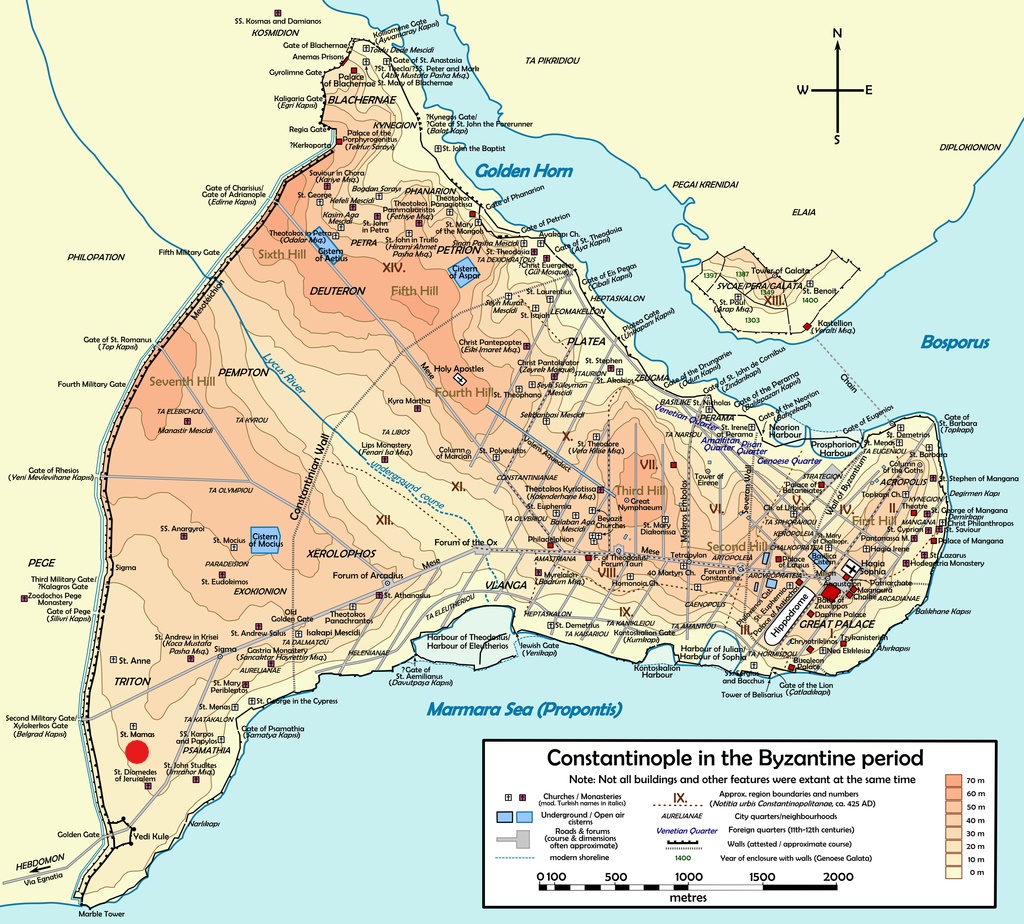
City of Constantinople of the Eastern Roman Empire by Cplakidas w St. Mamas District of the Rhos (Red Dot)
BOOK THREE: THE SAGA OF PRINCE HELGI ‘ARROW ODD’ ERIKSON
A Novel By Brian Howard Seibert
© Copyright by Brian Howard Seibert
WRITER’S UNCUT EDITION
(Contains Scenes of Violence and Sexuality Consistent with the Viking Period)
(May be Offensive to Some)
CHAPTER THIRTY TWO
32.0 THE SIEGE OF CONSTANTINOPLE OF 907 or T.B.B.T.N.W.
“When I was working in Gurguri, Pakistan, installing and starting
up a gas plant I had designed and built in Canada, the Pakistani
engineers who were helping called the local Pashtun people
Germans. I asked them why they would call the Pashtuns Germans?
They said it was because the Pashtuns were offspring of the army
of Alexander ‘the Great’. Perhaps Emperor John Tzimiskes of
Constantinople, but originally of Armenia, was also referring to the
Pashtuns or Hazaras of Afghanistan as Germans. Interestingly,
the gas plant had been purchased by Magyar Oil Limited (MOL)
of Hungary, the offspring of the same Magyars that had blocked
the Dnieper River off from Prince Erik of Gardariki.”
Comment on: ‘The History of Leo ‘the Deacon’ as read by B H Seibert
(907 AD) “I remember when I was a boy,” Oddi said loudly, as his longship’s prow cut through Scythian (Black) Sea waves, “and you gave me Fair Faxi. Uncle Roller shit himself.”
“Good thing he was wearing his brown britches!” Erik shouted back and they both laughed.
“Roller ‘Bruinbrok’, son of Ragnar ‘Lothbrok’,” Oddi shouted back. They hadn’t seen each other in a while. They were both busy building up the Hraes’ Trading Company and it had grown, so much so, that the Romans were alarmed and cancelling orders and changing treaty conditions. It had been many years since they had both sojourned to Constantinople, Oddi via the Mediterranean route and Erik via the Scythian whale road.
“I’m not sure why it bothered him so much,” Oddi said, not quite as loudly.
“I guess he looked at it as a generational passing thing. Time slipping away from us all. Or perhaps he already suspected that you were my son and saw it as me passing along the curse?”
“So why didn’t you want to ride with the cavalry?” Oddi asked his father, changing the subject.
“Even when I was young, it was Frodi or Roller who would lead the cavalry troops on the flanks and I would lead the warriors and fight in the shield wall right up the middle. I don’t mind horses….they have a leg on each corner and all, but today’s dragon ship has forty-eight legs and wings with which to catch wind as it travels over the waves.”
“And the dragon breathes fire!” Oddi laughed.
“Only the Greek dragons!” Erik laughed.
As they camped on the shore that evening, Oddi asked his father to recount the tale of how his father, Ragnar ‘Lothbrok’, had gotten those shaggy breeches he was wont to wear. It had been ages since Prince Erik had sat around a fire and told stories of old, but he was still, at last reckoning at least, a skald, so, as his lieutenants gathered round and the ale started flowing, he began his story:
“Ragnar ‘Lothbrok’ wasn’t the first to reopen the Nor’Way after the world-wide cooling had ended. He hadn’t even planned on being a part of it. He had promised Princess Aslaug ‘Kraka’ Sigurdsdottir that he would slay a fire-breathing dragonship in return for her hand in marriage. Now, he didn’t have the name Ragnar ‘Lothbrok’ when he went south into Scythia, but was called Gunnar when he sailed to the Kingdom of the Volsungs. They were informed by an Arab in the House of Lanterns that the Romans were sending the Khazars a hoard of gold, the Red Gold Hoard of Byzantium, with which to build a fortress on the Don River to choke off Nor’Way trade. He was told that the gold hoard was on board a Byzantine bireme and the ship was equipped with Greek fire. He was also instructed on how to attack such a fire breathing dragon ship. And in exchange for this information, he had only to keep a small red book secure in his northern lands, as far from civilization as possible. And to help him with this endeavour, he was assigned a Magi named Jarl Brak of Damascus, a Guild trained steel smith of some renown. He spoke old Norse, having lived with Goths on the Scythian Sea coast, and he knew Greek fire, having been in the Alchemists’ guild responsible for supplying the Romans with that science in the first place. He also had several barrels of a certain type of sour wine, a special type of vinegar. A half dozen Viking longships sailed across the Scythian Sea and up the Sea of Azov to the mouth of the Don River where their pace slowed as they had to row and keep watch for the Roman bireme. They had been supplied with sheepskin rawhide awnings for one of the Viking longships, Gunnar’s ship, and rawhide breeches and coats for the men of that ship, Gunnar’s men, who were all berserks. A week up the Don found them nearing a clearing and a quay at which were tied several merchant ships and Greek biremes so, they snuck past them and hid in creeks and waited for the arrival of the Roman fire-breather.
“When they saw it coming up the Don they prepared to intercept. Gunnar and his men set up their awnings while Brak poured his vinegar all over the hairs of the hides as they progressed. He did the same to their shaggy breeches and coats as they donned their gear and tied hides over their shields. When they attacked the fire-breathing dragonship it belched out a fiery flame with a thunderous roar of ‘Hraaaeee,’ and a huge stream of flaming liquid arced out over the waters and missed their longship. As they neared, the captain of the Roman bireme fired again and another stream of fiery flames shot forth and hit the wine soaked sheepskin awnings and the flames rolled off of the awnings and burned and boiled atop the waters. The captain of the fire breather threw his helmet down on the deck in anger and prepared his ship to be boarded. “Gunnar’s berserks bit their Linden shields and went into their furies as Gunnar leapt upon the top strakes of his ship’s forestem and bellowed out “Hraaae” in a great roaring voice as the rage overtook him. A few short strokes and the longship was cutting through the bireme’s portside bank of oars. When it came to a stop, the Vikings threw up grappling hooks and lashed the ships together. They then boarded the bireme and fell into combat with the Roman marines on the deck. They were all in their berserk furies by then and Gunnar led them forward in a great cutting swath across the deck. Roman soldiers were being mowed down right and left as the berserks rampaged both forward and aft. Gunnar faced off against the Roman captain on the foredeck of the galley right by the firing tube. Although the captain was well armed and armoured, Gunnar made short work of him. Soon the deck was cleared and when they went below deck they found the hoard of gold. They also found sixty slaves chained to their rowing benches. The Orthodox Christians were against slavery, or so they claimed, but they always seemed to find enough criminals in Constantinople to power their fleet.
“Our forefathers called the hoard the Red Gold Hoard of Byzantium, because the Roman Emperor had debased the gold with copper and it gave the gold a reddish hue and they called Gunnar, Hraegunar because he had imitated the roar of the fire breathing dragonship and ‘Lothbrok’ because the shaggy breeches were all that survived of his clothing during the battle. The prename was added to Ragnar’s sons’ names, making my name Erik, Hraerik in honour of my father.
“They soon learned that the red gold was cursed. The Roman Emperor had added enough copper to his gold to give it a red hue, and that warned all that the red gold was the Emperor’s gold. He added the copper to gold he was transporting to discourage theft as only Roman science and the Alchemists Guild knew how to get the copper back out at the other end of the journey. So, Ragnar kept the Red Gold Hoard locked up in a cave at Hraegunarstead, so that none of his men would try to spend the gold in Constantinople and wind up executed by the Romans for having stolen gold of the Emperor in their hands. I spent many years prizing the secret of getting copper out of gold from the Alchemists Guild in Baghdad, so many years, that I ended up becoming an Alchemist. That is why there are so many Guilds in Gardariki. I took the copper out of the Red Gold Hoard and I spent the gold in Constantinople buying marble and glass and chariots and built a city for my wife, Princess Gunwar.”
When the huge Hraes’ fleet arrived at Constantinople, they found a small Roman fleet hunkered in the Golden Horn, a long narrow port that stabbed inland up the eastern side of the city, protected by a huge chain across its mouth that kept ships from attacking them. Prince Erik’s spies had told him that the main Roman fleet was out fighting on the Mediterranean and the Norwegian, Danish and Norman cavalry units provided by Duke Rollo of Normandy arrived from that direction a few days later. The Duke, however, being old and newly married, chose not to come himself.
“How are we to capture the city?” Oddi asked Erik.
“And why would you want to capture Constantinople? Will it help our Southern Way trade?”
“Why…no. It would likely hurt it.”
“So, what exactly do we really want?”
“We want a trade agreement that works for us.”
“We want them to see things our way, not their way, so we have to do something to make them see things differently, from a different perspective.”
“How do we do that?”
“Well….right now they see their city as impregnable, its weakest point being the main city gate, but their little fleet protects the gate safe behind that chain across the Golden Horn. If we neutralize that little fleet, we shall shift their perspective.”
“And how do we put their little fleet on ice?” Oddi asked.
“I shall leave that up to you, King Odd of Tmutorokan,” Erik answered. “But I will give you a hint,” he added. “Essoupi.”
“Essoupi?”
“Yes….Essoupi.”
Oddi thought about it for a full day then sent cavalry units out into the surrounding farms and estates to pillage. They loaded livestock and valuables onto the farmers’ heavy wains and wagons and drove them into the shoreline camp of the Hraes’ fleet. The goods were loaded onto ships, the livestock fed the troops and the wagons were modified to transport the small Nor’Way longships overland, just as some ships were portaged around a rapid of the Dnieper River called Essoupi. Two weeks of pillaging and modifications led to two hundred Nor’Way ships being portaged from their shoreline anchorages through the surrounding village roads to the northern end of the Golden Horn port, thus bypassing the chain that barred the southern end of the port from the sea. As the ships slipped into the water from the streets leading up to the port, the Roman fleet was caught by surprise. The plundered livestock had provided rawhide awnings and garments for all the Nor’Way ships and teams of medical alchemists supervised the soaking of the hides with vinegar prior to the ships slipping into the waters. Erik had been experimenting with the idea of attaching teams of medical alchemists with the army and the fleet. The intent was to save lives after the battle, but here the attempt was to save lives during the battle by protecting the troops from the terror of Greek fire. But their efforts were wasted because all the fire breathing biremes were at the other end of the fleet, facing the chained off sea, and in the congested harbour, they had no way of getting to the Hraes’ fleet that was attacking their rear. The Nor’Way longships drove the Byzantine biremes away from the main gates of the city and a longship called Fair Faxi was tied off at the main quay of the gates. Oddi leapt onto the dock and extended a hand to his father as he stepped over the top strake.
“That takes me back, son,” Erik said. “I remember helping Princess Alfhild over the top strake when I first won this ship from her father, King Gotar.” Erik tried to count the decades mentally, but the troops were surrounding their leaders in a shield wall, a Roman turtle, as they progressed up the quay. Oddi nailed a shield to the left gate and Erik tacked the vellum list of their demands, written in his best Greek, onto the shield. The rest of the Varangian fleet kept the Byzantine fleet hemmed in at the south end of the port while Fair Faxi was sailed off to the north end of the port and was portaged back to the main Hraes’ camp.
The next day Erik and Oddi returned to the quay of the main gates and found a treaty tacked to the shield still nailed upon the left gate. Two camp chairs were carried to the main gates and Erik and Oddi sat and went through the details of the treaty, which was written in both Latin and Greek, as the shield turtle sheltered them from the sun. Erik crumpled up the Latin documents, even though he was more fluent in reading that language and he perused and signed the Greek documents. The Greek held more significance to him, as learning to read the language had saved his life when he had been forced to escape the Romans through the Eastern Frankish Empire, again, so many decades before. He then passed one copy of the treaty to Oddi, who tacked it to the shield upon the gate.
The treaty provided for twelve grivna per rowlock for the two thousand ships that were participating in the campaign, five hundred dragonships, five hundred Nor’Way ships and a thousand merchant monoxylan that had arrived for trade prior to the signing. Special trading funds were to be set up by the Emperor for each major city of the Hraes’: Kiev, Chernigov, Pereiaslav, Polotsk, Rostov, Liubech and “others”, the others being Tmutorokan, Atil-Kazaran and Bulghar, typically cities involved in Nor’Way trade. These funds would provide food, lodging and baths for all merchants from those cities while in Constantinople. They were allowed to enter the city in unarmed groups of up to fifty under the care of a Byzantine officer or Emperor’s merchant. Most importantly, all Hraes’ merchants were exempt from tithes or duties.
“Essoupi enough for you?” Oddi asked, as they returned to Fair Faxi.
“Essoupi enough,” Erik answered.
As they sailed back to the northern end of the harbour, Oddi marvelled at how his father had gone into enough details in his story of Ragnar ‘Lothbrok’ and the Red Gold Hoard to teach his lieutenants how to beat the fire breathing biremes of the Romans. He had once thought that his uncle, King Roller, was the wisest king he had ever met. He knew now that his father, Prince Erik, was the wisest kagan-bek. As they portaged back to the Hraes’ camp he looked out upon the Port of the Golden Horn and he wondered what would have happened if the fire breathing dragons had been facing in the right direction. The hroar of the Greek fire tubes, and the great flames spewing, out across the waters, ships alight, warriors burning, the tales that would have grown out of that battle. He shook his head. Of all the battles that never were, this was definitely The Biggest Battle That Never Was.
But there still had been a bit of a fight and, once they were back in the main camp, Erik gave Oddi a tour of the hospital that had been set up by the Medical Alchemists’ Guild. An estate had been commandeered and its many rooms were filled with the wounded and dying, but, more importantly, the saved. Battling head to head with three foot long razor sharp swords, it came as no surprise that severed limbs made up a large proportion of injuries during battles. Field medical teams were established to use nooses to cut off loss of blood from the injured limbs of warriors and get them to field stations equipped with hot irons for cauterizing wounds. Once injuries were stabilized, the patient was transferred to the field hospital for recovery. The medical alchemists were already developing prosthetics to hold shields or ride horses with to compensate for missing arms and legs. And Erik had plans to establish special centuriatas of amputee warriors retrained to fight again. Good Varangians were in short supply and losing them to a lopped off hand or a severed foot was not a price The Prince was willing to pay.
Oddi and his men returned to Gardariki, while Erik and his forces returned to Kiev. The cavalry force that Duke Rollo of Normandy had sent decided to stay in Constantinople and serve the Emperor as mercenaries and they joined the Varangian Guard, even though, technically, having come by way of the Mediterranean, they were not Varangers, Way Wanderers.
When Prince Erik got back to Kiev, young Prince Igor was walking and his mother, Princess Eyfura, was doting over him while she monitored the training of her grand-daughter, Hervor. Normally a young woman her age would have been trained in sewing and singing and playing a harp or lute, but she was being trained in archery and sword fighting, horse riding and sailing, the craft of warriors. And she was very adept at it. Training rigorously, her lithe form grew strong and well-muscled. Her auburn hair was constantly tied back, and she often wore a man’s brimmed hat and passed herself off as a warrior. She drank and she fought and she sometimes killed. People around her began to fear her and they complained to their Polis officers, but Princess Eyfura always stood by her and protected her.
CHAPTER THIRTY THREE
33.0 THE TREATY OF 911 or THE WAKING OF ANGANTYR
Hervor said:
You give me a lie ! So the gods do cry
resting whole in your howe your bones piled
atop Tyrfingr; and unwilling you are
to give the heirloom to your child.
Even though child, with your mother plot wild,
a revenge on the bane of your brothers.
One survivor doth claim you deprived him of fame,
by baring your breast to the other.’
Angantyr answered:
” Beneath my back is laid the bane of Hjalmar,
All around it enwrapped in fire;
In the world walking no woman know I
Who would dare in her hand to hold this sword?
The Ghost of Angantyr; Arrow Odd’s Saga
(911 AD) Four years after the Treaty of 907, Erik and Oddi once more led a fleet against the Eastern Romans. This time it was a show of force. Heavily armed longships accompanied the spring throng of merchants heading for trade in Constantinople. The longships waited on the Bosporos while the merchant ships carried on with their trade in the city. The full Roman fleet was home and on manoeuvres around the Golden Horn, so there was much belching of Greek fire and a number of target ships were burned in warning. The Varangian Guard came out from behind the city walls to warn the Hraes’ to respect the existing treaty, but they ended up drinking and celebrating with the Hraes’ troops. The standoff carried on for several weeks until, eventually, a large number of Hraes’ merchants and sailors were released from Roman custody.
The previous year’s trade was marked by numerous storms on the Bosporus and the Scythian Sea and a number of Hraes’ merchant ships sank or broke up on reefs and the survivors were often captured and enslaved by the Greeks and forced to work off their ‘saviour debt’ by rowing in the bellies of Roman biremes and triremes. Varangians were prized as ‘debtors’ because they were born to the oar, and spent most of their lives rowing, and a trireme full of Varangers was the fastest warship on the seas. So, the Roman Hraes’ Treaty of 907 became a fuller, more encompassing Treaty of 911, that included maritime laws protecting the rights of stranded and injured sailors and merchants of any nation. Strand laws more favourable to those being shipwrecked were implemented, as well as mutual laws in the handling of crimes. Asylum laws were also included granting rights of civil protection.
Once the treaty was concluded, Prince Erik returned to Kiev, but had extracted a promise of a visit from his son. King Oddi had been mulling over a return to Hrafnista via the Nor’Way, with perhaps a stop in Giantland along the way, followed by stops in York and Dub-Lin and Rouen and then perhaps even a stop in Stavanger Province to visit Hraegunarstead and Berurjod and perhaps even the Newfoundland before an extended visit with his father in Kiev.
Prince Erik told Princess Eyfura that he had convinced his son to visit him in Kiev on his return trip from the Nor’Way. Princess Eyfura told Hervor, “It is time.”
And Hervor said:
“As quick as you can equip me in all ways,
wisest of women, as you would your own son!
In dreams is told me the truth only;
No contentment shall I taste here now.”
A longship was secretly prepared for Hervor and manned by stout young warriors of Kiev. They sailed north up the Dnieper, past Chernigov to Smolensk, then portaged across to Surazh and were discharged into the Dvina. They continued north down the river, passing by Polotsk, and kept sailing all the way across the Baltic until they reached Zealand. It was late summer, so Hervor passed herself off as Captain Hervard, and she and her crew spent the winter in the harbour town that served the Royal City of Liere. She spent time in the round fortress of her great grandfather, King Frodi. Tales were still being told by skalds of a great battle upon the ice there and the fall of the House of Westmar. Newer poems were being forged of a great holmgangr fought on the Island of Samso between Hjalmar ‘the Brave’, representing Sweden, and his second, Arrow Odd, representing Norway, against Angantyr of Holmgard and his eleven brothers, serving King Frodi the Peaceful, and representing Denmark and Hraes’ in the east.
In late spring Hervor gathered up her crew and they sailed to Samso and arrived at Munarvag Bay one evening, just as the sun was going down. Fearing the spirits of that now infamous island, Hervor’s crew refused to leave their ship, so she had their four oared boat lowered into the water and she rowed herself to the beach of the bay. She could make out the great howe on the beach that Oddi had erected for his own men and further up on the land, just outside the woods, she saw the howe fires glowing of what looked like her relatives’ barrow.
A local farmer saw the warrior and shouted:
Who among mortals moves on the island?
Now flee you fast to find shelter !
Hervor replied:
Flee I will not to find shelter,
none do I know of the native people;
rather tell me ere we turn away:
where do the cairns lie called after Hjorvard?
Then the herdsman said:
Do not ask me — you are not wise !
Friend of Vikings, you are far astray;
fare us as fast as feet can bear us —
out in the open all is evil for men.
She answered:
We’ll not faint nor fear at such fire’s crackling,
though all the land be alight with flame;
men such as these who matter too small
to make us tremble– let us talk further !
He spoke:
Fool I call him who fares onward,
a man all alone in the murky night;
fires are moving, mounds are opening,
burns field and fen — let us faster run !
And the farmer ran off home. Hervor saw where the barrow fires burned and she followed the flames to the howe of her ancestors, ‘The Barrow of the Berserks’.
Then she spoke:
Wake, Angantyr, wakes you Hervor,
Svafa’s offspring, your only daughter;
the keen-edged blade from the barrow give me,
the sword dwarf-smithied for Sigrlami.
Hervard, Hjorvard, Hrani, Angantyr !
From the roots of the tree I arouse you all,
with helm and corselet, keen-edged weapon,
gear and buckler and graven spear.
All but to dust have Arngrim’s children,
men of evil, in the mound been turned,
if of Eyfura’s sons no single one
to me will speak in Munarvag.
Hervard, Hjorvard, Hrani, Angantyr !
May it seem to you all within your ribs
as if in mound of maggots you mouldered away,
if you fetch not the sword forged by Dvalin;
it becomes not ghosts costly arms to bear.
Then Angantyr answered her:
Why do you hail me, Hervor, daughter?
To your doom you are faring filled with evil !
Mad you are now, your mind darkened,
when with wits wandering you wake the dead.
No father nor kinsman in cairn laid me;
It was our banes who laid us in this barrow,
they kept Tyrfingr, the two survivors –
one alone did wield it after.
Hervor answered:
You give me a lie ! Even the gods cry
resting whole in your howe your bones piled
atop Tyrfingar; and unwilling you are
to give the heirloom to your child.
Even though child, with your mother plot wild,
a revenge on the bane of your brothers.
One survivor doth claim you deprived him of fame,
by baring your breast to the other.’
With those words the barrow opened, and Angantyr spoke angrily:
Hel’s gate is lifted, howes are opening,
the isle’s border ablaze before you;
grim outside now to gaze around you –
to your ships, if you can, quick now, maiden !
She answered:
No blaze can you light, burning in darkness,
that your funeral fires should with fear daunt me;
unmoved shall I remain the maiden’s spirit,
though she gaze on a ghost in the grave-door standing.
Then Angantyr said:
I tell you, Hervor — hear my words out ! –
what shall come to pass, prince’s daughter:
trust what I tell you, Tyrfingr, daughter,
shall be ruin and end of all your family.
You shall bear offspring who in after days
shall wield Tyrfingr and trust in his strength;
by the name Erik known to his people,
born the strongest beneath the sun’s curtain.
Then Hervor said:
A human indeed I was held to be
ere I came hither your hall seeking;
hater of mailcoats from the mound give me,
peril to bucklers bane of Hjalmar !
Angantyr answered:
Beneath my back is laid the bane of Hjalmar,
All around it enwrapped in fire;
In the world walking no woman know I
Who would dare in her hand to hold this sword?
Then Hervor said:
I will guard it and grasp it in hand,
The keen-edged sword, can I but obtain it;
No fear have I of the fire burning;
The flame grows less as I look towards it.
Angantyr answered:
Fool you are, Hervor, in your heart’s daring,
With eyes open to enter the fire !
The blade from the barrow I will bring, rather;
O young maiden, I may not refuse you.
Hervor answered:
Son of warriors, you do well in this,
The blade to me from the barrow yielding;
king, to keep it I count it dearer
than were all Norway beneath my hand.
Angantyr spoke:
You see it not — you’re in speech accursed,
woman of evil ! — why you’re rejoicing;
trust what I tell you, Tyrfingr, daughter,
shall be ruin and end to all your family.
Hervor spoke:
I will go my way to the wave horses,
chieftain’s daughter, cheerful hearted;
I care not at all O king’s companion,
how my sons will strive hereafter.
Angantyr spoke:
You shall keep Tyrfingr with contentment long;
the bane of Hjalmar in hiding (sheathed) keep;
touch not the edges — in each is poison;
worse than deadly, doom-bringer to men.
Farewell, daughter ! fain would I give you
twelve heroes’ lives — trust what I tell you ! –
the goodly strength and strong endurance
that Arngrim’s sons left after them.
And now Hervor said:
May you all lie unharmed in the howe resting –
to hasten hence my heart urges;
I seemed to myself to be set between worlds,
when all about me burnt the cairn fires.
Hervor went down to the beach and curled up in a fur in her four oared boat and held Tyrfingr close to her breast. With dawn came her longship, with a soft drawn-out scud, into the sand of the beach. She showed her crew the hilts of Tyrfingr and pulled the sword free of the sheath and, in morn’s waxing light, some could make out a glow along the blade’s edges and some could not. She sheathed the sword, they loaded up the boat and sailed back to the port town that serviced Liere. With the last of the gold that her grandmother had given her, Hervor bought their supplies for the long trip back to Kiev. It was summer’s end before Hervor’s ship slunk into a quay of the city.
“We must be patient,” Princess Eyfura told Hervor. “Whenever it is that Arrow Odd returns to Kiev, you must cut him with the blade and let the poison do the work. The bones of my son, your father, have kept the poison trapped within the blade, so it is stronger now than ever, thus, even in death, Angantyr shall play a part in avenging his brothers. We do not want to kill Oddi. Any blade could do that. But the poison in this blade has been paid for by the blood of your father. It is imperative that the poison of the blade, the blood of Angantyr, kill Oddi.”
Chapter 34.0: THE PROPHESY OF ARROW ODD of BOOK 3: THE SAGA OF PRINCE HELGI ‘ARROW ODD’ ERIKSON shall follow on next Post.
Note: This website is about Vikings and Varangians and the way they lived over a thousand years ago. The content is as explicit as Vikings of that time were and scenes of violence and sexuality are depicted without reservation or apology. Reader discretion is advised.
The VARANGIANS / UKRAINIANS or The Nine Books of Saxo’s Danish History Per Brian Howard Seibert
BOOK ONE: The Saga of King Ragnar ‘Lothbrok’ Sigurdson
King Ragnar ‘Lothbrok’ Sigurdson’s third wife, Princess Aslaug, was a young survivor of the Saga of the Volsungs and was a daughter of King Sigurd ‘the Dragon-Slayer’ Fafnirsbane, so this is where Ragnar’s story begins in almost all the ancient tales (except Saxo’s). In our series, we explore this tail end of the Volsungs Saga because King Sigurd appears to be the first ‘Dragon-Slayer’ and King Ragnar ‘Lothbrok’ would seem to be the second so, it is a good opportunity to postulate the origins of Fire Breathing Dragons and how they were slain. King Ragnar would lose his Zealand Denmark to the Anglish Danes of Jutland, who spoke Anglish, as did the majority of Vikings who attacked England, which spoke both Anglish and Saxon languages, sometimes mistakenly called a common Anglo-Saxon language. The Angles and Saxons of England never really did get along, as shall be demonstrated in the following books. King Ragnar assuaged the loss of Zealand by taking York or Jorvik, the City of the Boar, in Angleland and Stavanger Fjord in Thule from which he established his Nor’Way trade route into Scythia.
BOOK TWO: The Saga of Prince Erik ‘Bragi’ Ragnarson
Book Two of the Nine Book The Varangians / Ukrainians Series places The Saga of Prince Erik ‘Bragi’ Ragnarson from Book Five of The First Nine Books of the Danish History of Saxo Grammaticus (c. 1200 AD) about King Frodi ‘the Peaceful’ into its proper chronological location in history. In 1984, when I first started work on the book, I placed Prince Erik’s birth at circa 800 CE, but it has since been revised to 810 CE to better reflect the timelines of the following books in the series. Saxo had originally placed the saga at the time of Christ’s birth and later experts have placed the story at about 400 CE to correspond with the arrival of the Huns on the European scene but, when Attila was driven back to Asia, the Huns didn’t just disappear, they joined the Khazar Empire, just north of the Caspian Sea, and helped the Khazars control the western end of the famous Silk Road Trade Route. Princes Erik and Roller, both sons of Ragnar ‘Lothbrok’, sail off to Zealand to avenge their father’s loss, but Erik falls in love with Princess Gunwar, the sister of the Anglish King Frodi of Jutland and, after his successful Battle Upon the Ice, wherein he destroys the House of Westmar, Erik marries Gunwar and both brothers become King Frodi’s foremost men instead, and the story moves on to the founding of Hraes’ and Gardar Ukraine.
BOOK THREE: The Saga of Prince Helgi ‘Arrow Odd’ Erikson
Book Three, The Saga of Prince Helgi ‘Arrow Odd’ Erikson, recreates Arrow Odd’s Saga of circa 1200 AD to illustrate how Arrow Odd was Prince Helgi (Oleg in Slavic) Erikson of Kiev, by showing that their identical deaths from the bite of a snake was more than just coincidence. The book investigates the true death of Ragnar ‘Lothbrok’ by poisoned blood-snakes in York or Jorvik, the ‘City of the Boar’, and how his curse of ‘calling his young porkers to avenge the old boar’ sets up a death spiral between swine and snake that lasts for generations. The book then illustrates the famous Battle of the Berserks on Samso, where Helgi ‘Arrow Odd’ and Hjalmar ‘the Brave’ slay the twelve berserk grandsons of King Frodi on the Danish Island of Samso, setting up a death struggle that takes the Great Pagan Army of the Danes from Denmark to ravage Norway and then England and on to Helluland in Saint Brendan’s Newfoundland. A surprise cycle of vengeance manifests itself in the ‘death by snakebite’ of Helgi ‘Arrow Odd’.
BOOK FOUR: The Saga of Prince Ivar ‘the Boneless’ Erikson
Book Four, The Saga of Prince Ivar ‘the Boneless’ Erikson, reveals how Ivar ‘the Boneless’ Ragnarson was actually Prince Eyfur or Ivar (Igor in Slavic) Erikson of Kiev and then King Harde Knute ‘the First’ of Denmark. By comparing a twenty year lacuna in the reign of Prince Igor in The Hraes’ Primary Chronicle with a coinciding twenty year appearance of a King Harde Knute (Hard Knot) of Denmark in European Chronicles, Prince Igor’s punishment by sprung trees, which reportedly tore him apart, may have rather just left him a boneless and very angry young king. Loyal Danes claimed, “It was a hard knot indeed that sprung those trees,” but his conquered English subjects, not being quite as polite, called him, Ivar ‘the Boneless’. The book expands on the death curse of Ragnar ‘Lothbrok’ and the calling of ‘his young porkers to avenge the old boar’ when Ivar leaves his first son, King Gorm (Snake) ‘the Old’, to rule in Denmark and his last son, Prince Svein (Swine) ‘the Old’ to rule in Hraes’, further setting up the death spiral between the swine and snake of the ‘Lothbrok’ curse.
BOOK FIVE: The Saga of Prince Svein ‘the Old’ Ivarson
Book Five, The Saga of Prince Svein ‘the Old’ Ivarson, demonstrates how Prince Sveinald (Sviatoslav in Slavic) ‘the Brave’ of Kiev was really Prince Svein ‘the Old’ Ivarson of Kiev, who later moved to Norway and fought to become King Sweyn ‘Forkbeard’ of Denmark and England. But before being forced out of Russia, the Swine Prince sated his battle lust by crushing the Khazars and then attacking the great great grandfather of Vlad the Impaler in a bloody campaign into the ‘Heart of Darkness’ of Wallachia that seemed to herald the coming of the Four Horsemen of the Apocalypse and included the famed 666 Salute of the Army of the Impalers. The campaign was so mortifying that the fifteen thousand pounds of gold that the Emperor of Constantinople paid him to attack the Army of the Impalers seemed not nearly enough, so Prince Svein attacked the Eastern Roman Empire itself. He came close to defeating the greatest empire in the world, but lost and was forced to leave Hraes’ to his three sons. He returned to the Nor’Way and spent twelve years rebuilding Ragnar’s old trade route there.
BOOK SIX: The Saga of Grand Prince Valdamar ‘the Great’ Sveinson
Book Six, The Saga of Grand Prince Valdamar ‘the Great’ Sveinson, establishes how Grand Prince Valdamar (Vladimir in Slavic) ‘the Great’ of Kiev, expanded the Hraes’ Empire and his own family Hamingja by marrying 700 wives that he pampered in estates in and around Kiev. Unlike his father, Svein, he came to the aid of a Roman Emperor, leading six thousand picked Varangian cataphracts against Anatolian rebels, and was rewarded with the hand of Princess Anna Porphyrogennetos of Constantinople, a true Roman Princess born of the purple who could trace her bloodline back to Julius and Augustus Caesar. She was called ‘Czarina’, and after her, all Hraes’ Grand Princes were called ‘Czars’ and their offspring were earnestly sought after, matrimonially, by European royalty.
BOOK SEVEN: The Saga of King Sweyn ‘Forkbeard’ Ivarson
In The Saga of King Sweyn ‘Forkbeard’ Ivarson, Prince Svein anonymously takes the name of Sweyn ‘Forkbeard’ in Norway and befriends the Jarls of Lade in Trondheim Fjord in Norway as he expands the Nor’Way trade route of his grandfather, Ragnar ‘Lothbrok’. He had come close to defeating the Eastern Roman Empire, and still felt that he was due at least a shared throne in Constantinople. He used the gold from the Nor’Way trade to rebuild his legions and his Hraes’ cataphracts and though his brother, King Gorm ‘the Old’, was dead, his son, Sweyn’s nephew, King Harald ‘Bluetooth’ Gormson had usurped the throne of Denmark and had hired the famed Jomsvikings to attack Prince Sweyn in Norway, setting up the famous Battle of Hjorungavagr in a fjord south of Lade. King Sweyn ‘Forkbeard’ would emerge from that confrontation and then he would defeat King Olaf Tryggvason of Norway in the Battle of Svolder in 1000 AD, in an engagement precipitated over the hand of Queen Sigrid ‘the Haughty’ of Sweden. Later he attacked England in revenge for the following St. Brice’s Day Massacre of Danes in 1002 AD and he fought a protracted war with the Saxon King Aethelred ‘the Unready’ that could only be described as the harvesting of the English for sale as slaves in Baghdad and Constantinople. With the help of his son, Prince Valdamar of Kiev, and the legions and cataphracts of Hraes’, he conquered England on Christmas Day of 1013, but victory was not kind to him.
BOOK EIGHT: The Saga of King Canute ‘the Great’ Sweynson
Prince Valdamar ‘the Great’ Sveinson of Kiev, who had supported his father, King Sweyn ‘Forkbeard’ of Denmark in attacks upon England left his ‘Czar’ sons in charge of Hraes’ and took over as King Valdamar of England, but the Latin Christian English revolted against his eastern name and Orthodox Christian religion and brought King Aethelred back from exile in Normandy and Valdamar had to return to Hraes’ and gather up the legions he had already sent back after his father’s victory. His half brother was ruling in Denmark and his sons were ruling in Hraes’ so, in 1015 AD Grand Prince Valdamar ‘the Great’ of Kiev was written out of Hraes’ history and in 1016 the Latin Christian Prince Canute ‘the Great’ returned to England to reclaim his throne. He defeated Aethelred’s son, King Edmund ‘Ironside’ of England, at the Battle of Assandun to become King Canute ‘the Great’ of England and later King Knute ‘the Great’ of Denmark and Norway as well. But that is just the start of his story and later Danish Christian Kings would call his saga, and the sagas of his forefathers, The Lying Sagas of Denmark, and would set out to destroy them, claiming that, “true Christians will never read these Sagas”.
BOOK NINE: The Saga of King William ‘the Conqueror’ Robertson
The Third Danish Conquest of Angleland was seen to herald the end of the Great Viking Manifestation of the Middle Ages, but this, of course, was contested by the Vikings who were still in control of it all. Danish Varangians still ruled in Kiev and Danes still ruled the Northern Empire of Canute ‘the Great’, for the Normans were but Danish Vikings that had taken up the French language, and even Greenland and the Newfoundland were under Danish control in a Hraes’ Empire that ran from the Silk Road of Cathay in the east to the Mayan Road of Yucatan in the west. “We are all the children of Ragnar ‘Lothbrok’,” Queen Emma of Normandy often said. Out of sheer spite the Saxons of England took over the Varangian Guard of Constantinople and would continue their fight against the Normans in Southern Italy as mercenaries of the Byzantine Roman Empire. They would lose there as well, when in the Fourth Crusade of 1204, the Norman Danes would sack the City of Constantinople and hold it long enough to stop the Mongol hoards that would crush the City of Kiev. It would be Emperor Baldwin ‘the First’ of Flanders and Constantinople who would defeat the Mongol Mongke Khan in Thrace. But the Mongols would hold Hraes’ for three hundred years and this heralded the end of the Great Viking Manifestation. The Silk Road was dead awaiting Marco Polo for its revival. But the western Mayan Road would continue to operate for another hundred years until another unforeseen disaster struck. Its repercussions would be witnessed by the Spanish conquerors who followed Christopher Columbus a hundred and fifty years later in the Valley of the Mound Builders.
Conclusion:
By recreating the lives of four generations of Hraes’ Ukrainian Princes and exhibiting how each generation, in succession, later ascended to their inherited thrones in Denmark, the author proves the parallels of the dual rules of Hraes’ Ukrainian Princes and Danish Kings to be cumulatively more than just coincidence. And the author proves that the Danish Kings Harde Knute I, Gorm ‘the Old’ and Harald ‘Bluetooth’ Gormson/Sweyn ‘Forkbeard’ were not Stranger Kings, but were Danes of the Old Jelling Skioldung Fridlief/Frodi line of kings who only began their princely careers in Hraes’ and returned to their kingly duties in Denmark with a lot of Byzantine Roman ideas and heavy cavalry and cataphracts.
 SeiberTeck: 'The Varangians Series'