THE SAGA OF PRINCE HELGI ‘ARROW ODD’ ERIKSON Has Been Added to The Site Under the New Heading The VARANGIANS / UKRAINIANS Book Series – The True History of ‘The Great Viking Manifestation of Medieval Europe’© and the below Post Covers CHAPTER THIRTY FOUR:
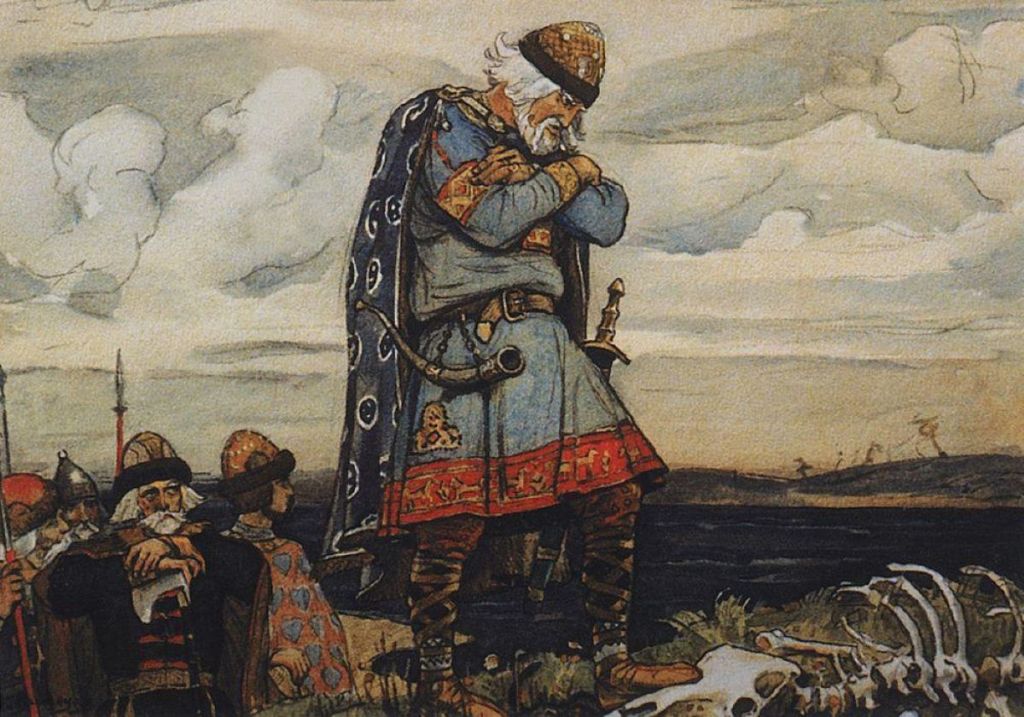
Prince Helgi (Oleg) ‘Arrow Odd’ Erikson’s Prophesy by Vasnetsov (1899)
BOOK THREE: THE SAGA OF PRINCE HELGI ‘ARROW ODD’ ERIKSON
A Novel By Brian Howard Seibert
© Copyright by Brian Howard Seibert
WRITER’S UNCUT EDITION
(Contains Scenes of Violence and Sexuality Consistent with the Viking Period)
(May be Offensive to Some)
CHAPTER THIRTY FOUR
34.0 THE PROPHECY OF ARROW ODD, Part One (Circa 911 AD)
‘It is remarkable what may be accomplished through witchcraft and enchantment. For on one occasion he (Helgi/Oleg) had made inquiry of the wonder-working magicians as to the ultimate cause of his death. One magician replied, “Oh Prince, it is from the steed which you love and on which you ride that you shall meet your death.” Oleg then reflected and determined never to mount this horse or even to look upon it again. So he gave command that the horse should be properly fed, but never led into his presence. He thus let several years pass until he had attacked the Greeks.’
Hraes’ (Rus’) Primary Chronicle
(911 AD) King Odd had been long settled in his kingdom, and he’d had a long life there, and he had two sons with his wife, Queen Silkisif. Asmund, the eldest, was named after Odd’s foster-brother, and the youngest was named Holmar after Silkisif’s father. They were both very promising young men. One evening, when Oddi and Silkisif went to bed, he slowly told her: “There is one place that I would like to go.”
“Where would you like to go?” Silkisif asked.
“I want to go north to Hrafnista,” he answered, “and I want to know who now holds the island, because I own it with my family and I have much wealth buried there.”
“I think,” she said, “you have enough wealth and property here. You have Gardariki and have won all Tmutorokan and can take other goods and countries that you want, and I think you should not worry about one small island in the north.”
“Yes,” he said, “that may be true, it may be that the island is worth little, but I have the treasures of many victories buried there and I wish to choose the ruler it will have, and you should not discourage me, because I have decided to go. I will only be away for a while.” The next day he sailed away in Fair Faxi, with a cargo knar following, and with forty picked and well-armed warriors aboard each, and they sailed up the Nor’Way to Hawknista and entered Giantland. He found the dwarf, Durin, there and had gifts for him.
“Prince Erik left to find aid in Constantinople,” Durin explained, “and when he didn’t return with his ship, Princess Gunwar thought the Romans must have killed him. She was pregnant with you at the time and she wanted to protect her lands for you.”
“I just wanted to thank you for helping her when she was so alone,” Oddi said.
“Don’t thank me,” the dwarf said, dejectedly. “I failed her. I failed Prince Erik, when he rushed back to Gardariki to save you and your mother; I lost the battle against the Huns on the Don Heath. The Hraes’ officers wouldn’t follow the orders of a dwarf. And I failed Princess Gunwar. She died fighting beside me, when Prince Hlod snuck up on the other side of her and pierced her with his golden lance. And now, I learn that I failed Brother Gregory as well. I should have helped him further, perhaps I could have saved him.”
“Still, you beat back Prince Hlod and recovered her body for the Christian burial she so wanted,” Oddi said encouragingly. “And The Prince and Duke Roller always speak fondly of you.”
“King Roller is a Duke now?”
“Yes. A Duke in Frankia. King Frodi pillaged Norway and set up a puppet king there, Harold Fairhair. Roller fled with me and now he is Duke Rollo of Normandy and is a good Christian, haunted only by my mother.”
“Princess Gunwar haunts King Roller?”
“She has her way with him whenever she wants something,” Oddi said, laughing. “And it’s mostly when she’s trying to save me!”
Durin joined him, laughing, “Those Christians! They’re taking over the spirit world as well.”
Oddi was glad that he was able to cheer up the dwarf somewhat. They parted great friends. Then Oddi returned to Hawknista and proceeded further north to Varg Island and entered the north of Giantland, leaving his men to wait on the isle for him.
Oddi learned that Hildigunn had taken his advice and married a giant and they had many children together. Hraegunhild was all grown up and married to a half giant and she had many children as well. King Hilder was old and ill. Giants didn’t seem to live as long. Oddi had gifts for all of them.
“You were right to have Hraegunhild with Hildigunn,” King Hilder told Oddi privately. “Hraegunhild has brought us both much happiness over the years. And she kept us both occupied until Hildigunn was ready for marriage. You have given us both much sage advice, and for that I thank you.”
When Oddi got back to Varg Island he learned from his terrified men that several young giant warriors had brought him another two chests full of gold Byzants and a silver cauldron full of Kufas but had covered them with a large flat stone. It took both ships crews to get the stone off of the gifts.
There is nothing more to be said about his journey until he came north to Hrafnista in Halogaland. His relatives welcomed Oddi there and they gave him a great banquet to greet him with and they gave him a fortnight of feasting. They invited him to rule over the island and all the property that belonged there. He gave them all the property he had kept there and would not stay there. He dug up all his treasures and shared much of the gold with his kin, then he prepared for his homeward journey, and the people brought him fine gifts. When they left, his men understood why he had taken two ships.
In Ireland, Queen Olvor and Hraegunhild were happy to see Oddi. His first child was married with children and some of her children had children.
“It makes me feel old just watching all of them,” Queen Olvor said. “Age doesn’t seem to touch you, Oddi, the way it seems to touch others.”
“I’ve never felt old,” Oddi confessed, getting up on his elbow and stroking Olvor’s silver blonde hair as she lay in bed. “Even my wounds haven’t bothered me. It takes longer for them to heal these days, but once they’re healed, it’s like I never had them, save the scars that is.”
“You’re blessed, Oddi. I remember taking your shirt off years ago when I was fitting you for your Roman scalemail shirt, your body was so beautiful, but so battle scarred. That’s when I fell in love with you. Now, it’s still beautiful, but some of your scars have scars. It’s like you’re immortal.”
“I’m not feeling that good,” Oddi laughed. “But my father, Prince Erik, is an alchemist and I’m starting to think he just may be immortal. I have silver in my blonde, but his hair is still Hrafn black. I guess he does have a bit of grey, but he still leaps into his saddle. You’re a healer, how is this possible?
“I did join the Healers Guild, as Princess Blaeja requested,” Olvor started, “but that’s medical alchemy. Your father is a Magi. He’s way up there in the ‘turns lead into gold’ alchemy, the talking to the Norns category. Anything is possible with the Alchemists Guild. But I did attend a Hraes’ Trading Company meeting in Rouen last year and your uncle, Rollo, is looking quite spry with his young wife and new baby. Perhaps it just runs in your family?”
“I’ll ask him,” Oddi replied, getting up, out of bed, “because that’s where I’m heading next.”
“Will you be stopping in at York as well?”
“Right after Rouen. Why?”
“Princess Blaeja has a surprise for you.”
“What is it?”
“I’m not supposed to tell.”
“Com’on, spill it,” Oddi prodded.
“Let’s just say…it’s a boy!”
“It is a boy,” Duke Rollo confirmed in Rouen. “But he’s a handsome young man now. You’ve been away quite a while. Hraegunhild is married with children. You’re a grandfather now!”
“People keep telling me that,” Oddi complained. “But she named our son Ragnar! She’s still afraid of the curse.”
“I’m sure she just named him after your grandfather.”
“And to try to keep her offspring clear of the curse. Kraka was quite clear that she considered Ragnar’s curse to be ongoing.”
“My mother, Kraka, God bless her soul,” and Rollo crossed himself, “should perhaps have kept that opinion to herself. But even if Princess Blaeja is trying to buy herself some extra blessings, then what’s the harm. It could be worse…she could have named him Prince AElla.”
“Don’t even say that,” Oddi said, looking over both his shoulders, first the left, then the right.
“See? It doesn’t hurt to be safer than sorry.”
Oddi spent a lot of time in Rouen visiting with his uncle and his new wife and baby. They all spoke in French around the Duke’s palace and Oddi found it a good opportunity to brush up in the language. He spent time in Paris, visiting with his foster-mother, Sister Saint Charles, and some time in Flanders visiting his brother, Baldwin. He wanted to go to Kiev just before spring trading got started, and Frankia seemed like a good place to overwinter. He didn’t have any children here, at least that he knew of.
“If you’re nervous about going to York to overwinter,” Duke Rollo started, “Princess Blaeja is still single and beautiful and, if things don’t work out, you can come back here.”
“It’s not that,” Oddi began, “well, it’s just that they’re grandmothers. I still found Queen Olvor very attractive, but I’m having sex with grandmothers. I think back to the days when I was raiding and battling slavers and Asmund and I were having sex with Gudrun and Sigrid. We’d have scared shitless sex before we headed out after those sea-king bastards and then we’d have thank the gods we’re still alive sex when we got back. And the people that we saved thought we were heroes and we’d have cook-outs for them on the beaches of The Vik and then we’d have more thank the gods sex. It was the worst of times and the best of times.” A servant brought more mead to the highseats. “I felt so young and alive. Now I’m having sex with grandmothers.”
“I know,” Rollo said. “I was there, and if I remember right, you’re the one that made them grandmothers. Well, mothers anyway. But that’s a necessary step in becoming a grandmother.”
“I know. I hold myself fully responsible. Do you know that, after you told me that Gudrun and Sigrid had been whisked off to Polotsk by their father, I stopped in at Polotsk, on my way to kill King Frodi, and told them to meet me in Gardariki when they got the chance. So, the two sisters show up at my longhall, looking hot as hell and we have this great threesome all night long and in the morning they tell me that they each have a son, one named Oddi, and one named Asmund, so I’m overjoyed because Asmund has a son, and me as well, of course, so I tell the girls that I want to meet them.” Oddi paused and quaffed some mead.
“Well, go on,” Rollo said, “don’t leave me hanging.”
“So I get invited to their father’s hall, expecting to meet some boys,” Oddi explained, “and I get there and these boys are each twenty four years old. I was just floored. I didn’t know what to say.” Oddi started laughing and Rollo joined in. “I had brought some boys games as gifts, I think it was Oddis and Knights, so I had to hide the gifts in my tunic and they were scratching my side the whole visit…” Oddi was laughing so hard he couldn’t get the words out. Rollo was laughing so hard he started choking on the mead. “And Gudrun and Sigrid had seen me hide the gifts and you’d think they would have helped, but no. And the next time we had sex, Gudrun played the Oddi and Sigrid played the Knight, and they wouldn’t stop. And they’re grandmothers now and we still fock. And I travel halfway around the world, and I’m still focking grandmothers!”
The young servant girl set a pitcher of mead between the highseats and fled the hall.
Oddi and his uncle drank late into the evening and the next day Oddi left for York.
As Oddi sailed up the Humber River and entered the mouth of the River Ouse, he noticed that he was being shadowed by cavalry units. He considered rowing back to the Humber, as it was a large river and afforded ships some security from land based attack that the smaller Ouse just could not. And both his ships were full of treasure. But he soon gathered, from the peace banners and the cheerful demeanor of the troops, that they were there to hail him, not bury him. He had his men row Fair Faxi towards the riverbank, but he directed his knar to remain centered in the river.
“Princess Blaeja sends greetings,” the cavalry officer shouted from the riverbank. “She has planned a welcoming banquet for you on your arrival.”
“Tell her we shall arrive tomorrow,” Oddi shouted.
“If you ride with us,” the officer started, “we can be in York tonight.”
“A Viking never leaves his ships behind!” Oddi shouted. ‘Especially when going to York,’ he thought.
“We shall ride ahead and tell the Princess you’ll arrive tomorrow,” the officer replied, and the troop rode off.
Oddi knew that Princess Blaeja controlled only her small corner of York which included Castle York, the Hraes’ Company Trading Station of York and a few surrounding streets and fields. The rest was controlled by various Northumbrian princes who were all allied with various southern Angle and Saxon kings. And he knew and trusted only Blaeja.
“I thought if I threw you a great welcoming banquet and royal reception,” Princess Blaeja explained, “then I could convince you to stay in my castle, instead of having me join you on your ship.” They were sneaking aboard Fair Faxi after the welcoming banquet and had both been drinking a bit too much to be overly stealthy in the darkness of night.
“Hjalmar’s rules,” Oddi said, as he gently lifted Blaeja over the topstrake.
“I’m glad that Fair Faxi still has two masts,” Princess Blaeja said, but Oddi had a puzzled look, so she added, “Your second mast was jabbing me in the ribs as you were lifting me.”
“It is the second mast that is hardest to control,” Oddi apologized, as he carried her under the awnings and placed her gently upon the bed.
“Let’s see what we can do about that hardness,” Blaeja offered, pulling Oddi onto the bed with her. It had been years since they’d been together, made love together. And the children of their past times together were still in the hall celebrating. Their daughter, Hraegunhild, was married with six children of her own and their son, Ragnar, was a young man in charge of all Hraes’ trading in Northumbria.
“What do you think of Ragnar?” Blaeja asked.
“He is a fine young man with a marked resemblance to yours truly,” Oddi answered. “But his name concerns me.” Oddi paused. “You’re still anxious about this curse thing and it worries me.”
“I have dreams,” Blaeja admitted. “Viking princes coming out of the east and having their way with the women of York and having their way with Angleland.”
“Are all you healers gifted?” Oddi asked. He took dreams very seriously.
“They aren’t nice like you are, Oddi,” Princess Blaeja said, sitting up and crying. Oddi sat up and held her in his arms. “And the last Viking prince,” she said, “the worst Viking prince, isn’t even from the east. He’s from Frankia.” Oddi held her, crying, for a long time.
“My father dreams of great kagans riding into Tmutorokan from the east with hordes of horsemen and they are all killers and rapists and slavers. He says the evil of King Frodi shall shine next to the darkness they shall bring.”
“Will they come here?” Princess Blaeja asked incredulously.
“No. He has plans to stop them.”
“How? How will he stop these terrible hordes?”
“He says sometimes our enemies are far better than the enemies that will replace them once they are defeated. So he works with our Khazar enemies, rather than crushing them, by giving them a working interest in the Nor’Way. He feels that they will hold back those hordes if they have as much to lose as we do.”
“He sounds like a very wise Prince,” Blaeja said, feeling better knowing she was not alone in her dreams. “No wonder he is a Grand Magi of the Alchemists.”
“Yes, I suppose he is,” Oddi replied, “but if this is what you believe the fates hold for your future, for our children’s future then you must prepare for the coming storm.”
“I have been. Why do you think our children’s names are Hraegunhild and Ragnar?”
“To insulate them from Ragnar’s curse?”
“Yes. And to expose them to Ragnar’s Hamingja, his luck.”
“You’re Christian,” Oddi stated. “You’re not supposed to believe in that.”
“When it comes to our children, I leave nothing to chance. I haven’t seen anything intelligent coming out of Christian mouths for a very long time. They are beginning to persecute our healers of the Alchemists Guild. In Frankia they are burning our medical alchemists as witches and are replacing medicines with prayer. People are dying from things as simple as a tooth ache, because their prayers are not being answered.”
“If it wasn’t for your healers guild, I’d be dead a few times over,” Oddi admitted.
“A plague broke out in Amarka and people refused to wear masks, claiming they are unholy, and praying to God for protection from foul ethers. They’re dying like flies there and our healers can’t speak up or they’ll be burned alive. It’s all quite sinful.”
“Not to change the subject,” Oddi whispered, “but I have a gift for you. Only if you have time,” he teased. He got out of bed and opened the doors on his raised quarterdeck and withdrew several packages. “Silks from Rouen,” he started, “and the latest fashions from Paris!” And Oddi began opening the gifts and showering Blaeja in silk as she knelt on the bed and bounced in glee. Oddi returned to the quarterdeck and withdrew a chest of gold Byzants and set it on the bed. “This is for you and the children,” he said as Blaeja pulled him onto the bed and into the silks.
In early spring, Oddi sailed straight from York to Hraegunarstead, in Stavanger Fjord. Then he told his men to reef the sails. Oddi went ashore with a group to where Ingjald’s farm, Berurjod, had been, and it was all a shambles and grown over with weeds. Norway still suffered from the damage that King Frodi had wrought. He looked the place over and said, “This is awful, a good farm should be in ruins like this, instead of the grand place it was before.” He told his men where he and Asmund had practiced archery all day and where they had gone swimming to cool off, and then he named off all the landmarks. They were heading out, going down to the bay, and everywhere around them the soil had been eroded. “I think that now hopes are fading that Heid’s prediction will ever happen,” Oddi said confidently, “as the old witch foresaw so long ago. But what is that, there?” Oddi asked. “What lies there exposed? Is that not a horse’s skull?”
“Yes,” his men agreed, “and extremely old and bleached, very big and all grey outside.”
“Do you think it could be the skull of Faxi?” Oddi asked and he pounded the skull with the steel butt of his spear. The skull suddenly turned all white against the black earth, but nothing crawled out from under it. Oddi flipped the skull over with the spear tip but there was no adder there. No serpent sprang forth and struck at Oddi. No snake bit his leg above the boot and no venom took him down. “That old witch Heid,” Oddi swore, “…she lied,” and he snatched up the skull of Faxi and carried it at his hip. When they got to their ships, Oddi nailed the skull atop the curlicue of the forestem of Fair Faxi. He would show his father how their curse had amounted to nothing. Then Odd returned to shore and stood upon a huge flat stone on the beach and said, “Now we must divide up into two groups. Forty men must stay here with the knar and the silver and rebuild Berurjod. And when King Harold Fairhair is dead, rebuild Hraegunarstead. Forty must come with me in Fair Faxi and help guard the gold until we reach Kiev and then Gardariki. I shall leave it up to you who shall stay and who shall go.”
Oddi had planned on visiting his wife, Watseka, and their children in the Newfoundland, but his Syphilis had returned over winter with lesions sometimes appearing on his honey dipper and he was experiencing bone pains in his shins and when he looked into his huge bronze mirror on Fair Faxi, he swore he could see that his nose was smaller and had lost some bone. Even weirder, his dreams came to him with a certain madness he found disturbing. In his dreams he saw King Frodi without his mask and his nose was gone and when he tore Warlock Ogmund ‘Eythjofsbane’s mask off, his nose was gone as well. It was unlikely that Frodi or Ogmund could have visited the Newfoundland without raping one or two dozen native women, so perhaps they had gotten the Greek disease too. And then the dreams told him that he was running out of time, that he wouldn’t make it to the Newfoundland and back and that it was time to head home. He even thought for a moment that he should sail straight past Kiev and not stop and visit his father there, that he would never make it home to Tmutorokan if he spent time there.
Chapter 35.0: THE PROPHESY OF ARROW ODD 2 of BOOK 3: THE SAGA OF PRINCE HELGI ‘ARROW ODD’ ERIKSON shall follow on next Post.
Note: This website is about Vikings and Varangians and the way they lived over a thousand years ago. The content is as explicit as Vikings of that time were and scenes of violence and sexuality are depicted without reservation or apology. Reader discretion is advised.
The VARANGIANS / UKRAINIANS or The Nine Books of Saxo’s Danish History Per Brian Howard Seibert
BOOK ONE: The Saga of King Ragnar ‘Lothbrok’ Sigurdson
King Ragnar ‘Lothbrok’ Sigurdson’s third wife, Princess Aslaug, was a young survivor of the Saga of the Volsungs and was a daughter of King Sigurd ‘the Dragon-Slayer’ Fafnirsbane, so this is where Ragnar’s story begins in almost all the ancient tales (except Saxo’s). In our series, we explore this tail end of the Volsungs Saga because King Sigurd appears to be the first ‘Dragon-Slayer’ and King Ragnar ‘Lothbrok’ would seem to be the second so, it is a good opportunity to postulate the origins of Fire Breathing Dragons and how they were slain. King Ragnar would lose his Zealand Denmark to the Anglish Danes of Jutland, who spoke Anglish, as did the majority of Vikings who attacked England, which spoke both Anglish and Saxon languages, sometimes mistakenly called a common Anglo-Saxon language. The Angles and Saxons of England never really did get along, as shall be demonstrated in the following books. King Ragnar assuaged the loss of Zealand by taking York or Jorvik, the City of the Boar, in Angleland and Stavanger Fjord in Thule from which he established his Nor’Way trade route into Scythia.
BOOK TWO: The Saga of Prince Erik ‘Bragi’ Ragnarson
Book Two of the Nine Book The Varangians / Ukrainians Series places The Saga of Prince Erik ‘Bragi’ Ragnarson from Book Five of The First Nine Books of the Danish History of Saxo Grammaticus (c. 1200 AD) about King Frodi ‘the Peaceful’ into its proper chronological location in history. In 1984, when I first started work on the book, I placed Prince Erik’s birth at circa 800 CE, but it has since been revised to 810 CE to better reflect the timelines of the following books in the series. Saxo had originally placed the saga at the time of Christ’s birth and later experts have placed the story at about 400 CE to correspond with the arrival of the Huns on the European scene but, when Attila was driven back to Asia, the Huns didn’t just disappear, they joined the Khazar Empire, just north of the Caspian Sea, and helped the Khazars control the western end of the famous Silk Road Trade Route. Princes Erik and Roller, both sons of Ragnar ‘Lothbrok’, sail off to Zealand to avenge their father’s loss, but Erik falls in love with Princess Gunwar, the sister of the Anglish King Frodi of Jutland and, after his successful Battle Upon the Ice, wherein he destroys the House of Westmar, Erik marries Gunwar and both brothers become King Frodi’s foremost men instead, and the story moves on to the founding of Hraes’ and Gardar Ukraine.
BOOK THREE: The Saga of Prince Helgi ‘Arrow Odd’ Erikson
Book Three, The Saga of Prince Helgi ‘Arrow Odd’ Erikson, recreates Arrow Odd’s Saga of circa 1200 AD to illustrate how Arrow Odd was Prince Helgi (Oleg in Slavic) Erikson of Kiev, by showing that their identical deaths from the bite of a snake was more than just coincidence. The book investigates the true death of Ragnar ‘Lothbrok’ by poisoned blood-snakes in York or Jorvik, the ‘City of the Boar’, and how his curse of ‘calling his young porkers to avenge the old boar’ sets up a death spiral between swine and snake that lasts for generations. The book then illustrates the famous Battle of the Berserks on Samso, where Helgi ‘Arrow Odd’ and Hjalmar ‘the Brave’ slay the twelve berserk grandsons of King Frodi on the Danish Island of Samso, setting up a death struggle that takes the Great Pagan Army of the Danes from Denmark to ravage Norway and then England and on to Helluland in Saint Brendan’s Newfoundland. A surprise cycle of vengeance manifests itself in the ‘death by snakebite’ of Helgi ‘Arrow Odd’.
BOOK FOUR: The Saga of Prince Ivar ‘the Boneless’ Erikson
Book Four, The Saga of Prince Ivar ‘the Boneless’ Erikson, reveals how Ivar ‘the Boneless’ Ragnarson was actually Prince Eyfur or Ivar (Igor in Slavic) Erikson of Kiev and then King Harde Knute ‘the First’ of Denmark. By comparing a twenty year lacuna in the reign of Prince Igor in The Hraes’ Primary Chronicle with a coinciding twenty year appearance of a King Harde Knute (Hard Knot) of Denmark in European Chronicles, Prince Igor’s punishment by sprung trees, which reportedly tore him apart, may have rather just left him a boneless and very angry young king. Loyal Danes claimed, “It was a hard knot indeed that sprung those trees,” but his conquered English subjects, not being quite as polite, called him, Ivar ‘the Boneless’. The book expands on the death curse of Ragnar ‘Lothbrok’ and the calling of ‘his young porkers to avenge the old boar’ when Ivar leaves his first son, King Gorm (Snake) ‘the Old’, to rule in Denmark and his last son, Prince Svein (Swine) ‘the Old’ to rule in Hraes’, further setting up the death spiral between the swine and snake of the ‘Lothbrok’ curse.
BOOK FIVE: The Saga of Prince Svein ‘the Old’ Ivarson
Book Five, The Saga of Prince Svein ‘the Old’ Ivarson, demonstrates how Prince Sveinald (Sviatoslav in Slavic) ‘the Brave’ of Kiev was really Prince Svein ‘the Old’ Ivarson of Kiev, who later moved to Norway and fought to become King Sweyn ‘Forkbeard’ of Denmark and England. But before being forced out of Russia, the Swine Prince sated his battle lust by crushing the Khazars and then attacking the great great grandfather of Vlad the Impaler in a bloody campaign into the ‘Heart of Darkness’ of Wallachia that seemed to herald the coming of the Four Horsemen of the Apocalypse and included the famed 666 Salute of the Army of the Impalers. The campaign was so mortifying that the fifteen thousand pounds of gold that the Emperor of Constantinople paid him to attack the Army of the Impalers seemed not nearly enough, so Prince Svein attacked the Eastern Roman Empire itself. He came close to defeating the greatest empire in the world, but lost and was forced to leave Hraes’ to his three sons. He returned to the Nor’Way and spent twelve years rebuilding Ragnar’s old trade route there.
BOOK SIX: The Saga of Grand Prince Valdamar ‘the Great’ Sveinson
Book Six, The Saga of Grand Prince Valdamar ‘the Great’ Sveinson, establishes how Grand Prince Valdamar (Vladimir in Slavic) ‘the Great’ of Kiev, expanded the Hraes’ Empire and his own family Hamingja by marrying 700 wives that he pampered in estates in and around Kiev. Unlike his father, Svein, he came to the aid of a Roman Emperor, leading six thousand picked Varangian cataphracts against Anatolian rebels, and was rewarded with the hand of Princess Anna Porphyrogennetos of Constantinople, a true Roman Princess born of the purple who could trace her bloodline back to Julius and Augustus Caesar. She was called ‘Czarina’, and after her, all Hraes’ Grand Princes were called ‘Czars’ and their offspring were earnestly sought after, matrimonially, by European royalty.
BOOK SEVEN: The Saga of King Sweyn ‘Forkbeard’ Ivarson
In The Saga of King Sweyn ‘Forkbeard’ Ivarson, Prince Svein anonymously takes the name of Sweyn ‘Forkbeard’ in Norway and befriends the Jarls of Lade in Trondheim Fjord in Norway as he expands the Nor’Way trade route of his grandfather, Ragnar ‘Lothbrok’. He had come close to defeating the Eastern Roman Empire, and still felt that he was due at least a shared throne in Constantinople. He used the gold from the Nor’Way trade to rebuild his legions and his Hraes’ cataphracts and though his brother, King Gorm ‘the Old’, was dead, his son, Sweyn’s nephew, King Harald ‘Bluetooth’ Gormson had usurped the throne of Denmark and had hired the famed Jomsvikings to attack Prince Sweyn in Norway, setting up the famous Battle of Hjorungavagr in a fjord south of Lade. King Sweyn ‘Forkbeard’ would emerge from that confrontation and then he would defeat King Olaf Tryggvason of Norway in the Battle of Svolder in 1000 AD, in an engagement precipitated over the hand of Queen Sigrid ‘the Haughty’ of Sweden. Later he attacked England in revenge for the following St. Brice’s Day Massacre of Danes in 1002 AD and he fought a protracted war with the Saxon King Aethelred ‘the Unready’ that could only be described as the harvesting of the English for sale as slaves in Baghdad and Constantinople. With the help of his son, Prince Valdamar of Kiev, and the legions and cataphracts of Hraes’, he conquered England on Christmas Day of 1013, but victory was not kind to him.
BOOK EIGHT: The Saga of King Canute ‘the Great’ Sweynson
Prince Valdamar ‘the Great’ Sveinson of Kiev, who had supported his father, King Sweyn ‘Forkbeard’ of Denmark in attacks upon England left his ‘Czar’ sons in charge of Hraes’ and took over as King Valdamar of England, but the Latin Christian English revolted against his eastern name and Orthodox Christian religion and brought King Aethelred back from exile in Normandy and Valdamar had to return to Hraes’ and gather up the legions he had already sent back after his father’s victory. His half brother was ruling in Denmark and his sons were ruling in Hraes’ so, in 1015 AD Grand Prince Valdamar ‘the Great’ of Kiev was written out of Hraes’ history and in 1016 the Latin Christian Prince Canute ‘the Great’ returned to England to reclaim his throne. He defeated Aethelred’s son, King Edmund ‘Ironside’ of England, at the Battle of Assandun to become King Canute ‘the Great’ of England and later King Knute ‘the Great’ of Denmark and Norway as well. But that is just the start of his story and later Danish Christian Kings would call his saga, and the sagas of his forefathers, The Lying Sagas of Denmark, and would set out to destroy them, claiming that, “true Christians will never read these Sagas”.
BOOK NINE: The Saga of King William ‘the Conqueror’ Robertson
The Third Danish Conquest of Angleland was seen to herald the end of the Great Viking Manifestation of the Middle Ages, but this, of course, was contested by the Vikings who were still in control of it all. Danish Varangians still ruled in Kiev and Danes still ruled the Northern Empire of Canute ‘the Great’, for the Normans were but Danish Vikings that had taken up the French language, and even Greenland and the Newfoundland were under Danish control in a Hraes’ Empire that ran from the Silk Road of Cathay in the east to the Mayan Road of Yucatan in the west. “We are all the children of Ragnar ‘Lothbrok’,” Queen Emma of Normandy often said. Out of sheer spite the Saxons of England took over the Varangian Guard of Constantinople and would continue their fight against the Normans in Southern Italy as mercenaries of the Byzantine Roman Empire. They would lose there as well, when in the Fourth Crusade of 1204, the Norman Danes would sack the City of Constantinople and hold it long enough to stop the Mongol hoards that would crush the City of Kiev. It would be Emperor Baldwin ‘the First’ of Flanders and Constantinople who would defeat the Mongol Mongke Khan in Thrace. But the Mongols would hold Hraes’ for three hundred years and this heralded the end of the Great Viking Manifestation. The Silk Road was dead awaiting Marco Polo for its revival. But the western Mayan Road would continue to operate for another hundred years until another unforeseen disaster struck. Its repercussions would be witnessed by the Spanish conquerors who followed Christopher Columbus a hundred and fifty years later in the Valley of the Mound Builders.
Conclusion:
By recreating the lives of four generations of Hraes’ Ukrainian Princes and exhibiting how each generation, in succession, later ascended to their inherited thrones in Denmark, the author proves the parallels of the dual rules of Hraes’ Ukrainian Princes and Danish Kings to be cumulatively more than just coincidence. And the author proves that the Danish Kings Harde Knute I, Gorm ‘the Old’ and Harald ‘Bluetooth’ Gormson/Sweyn ‘Forkbeard’ were not Stranger Kings, but were Danes of the Old Jelling Skioldung Fridlief/Frodi line of kings who only began their princely careers in Hraes’ and returned to their kingly duties in Denmark with a lot of Byzantine Roman ideas and heavy cavalry and cataphracts.
 SeiberTeck: 'The Varangians Series'