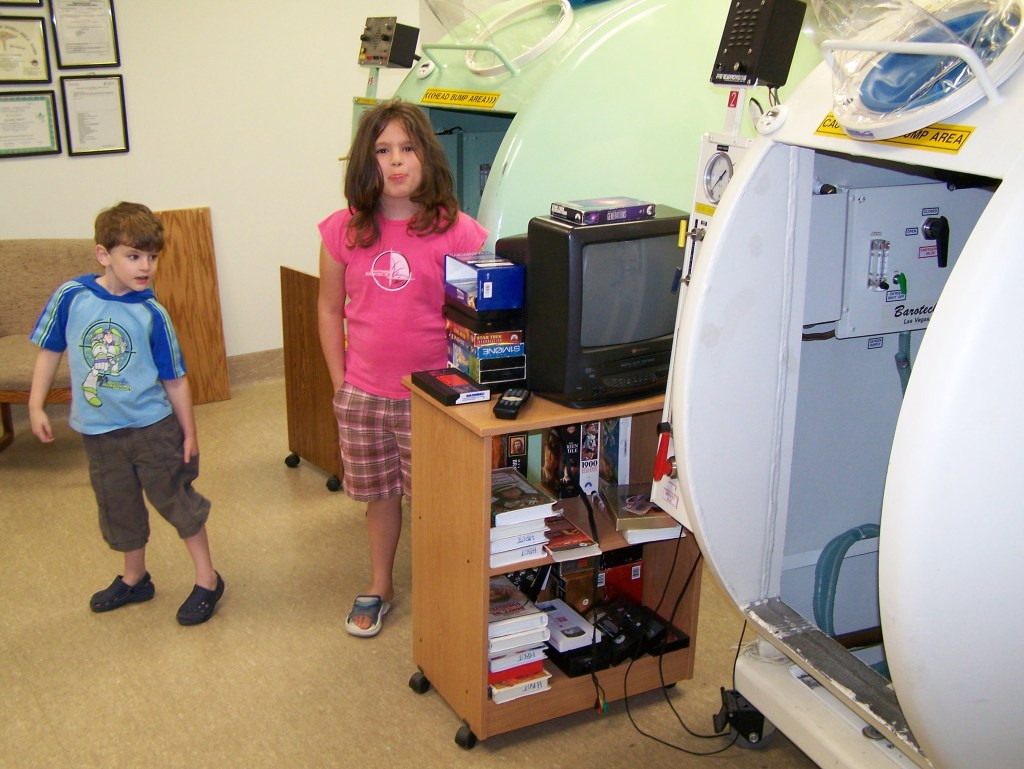
My son Austin and daughter Rachel standing in front of Gord Ward’s Hyperbaric Oxygen Therapy chambers
A Novel By Brian Howard Seibert
© Copyright by Brian Howard Seibert
In The Shadow of TASU (The Autism Spectrum Umbrella)
Chapter Two: Gurguri, Karak Province, NWFP, Pakistan (Talibanistan), January 2005:
We were driving along the gravel road to Gurguri, a small town in Karak Province, North West Frontier Provinces, Pakistan and I turned my head toward our company security officer and I asked him, “Do they paint the rocks alongside the road white for driving at night?” There were large white stones along either side of the road on about six foot spacing. He turned a little pale and looked up from the pistol he had taken out of its holster and placed on his lap and he said, “No!”
“Oh, no,” he repeated, visibly shaken, “Nobody drives at night.”
“Why not?” I laughed.
“Because you’ll be killed!”
I sat back for a moment and took it all in. “What if someone’s hurt?” I asked.
“If they can last, you wait. If they are dying, you make a run for it. As a matter of fact,” he added, “if you get stranded out here at night, make for one of the hilltop police stations. Go straight to one of the stations but be careful how you approach them or you may be shot at. Let them know who you are and approach them with caution.”
It must have been true what our security officer was saying. During the day police officers went out and stood along the highway at about one kilometer spacing, always within sight of each other, and when the highway curved around a mountain the spacing tightened up so the police officers could always see and signal the officers on either side of themselves. And at nightfall they would trudge along the highway, converging at the base of their little hilltop police fortress, and they would retreat into its safety and they would surrender the night to the drug caravans and they would watch and monitor the smugglers packing their illicit goods below, and in the morning the smugglers would hole up in their armed camps and the police would come out and patrol the roadways once again.
When we arrived at the outskirts of Gurguri the gravel highway turned into a dirt road that wound and curved through the town. Mud brick shops bordered the road, two story buildings with the shop on the main floor and with living quarters above and the shops all had wide corrugated steel roll-up security doors, some were closed, giving the building a fortress-like look, and some were open and there would be a bustling little shop inside where customers were bargaining with merchants over goods. We passed by the old hospital which was crumbling and broken and looked like it had been hit by rocket fire and we passed the new hospital the government had built, but the doctors had abandoned. Apparently, it was explained to me, the Pakistani doctors were afraid to treat the Pashtun Afghan locals, fearing reprisals for botched treatments. So there sat a large hospital with only one local nurse working there according to our security officer.
We passed through the town and drove on into a countryside of stone fences and brick buildings that would not have been out of place in Greece of 300 BC save for the odd place that had an electrical wire run to it on tall sticks to power a single light bulb in a home here or there. Soon we arrived at a fenced and guarded gas plant site which was abuzz with construction activity. Four hundred men had been working at the site for the past year and the plant was nearing completion. As we donned our Canadian flag patterned hard hats and toured the site we were a little disappointed with the construction progress. My associate, a turbo-expander expert from Texas, estimated that our client was still a good two weeks away from start up and it turned out he was correct. The gas plant was owned by MOL, the Hungarian National Oil Company, and we helped with the pre-commissioning work where we could and the Hungarian site engineers were very pleasant and cordial.
The MOL chief engineer had been to Canada for our gas plant factory acceptance test the summer before and I had told him then about my son Austin’s brain injury and how I was planning to get my son into hyperbaric oxygen therapy. He had then told me of how a niece of his had suffered from a birth trauma and now had a speech impediment. He’d taken a personal interest in what I had told him the summer before, so it was with great pride that I told him of Austin’s awesome progress over the past fall season. I told him that Austin’s seizures had immediately stopped and that he’d soon begun speaking and could now even read a few words. I had impressed him with my knowledge of Hungarian ancient history and what was meant by the acronym MOL, Magyar Oil Limited, the Magyars being the original migrating Turkish tribe that had, circa 800 AD, conquered the Dacian plain and renamed it Hungary after their former Dzungarian lands in northwest China. I had been studying the history of the ancient Danish conquest of Kiev and the establishment of the Hraes’ state since my university writing days and the Magyars had passed through the territory of present day Ukraine on their way to the Dacian Pannonian plain.
As our work progressed it became apparent to me that our local Pakistani engineers feared the local Pashtun tribesmen more than I did. They called them Germans and I asked one of our young engineers, “Why in the world do you call them Germans?”
“Because they came here with the army of Alexander ‘the Great’ many years ago,” he explained.
“Wouldn’t you call them Greeks then?”
“No. Even the Greeks call them Germans.”
This left me quite puzzled historically. But it did help explain their hair and their eyes. Some Pashtun tribesmen would have ‘Shocking Red’ hair and others ‘Quite Blue’ eyes and yet others ‘Bright Blonde’ beards and in ‘Dark Haired’, ‘Dark Eyed’ Southeast Asia this stood out. Then I remembered the Dorian columns of ancient Greece. They were different than other Greek architectural columns because Greece had been invaded by Grecians from the north who had driven many Greeks to Asia Minor. Perhaps this was where the term ‘Germans’ came from?
One evening I was talking with our Texas Turbine turbo-expander mechanic, David Hurdle, and he told me about the new American sub-prime mortgage scheme whereby people there were allowed to by property with mortgages based on what the value of the house or property would be in the future, its future higher value. I told him that it was just a disaster waiting to happen because I had seen house values in Alberta rise and fall as the oil and gas industry rose and fell. He laughed off my warning and told me he had purchased a second house as an investment using a sub-prime mortgage. I warned him once more that it was a disaster just waiting to unfold.
After a week of further construction the Eid al Abram holiday was approaching and we became concerned about possible security issues on site if everybody was off celebrating and an American from Texas was on site in the middle of Al Qaeda country. I decided that it would be best if my two man start up crew returned to Islamabad and hunkered down in an international hotel for the festivities, but one of our Canadian managers showed up unexpectedly and the MOL construction manager convinced him that start up was imminent so we were instructed to stay on site. Our Canadian manager left the day before Eid and apparently so did everybody else. The next day there were forty people left on the plant site instead of four hundred and my American associate pointed out nervously that there were now armed boys guarding the plant gates in lieu of the ex-Pakistani rangers that had been there the day before. A typical Canadian management decision…wrong!
We weren’t too concerned about the locals, but the Pakistani Army had been doing sweeps for Al Qaeda across North Waziristan and I was worried about Taliban supporters coming over the hill south of us to escape army pursuit. If cornered they would grab as many foreigners as they could for hostages. And our twelve year old boys guarding the gates would be gone at the first sign of trouble. I was hoping they would at least drop their rifles before they ran so we could have a chance to arm ourselves. I had spent a couple of years in my youth as a member of the Loyal Edmonton Regiment and I began seeing our guards as more weapons lockers than armed protectors.
But nothing serious transpired during our security lapse and after another week of construction we were ready to start up the gas plant. We got my super dehy up and running with just a few solvable instrumentation problems and then we got the Texas Turbines turbo-expander up and running with only a minor lube oil dilution problem that continued to plague us. One morning we returned to the plant from our trailer camp to learn that the night shift had flooded my super dehy with condensate, but when I asked them what had happened, they replied, “Nothing.” I knew that they had lost control of the hydrocarbon levels in the inlet separator but even with this sloppy operation my super dehy never lost its water dewpoint control upstream of the turbo-expander and our gas drying plant just kept running.
It was a new gas drying process I was developing and patenting and I had built only one before in Alberta for another client. It had worked well and this one had to get the gas even drier. For both plants I had to guarantee a moisture content of under 0.25 pounds of water per million standard cubic feet of gas and the MOL Pakistan gas drying plant was producing 0.05 lbs/MMSCF dry gas effluent. The process was a phenomenal success so I would be carrying on with the patenting of it.
When I returned to Canada, Ann told me she was reluctant to put Austin back into HBOT, worried that the pressure might be hurting his ears. I felt it was more like pressures were bothering her ears and it seemed as though her girlfriend Sherry was doing more for Austin than she was. Anyway, for whatever reason, we held off on putting Austin back into therapy. One good thing that happened in the month or so I was in Pakistan was that Austin forgot all about Tick-Tocks and I never reminded him of them. My arms finally got a break!
But by March, we could see Austin regressing a bit…not talking as much…seemed to be peering out the corner of his eyes. His hand flapping didn’t return…but I told Ann that we had to get Austion back into HBOT sessions…or it might. We called up Sherry and she signed on to be his primary dive buddy. Ann and I would trade off diving with Austin whenever Sherry needed a break and this dive session carried on into the summer.
In June, I put my sister Donna into a forty dive HBOT session to see if it would help her with the Post Natal Hypoxia brain injury she had suffered as a baby forty years earlier. She had suffocated on a plastic bib when she was six months old and she almost died and when the doctor at Spirit River wouldn’t even give Donna oxygen, my parents drove her into the hospital in Edmonton to get her better care. I doubt if they gave her better care, but Donna would just not die. She survived, but my parents both knew that she might have received a brain injury and, though I don’t remember all the details, by the time she turned three her mental progress began to slow and by five we all knew she was not going to be going to school with the rest of us children. She ended up going to the Winnifred Stewart School For The Mentally Retarded and later she was institutionalized at the Michener Centre in Red Deer. The Michener Centre was named after Grant Michener, a famous Alberta writer, and was built in the small city of Red Deer, hallway between the major centers of Edmonton and Calgary in order to equally inconvenience the handicapped of both major cities. Political graft was likely involved as well. It’s the Canadian way.
I had always been raised believing that Donna had been given the best possible care, but when Austin began exhibiting signs of his own brain injury and we began talking with doctors about it, I soon realized that there was no such thing as the best possible care when it came to brain injuries. If doctors could call it Autism, they would, and then they could blame genetics for the problem and reconcile themselves to doing nothing. When Autism first appeared in the 1940’s and 50’s, doctors attempted to blame the trauma on something the parents were doing in raising the child, but by the 1970’s this was disproven and genetics became the likely culprit because it seemed to run in families, but it didn’t take me long to realize that oxygen deprivation and birth traumas were the likely cause of all Autism as well as Cerebral Palsy and a host of other brain injuries and I don’t see why, to this day, medical professionals can’t see it clearly as well.
When Donna was on holidays in the early summer we started her off on daily double dives, so Sherry would dive with Austin and I would dive with Donna and then in the afternoon Ann would dive with Donna again. We did this for two weeks and then my mother insisted that Donna take a holiday at WEM, the West Edmonton Mall. The holiday had been booked months earlier, so we waited and completed the forty dives several weeks later. There didn’t seem to be any improvement in cognitive ability so we didn’t extend the sessions. Although we were getting very good dive rates, HBOT Therapy was still expensive and I was the one paying for it all. In truth, my mother didn’t want to carry on with the therapy after Donna’s little holiday, but I lied to Mom and I told her that I had already paid four thousand dollars for it and I couldn’t get my money back. I think that my wife Ann resented me spending that kind of money on my sister for she soon came up with some plans to spend some of my money on herself.
 SeiberTeck: 'The Varangians Series'
You are a lunatic! How dare you shame your son like this! If he ever reads this he would be hurt and ashamed of you! Have some decency and think of your son reading this misinformation. Why do I always have to explain your disgusting behavior!!
LikeLike