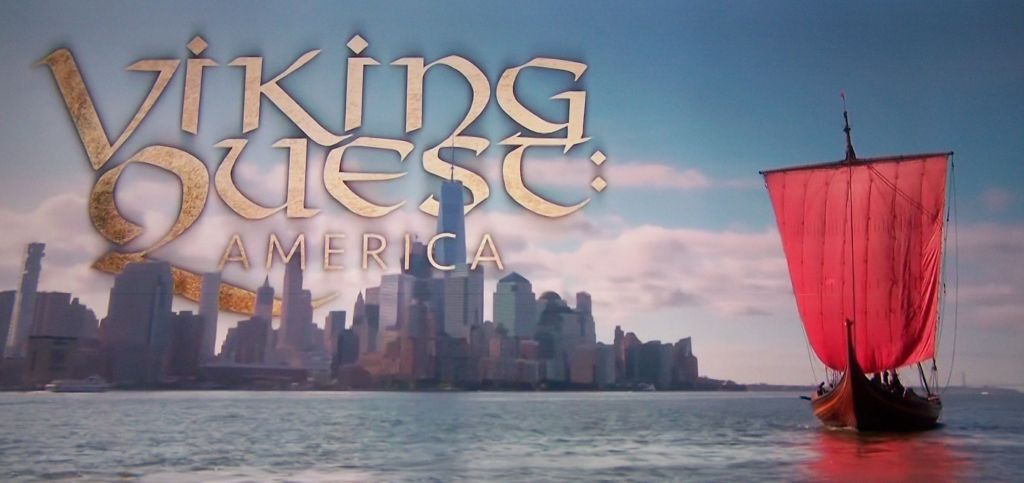
Draken Harald Harfagre Viking Ship in New York
VIKING QUEST: AMERICA Documentary TV Series, 2023
A Review By Brian Howard Seibert
© Copyright by Brian Howard Seibert
I’ve just finished watching Viking Quest: America, a documentary TV Series completed in 2023 covering a recreation of the Viking discovery of America by Europeans and I found the series quite fascinating.
In 2016 in Haugesund Norway a Viking recreation project of manifest proportions was begun by local Sigurd Aase. The largest Viking ship to be built in modern times, the Draken Harald Harfagre, had its keel laid by ten of Scandinavia’s best wooden shipbuilders, starting a project to retrace the Viking western diaspora of the middle ages from Norway to England to Iceland and then Greenland and finally to America. The Viking ship had to be strong enough to battle the powerful North Atlantic. It took two years to build the 35 meter long by 8 meter wide by 25 meter high 80 tonne longship complete with 300 square metres of silken red sail.
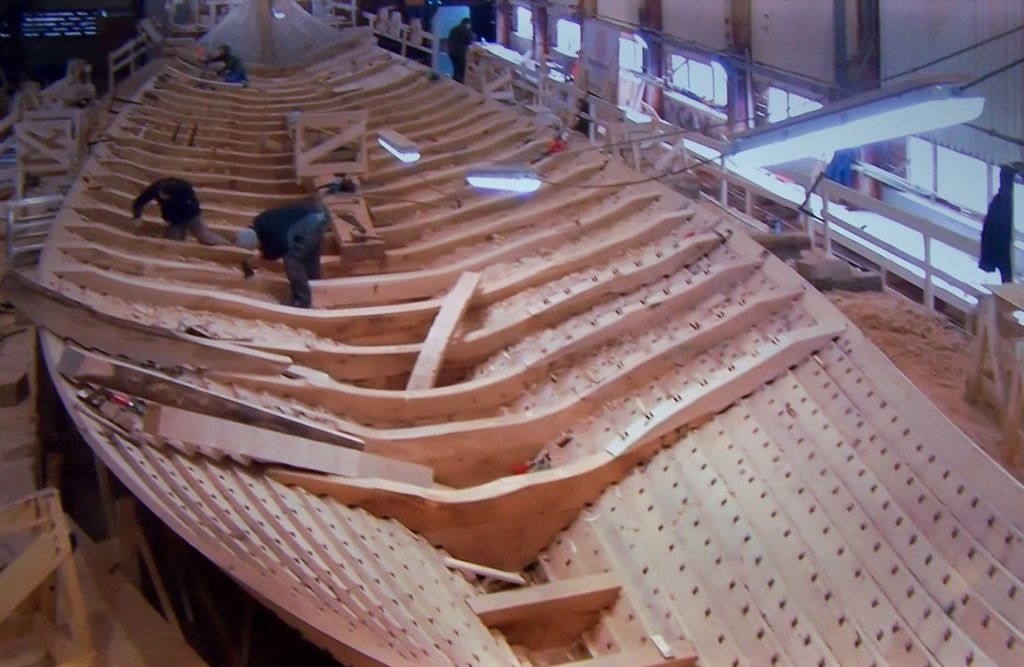
The construction of the oak clinker built ship is detailed throughout the first episode of the documentary and provides a fine explanation of design and fabrication of a ninth century Viking dragonship. At times, the show breaks off into explanations of deeper secrets of the Viking Age. Nearby Avaldnes was home to sea kings of the period, such as Harald Harfagre or Finehair, the first king of Norway, after whom the new ship was named, and home to Norse sagas that described very few ship building techniques, so Jon Bojer Godal was brought in to provide some Viking shipbuilding experience. His family had passed down traditional Norse clinker build techniques for the last thousand years and it was determined that he should lead the design team.
The team decided to test out three different hull designs based on the 9th century Gokstad ship in Oslo’s Viking Ship Museum:
- A hull design based on the Gokstad ship reconstruction
- A boat builder’s interpretation on the Gokstad construction
- And a boat builder’s dream construction

The boat builder’s interpretation turned out to be the most stable while the Gokstad reconstruction was found to be a dangerously narrow design. There was no word on the efficacy of the dream construction.
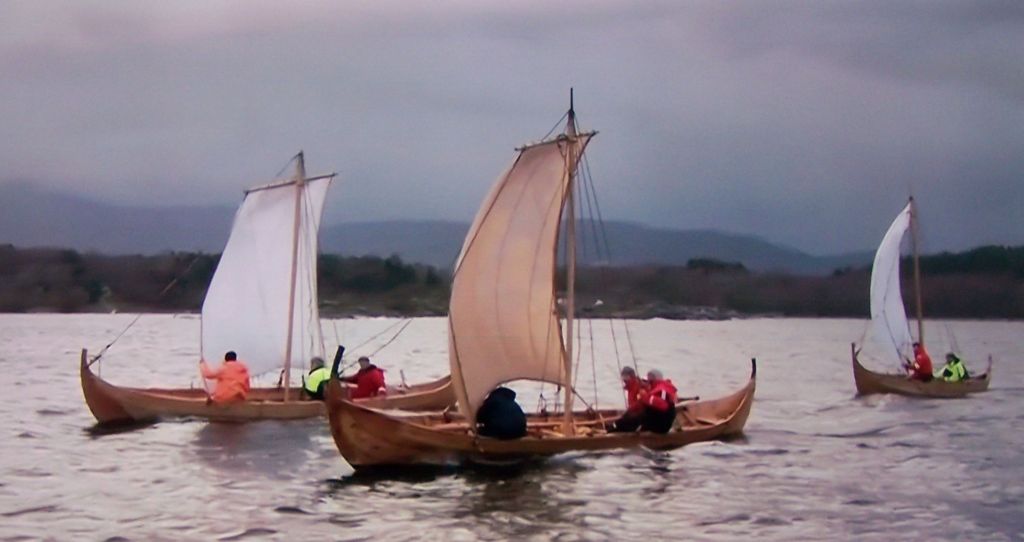
The Three Boat Sized Prototypes Are Raced During Test Trials

In another out-take Clare Downham of the University of Liverpool and Marit Synnove Vea discuss L’Anse Aux Meadows on the northern tip of Newfoundland Canada as a possible Vinland of the Vinland Sagas. Clare Downham states that Vinland means Vineland where grapes were cultivated, but Vinland actually means Wineland and the grapes there grew wild. She brings up a good point though in ‘were they ever cultivated there by either Vikings or local natives.’ L’Anse Aux Meadows is described as a temporary settlement but it was more likely strictly a mining camp located at a source of bog iron nodules for the manufacture of local iron and steel. The bog iron nodules are still present there, but they likely petered out and the camp was then abandoned. The two settlement locations described in the Vinland Sagas, both the Saga of the Greenlanders and the very similar Erik’s Saga Rautha, were further south, Straumfjord, meaning fierce current fjord, likely near the Bay of Fundy which has fierce currents, and Hope, meaning Tidal Lake, even further south in New England or beyond. The documentary correctly states that the lack of grapes in Newfoundland opens the explosive possibility that Vikings may have explored even further into North America. Erik’s Saga Rautha even makes this claim directly in Chapter 12/13 of the saga:
“One morning Karlsefni’s people beheld as it were a glittering speak (knight?) above the open space in front of them, and they shouted at it. It stirred itself, and it was a being of the race of men that have only one foot, and he came down quickly to where they lay. Thorvald, son of Eirik the Red, sat at the tiller, and the One-Footer shot him with an arrow in the lower abdomen. He drew out the arrow. Then said Thorvald, “Good land have we reached, and fat is it about the paunch.” Then the One-Footer leapt away again northwards. They chased after him, and saw him occasionally, but it seemed as if he would escape them. He disappeared at a certain creek.
“Then they journeyed away back again northwards, and saw, as they thought, the land of the One-Footers. They wished, however, no longer to risk their company. They conjectured the mountains to be all one range; those, that is, which were at Hop, and those which they now discovered; almost answering to one another; and it was the same distance to them on both sides from Straumsfjordr. They journeyed back, and were in Straumsfjordr the third winter.”
Here we have a geography that includes a range of mountains that extends from the south at Hop (New England?) to Straumsfjordr (Bay of Fundy?) in the north to the Land of the One Footers (Saint Lawrence Seaway?) further north. Captured native children further describe the Land of the One Footers as:
“the people there were dressed in white garments, uttered loud cries, bore long poles, and wore fringes. This was supposed to be Hvitramannaland (whiteman’s land).”


The Land of the One Footers, Hvitramannaland, may have been the trade route of the Danish Hraes’ Trading Company, first explored by Prince Helgi ‘Arrow Odd’ Erikson (Prince Oleg of Kiev) and the Greenland Vikings derogatorily called them One Footers because the Hraes’ traders had begun direct sailings from Southampton England and Normandy to the Newfoundland and had discovered, to their dismay, that the disease Scurvy would attack them during extended sailings and that Scurvy typically caused the loss of a foot. It was the Long John Silver one legged effect that would later plague both the Spanish that followed them over five hundred years later and then the English who acquired the name Limeys in their attempt to thwart the disease.
Some experts translate One Footers as the Greek word Unipeds and say the episode was added due to the author’s fondness for medieval learning which states that Unipeds were said to live in Africa. But the One Footers of Africa were the Greeks, themselves, who lost feet on their extended sailings while circumnavigating Africa (which the same experts claim could not have been done in such ancient times). Spoiler alert: As the documentary progresses you will see how fast the sailings go and realise that ancient ships were fully capable of such accomplishments, which takes us back to Haugesund.
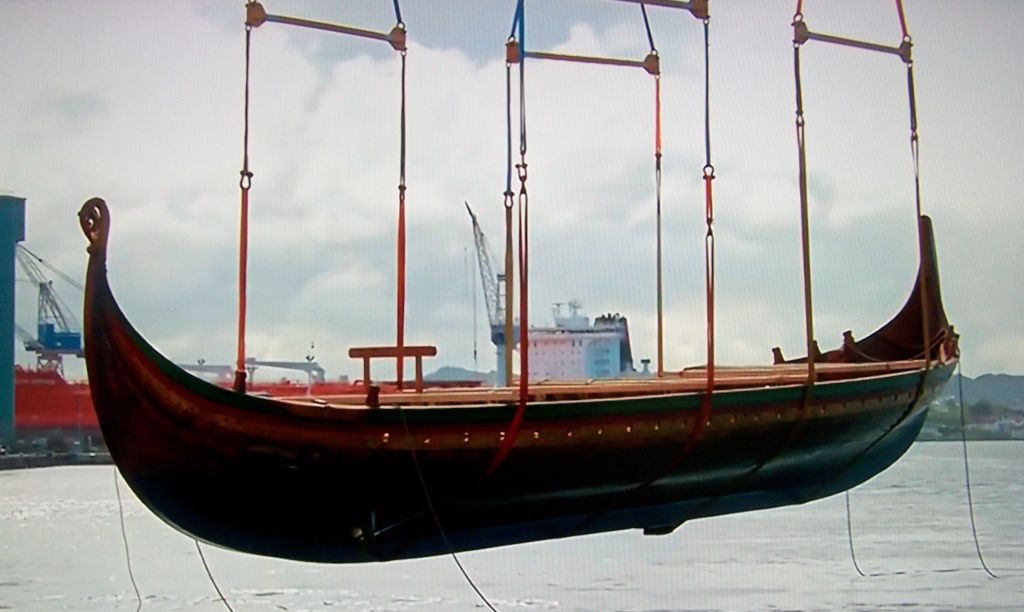
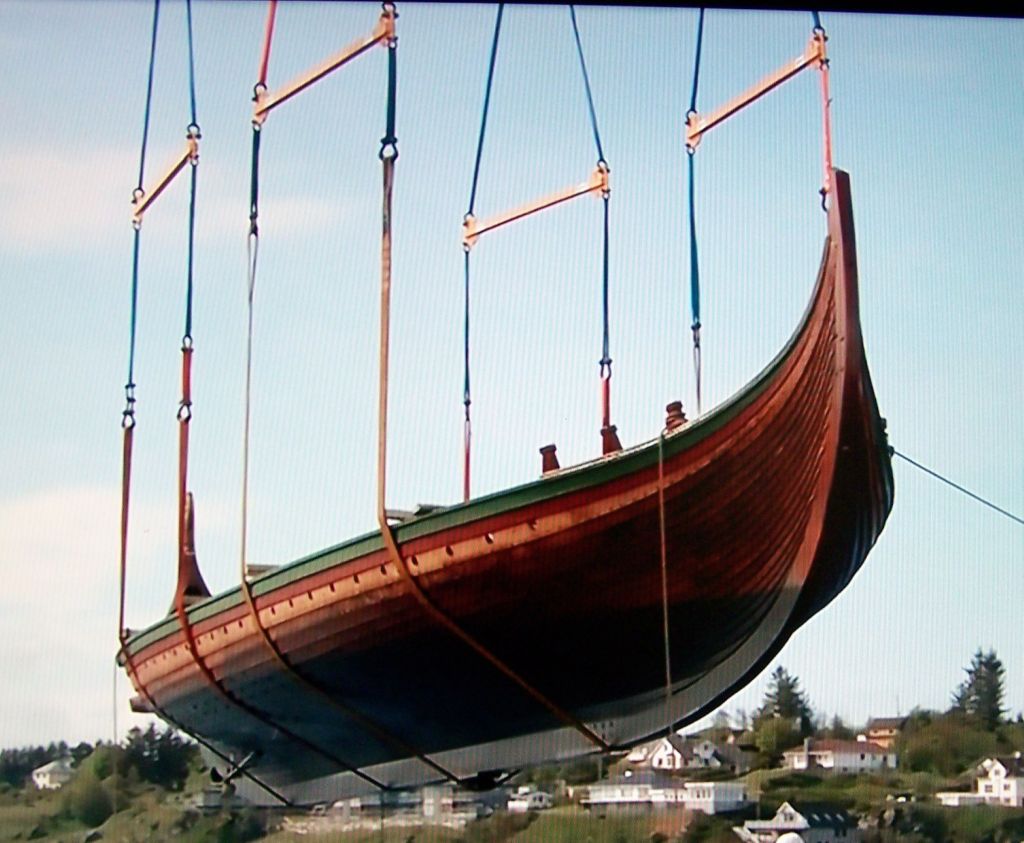
On the 1000th anniversary of the discovery of America (2021 CE) the completed full sized hull was craned out of the workshop and out into the harbour of Haugesund. Once in the waters, the huge two ton mast was lowered into the knee brace for the mast, but not before a coin was traditionally placed underneath it. This must be a later boat builder’s tradition, for Vikings did not do this. Most Viking ships had lighter masts that could be manually unfooted for stealth and that coin would soon be lost. They were Vikings after all. Then it is all hands on deck to set up the yard arm and hoist the 300 square meter red silk sail for the very first time. Most Viking ships had wool sails, but a king’s sea steed wore silk. In a, dare I use the term, christening ceremony, Draken is blessed with water and the ship builders are blessed with mead. Then a toast was spoken:
“May Njord always fill the sails of Dragon Harald Fairhair.
May its sails always grace the horizon.
And may its keel always kiss the sea.”
Next, the dragon must be tamed. Out of over 4000 applicants only 34 are chosen, seasoned sailors all, but none with square sail experience. So sea trials began with the oars. And the two man oars were huge! They looked like four by four posts almost twenty feet long with the handle whittled down to an inch and a half diameter dowel for the end rower, but the mid rower had hand grips carved into the square oar that looked quite cumbersome to handle.

I think the Vikings probably used lighter oars and it was the rowers’ responsibility to not break them by over-stressing them. Several rowing positions were practised, from sitting on crossmembers to sitting on square rowing chests to even standing on deck. But no technique seemed to allow the rowers to put their full backs and legs into the rowing stroke.


The Vikings are supposed to have sat upon their own personal chests while rowing and they may have stowed their personal gear and booty in their waterproof chests as well, and the only way a chest could have been designed to allow for a powerful rowing stroke would have been with a curved bottom, or perhaps a curved top that was strapped to the deck upside down, and thus the curved top sea chest was developed and became so common place among sailors and Vikings that it became a symbol of pirates and their treasures down to this very day. Vikings depended upon the speed of their ships and a curved rowing chest would allow them to put their backs and legs into their rowing stroke in much the same way that Olympic scullers do.
Rowing did not seem to be working well for the Draken crew so they moved on to learning the square sail. The sail was large and the rigging was correspondingly heavy and it took the full crew to run up the sail and catch a full breeze, but when the wind took hold of her, the dragon ship rose up out of the water and rode upon the waves like a true Vik king’s steed. And with practise and rigging modifications and fine tuning done on the fly, the Draken’s crew tamed their dragon ship.
The Draken’s crew was drawn from ten different countries around the world and to some this cultural melting pot might seem out of step with the exclusive Viking fraternity, but the latest science disagrees. Clare Downham, Professor of Medieval History at the University of Liverpool, in discussing Viking genetical diversity, says, “There isn’t a simple Viking genetic signature. The Vikings were diverse themselves.”
British researcher Stephen Harding adds, “There’s a myth, a misconception that Viking DNA just comes from Scandinavia.” Using DNA evidence he states that the local Liverpool and area people are of up to fifty percent Scandinavian DNA and that cultural mixing went two ways.
That may very well be, but it was Viking men putting their fifty percent DNA into Liverpool women, and quite often it went in involuntarily. And their Liverpool men were often shipped off to Iceland and Norway to be worked to death as field slaves. Right out of Chapter One of Eirik’s Saga Rautha we read, “Many well-born men, who had been taken captive in the British Isles by Vikings and were now slaves, came to Iceland with her (Aud the Deep Minded). One of them was called Vifil; he was of noble descent. He had been taken prisoner in the British Isles and was a slave until Aud gave him his freedom.” If cultural mixing went two ways, then one was the way of the victors and the other was the way of the victims. Vifil never made it back to the British Isles.
Things too could go two ways for the crew of the Draken Harald Harfagre, successfully, resulting in a history shattering voyage to the new world, or in failure, sending eighty tons of oak and thirty four human lives to the bottom of the sea. Everything Viking ends dramatically.
After quite a few modifications, including standby engine power, Draken Harald Harfagre left Haugesund and was sailed successfully to Iceland.
ICEBERG ALLEY
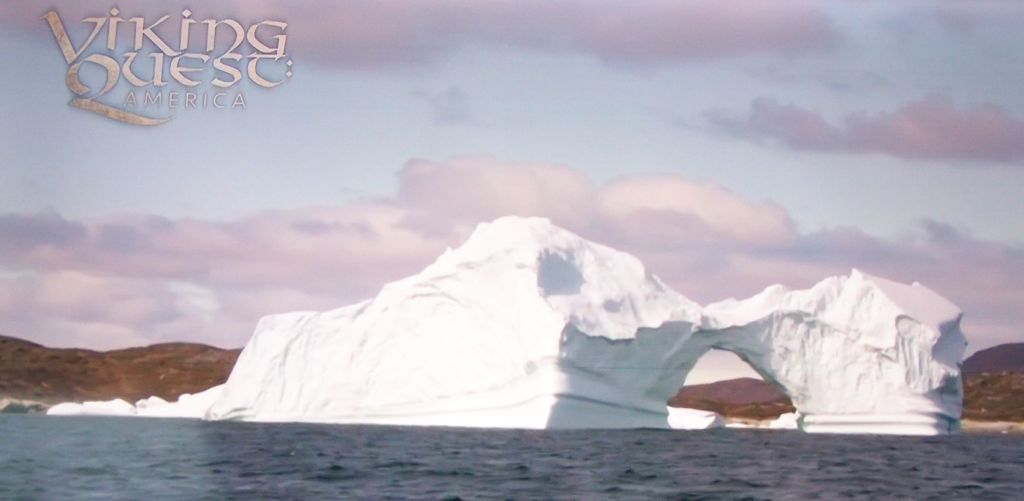
Draken sailed out of Reykjavik and a course was set for Cape Farewell on the southern tip of Greenland, a journey of over 1200 kilometers (744 miles), but the ultimate goal is L’Anse Aux Meadows in Newfoundland to honour the 1000th anniversary of Vikings arriving in the New World. Then Draken will push inland into North America to show how the Vikings may have been the first Europeans to explore the Americas.

Soon they are too far from land to be rescued by sea or air in the raging and icy North Atlantic. After five days sailing they approach Greenland and are in really dangerous waters when Draken has her first encounter with ice. It is very difficult to see the difference between white capped waves and bobbing ice and the ice packed shorelines turn two hours sail into two days. They have shifted into the Greenland Current and the water is immediately colder and the air more frigid. As they approach the harbour of Qaqortoq they wonder at how the Vikings navigated through the ice choked waters without radar and weather reports and engine power.

According to the Sagas, Eirik the Red arrived to settle Greenland in 982 AD. One crewman wonders at how the Vikings managed to live there with so much rock and so little vegetation. Then he states, “Some people say that it was much warmer during the Viking Era”.
I’m not sure it was ‘much’ warmer, but the Medieval Warming Period was somewhat warmer and that somewhat can make all the difference in the world. The Roman Empire had grown during the Roman Warming Period which peaked about the time of Christ and the following Roman Cooling Period valleyed about when Rome fell to the migrating Huns and Goths and Vandals in 476 AD. The Viking Era Medieval Warming Period followed and the surviving Eastern Roman Empire flourished and traded with the Danish Kievan Hraes’ State until Kiev fell to migrating Mongols in 1240 as the Medieval Cooling Period took over. And Constantinople fell to migrating Turks in 1453 as the cooling period valleyed. These vast multitudes were migrating because there was a cooling period and crops were not growing and they were starving as is detailed in many historical works of the time.
Currently, people are alarmed by Global Warming or Climate Change as if it were an entirely new thing, but it is not. There have been ongoing climate change cycles since the demise of the Ice Age and these cycles are historically traceable, both in literature and archaeologically. I only state this because ‘those who don’t learn their history are doomed to repeat it’ and, unless we learn proper history and use our science and abilities, those migrations shall begin to reappear circa 2240. So here is a bit on L’Anse Aux Meadows courtesy of Wiki and Hurstwic:
“Today the area mostly consists of open, grassy lands, but 1000 years ago there were forests that were convenient for boatbuilding, housebuilding and iron extraction.”
And Hurstwic adds, “L’Anse aux Meadows has changed during the 1000 years since Leif’s visit. The climate is cooler, so there are few trees, and none of any size. The sea level has dropped and the land has risen, so the remains of the Norse buildings are some distance from the water.”
However, one researcher, Professor Ray Bradley, has studied one Greenland lake for sediment cores and has found nothing to support the Viking Warming Period as having occurred. By studying the DNA of organics locked within the cores, analysis has revealed that it was drought, not a mini ice age, that drove the Vikings out of Greenland in the mid-fourteenth century
But a cooling period is a drought period. Many cooler areas of the world, though covered in snow, are considered desert areas due to lack of precipitation. Cold air has much lower moisture carrying capacity than warm air and cooling periods may tend to be drier than warming periods. If I remember correctly, these DNA Studies were initially called Pollen Studies and I was a little sceptical of them because pollen production is reproductive in nature and nature protects species reproduction regardless of local warming or cooling trends.
Professor Bradley also states, “there was a general deterioration in the exchange of ships’ back and forth trading. Europe was becoming more prosperous and there was less interest in trading that far away.”
Mid-fourteenth century Europe wasn’t more prosperous. The Black Plague of 1350 had just broken out and within the next few years half of Europe was maimed or dead. The Black Death reached the extreme north of England, Scotland, Scandinavia, and the Baltic countries in 1350. There were recurrences of the plague in 1361–63, 1369–71, 1374–75, 1390, and 1400. The Bubonic Plague was the gut punch that staggered the Viking settlements of Greenland. Contributing factors of global cooling and desertification and a failing European economy due to the plague put nails into the coffin that Greenland had become. And the arrival of Inuit hunters who had just migrated across Arctic America from Alaska, taking out local Dorset native peoples along the way, certainly exacerbated the Greenlanders’ demise. There had been no indigenous peoples living in Greenland when Erik the Red first settled there and the arrival of the Inuits was not taken sitting down. There were many incidents of violence between Scandinavians and Asians in Greenland in the west at the same time that Asian Mongols were attacking the Danes and Slavs of Kievan Hraes’ in the east. James Enterline, in his book ‘Viking America’, even states that it may have been Mongol restrictions of selling steel to the Inuit whale hunters of northern Asia that had driven the Inuit across Arctic America in search of the needed steel of the Vikings, perhaps steel from coastal Atlantic worksteads just like L’Anse Aux Meadows. Further adding to the mix, the Black Plague was reportedly first introduced to Europe via Genoese traders from their port city of Kaffa in Crimea in 1347. During a protracted siege of the city, between 1345 and 1346, the Mongol Golden Horde army of Jani Beg, whose mainly Tatar troops were suffering from the disease, catapulted infected corpses over the city walls of Kaffa to infect the inhabitants. Fleeing Genoese traders then carried it to Constantinople.
Meanwhile, back at the Draken, we are told that the legendary Leif Eirikson had discovered a place called Vinland by following the Greenland coast north until it neared the coast of America which he then followed south until he found a place suitable for settlement. A crew hand explains, “And that was Vinland. He called it Vinland because he found grapes there. Vinland in the region is Wine Land. It is situated in Newfoundland and is today called L’Anse Aux Meadows.”
Some people believe this, but grapes were never found in Newfoundland. A bit of Screech perhaps, but not wine. Leif Eirikson’s discovery of America, as detailed in the Sagas, took place before the death of his father in 1003, so perhaps 1001 AD. And, as will be revealed later in this documentary, tree ring dating places L’Anse Aux Meadows as being built circa 1021 AD which may have been after Leif’s time. There is also the possibility that the tree in question had been cut well after the site had been built. But Leif’s calling the country Vinland still places the location further south, where grapes actually did and do grow wild, perhaps in New England or even further south.
But Leif’s calling the region Vinland or Wine Land would not in itself necessarily mean there were grapes there, after all, his father did name Greenland Green Land. But the Sagas do detail episodes where Vikings actually found wild grapes growing there and some of these Vikings are reported to have gone missing for days to boot!
The crew of the Draken’s goal is to reach L’Anse Aux Meadows a thousand years after the Vikings did to solidify the historical record. It’s 1100 kilometers from Greenland to Newfoundland and it will be colder and icier than anything the crew has experienced to date.
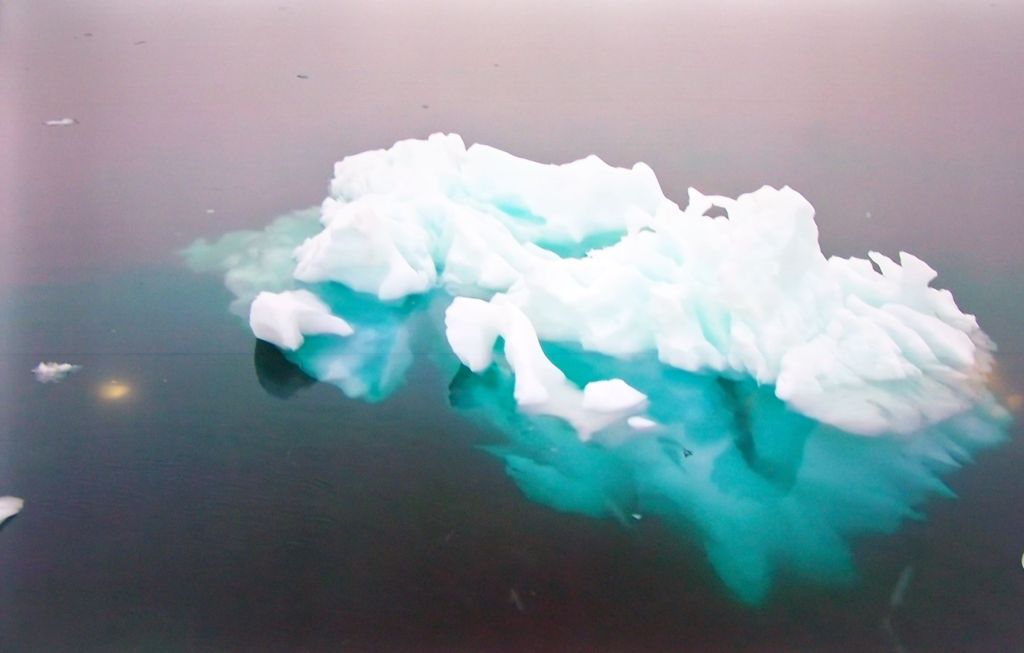
But during the sailing the crew are blown away by the brightness of the burgs instead of the gloom and darkness they had expected. The sea is full of light and life. Icebergs that look like clouds are full of seabirds and the waters are full of seals and whales and narwhals. A crewman describes the icebergs as being “beautiful and dangerous creatures”.
And this may be how icebergs are described in Arrow Odd’s Saga, as creatures, when Odd’s son Vignir describes them as they perhaps ‘sail to the Newfoundland’:
“Now I will tell you,” Vignir begins, “that these are two sea monsters. One is named Hafgufa, the other Lyngbak. The latter is the greatest of all whales in the world, but Hafgufa is the biggest of monsters created in the ocean. It is her nature that she swallows both men and ships and whales and all that she can reach. She stays submerged day and night together, and then she lifts up her head and nostrils, then it is never less time than the tide that she stays up. Now that sound that we sailed through was the gap between her jaws, and her nose and lower jaw were the rocks you saw in the ocean, but Lyngbak was the island that sank. Ogmund Tussock has sent these creatures to you with his enchantments to work the death of you and all your men. He thought that this would have killed more men than just those that drowned, and he meant that Hafgufa would swallow us whole. Therefore, I sailed through her mouth because I knew that she had just risen to the surface.”

The Gaping Jaws of Hafgufa
In this documentary it is explained that the dangers of Iceberg Alley challenges the most modern mariner which is why so many scholars refused to believe that the settlement of L’Anse Aux Meadows in Newfoundland is Viking. It was a revelation that archaeologist Birgitta Wallace had to see to believe. She says, “Even in 1973, when the Parks Canada excavations began there was a lot of doubt expressed.”
Clare Downham states, “They just thought this was a story that they found these lands and that the Vikings didn’t actually reach North America. But then there was a team of people who were determined to find the evidence, and eventually located something that proved the Vikings had been there.”
This team of people were Norwegians, the Explorer Helge Ingstad and his archaeologist wife Anne Stine, who had, on their own volition, tracked down and discovered and uncovered this rumoured site. And no where in this documentary about Viking discovery are their names even mentioned! So let us go to Wiki to find their accolade:
“The Norwegian explorer and author Helge Ingstad began an intensive search for Norse sites in North America, beginning in New England and working his way northward along the coast. At L’Anse aux Meadows in Newfoundland, local residents were aware of mounds located in the peat bogs, but always assumed that they were Indian burial mounds. A local inhabitant, George Decker, led Ingstad to these mounds in 1960. For the next eight years, Ingstad, and his wife Anne Stine Ingstad led a team of international archaeologists in the excavation of the site. Rather than being an Indian burial ground, the mounds are the remains of a Norse community dating from approximately the year 1000. Further excavations by Parks Canada in the 1970’s makes the conclusion incontrovertible.”
It should also be noted that there is a contingent of American Columbus scholars who led this pack of Leif ‘the Lucky’ deniers and who even currently claim that no other Viking location shall ever be found! They have spent the past two hundred years developing a false narrative of the Mound Builders of the Mississippi, claiming that it was some earlier race that had built the great mounds of the Mississippi Valley and that local natives had wiped these great people out! If one reads early American historical texts, this event is described in some detail, though it is currently quite evident historically that it was the local natives who indeed built these mounds themselves and may have patterned them after a combination of Mayan temples and Viking ring forts. Meanwhile, back to the Draken narrative, “Draken’s crew intends to prove that the Vikings could indeed have made the dangerous crossing. But, beyond that, they could have ventured further into North America than any one had thought possible.”
On day five of this leg of their journey they were approaching Newfoundland, only five days from Greenland to Newfoundland (take that you Colombophiles), but the crew were wearing their survival suits, which are safer though colder than their regular sailing gear. A crew hand describes the cold as giving her permanent trench hands or Viking hands.
The narrator states, “After 40 days at sea and 5000 kilometers of treacherous conditions, Draken is finally in sight of her goal.”
IN THE HEART OF AMERICA
The next day, as Draken approached America, a crew hand said, “It’s amazing! I feel very proud that we managed to make it through this last leg. It was quite tough!”
But as they neared America, Draken was in trouble. The wind was blowing the wrong way and an engine went down. It would have been exciting to see the crew break out the oars and row their way into St. Anthony Bay, but they did at least sound their huge Viking horn as they limped into harbour under half power. Locals gathered and toasts were made. They had now arrived at the end of established Viking history.
Later, at L’Anse Aux Meadows, the captain explains, “This is a recreation of Leif Eirikson’s house and in the background you can see the coast of Labrador.”
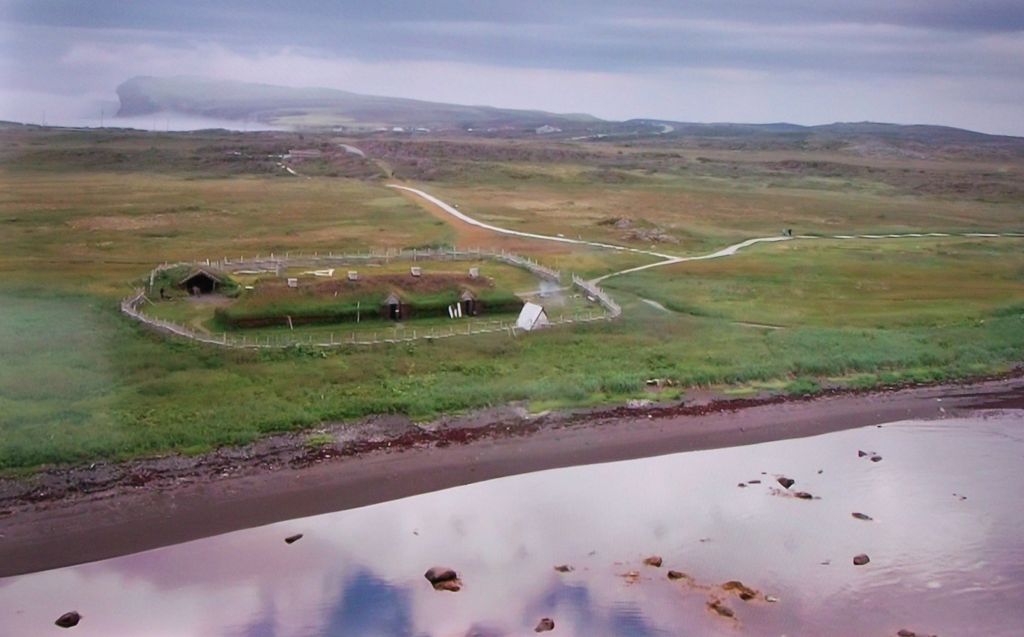
L’Anse Aux Meadows Newfoundland with Labrador Cliffs in Background
And behind him, the cliffs of Labrador stand out of the waters of the Strait of Belle Isle and one can almost imagine Ogmund Tussock’s Fortress of Solitude atop the cliff where he fought and killed Arrow Odd’s half-troll son, Vignir in the late 800’s.
Then a crew hand says, “For me it was very special to get to L’Anse Aux Meadows because growing up in Norway, going to school in a Norwegian school, we’ve been taught about this story from a very early age. It’s a really really beautiful place. I got goose bumps on my back.” It must have been wrenching for her to watch the final documentary and learn that Professors Ingstad and Stine weren’t even given a mention.
The narrator then states, “L’Anse Aux Meadows is one of the greatest archaeology discoveries of the twentieth century. The only known Norse settlement in North America. It proves part of the Vinland Sagas. That the Vikings made it to America nearly 500 years before Christopher Columbus.”
Professor Birgitta Wallace , who led the later Parks Canada excavations, says, “It was not really household things that came to light. It was signs of activities and three really stood out: one was carpentry, one was boat repair and another was making iron and working it.” The narrator asks, “But why did the Vikings choose this place to stop?” Then explains that the areas boggy terrain was host to a plentiful supply of iron in the form of bog iron. The Vikings purified the iron in clay lined kilns and forged the iron into hardware, tools and nails for ship repairs. “And thanks to a recent scientific study the secret of the exact date of the Vikings’ arrival here has just been unveiled. It was hidden inside this tiny piece of wood.”

Sample of Tree Rings Found at L’Anse Aux Meadows
It turns out that 993 AD was a bad year for solar flares and that all tree ring growth for that year, world-wide, was tainted and can be identified. A piece of wood cut at L’Anse Aux Meadows had that ring plus twenty eight (28) more which indicates it was cut 28 years later in 1021 AD, after which the settlement was apparently built. Thus the year 2021 marks the 1000th anniversary of Vikings in North America.
“If L’Anse Aux Meadows was a stopping place,” the narrator starts, “where did the Vikings go from here?” To find out, the next day the Draken and her crew sailed south for the St. Lawrence Seaway and into America and its Great Lakes.
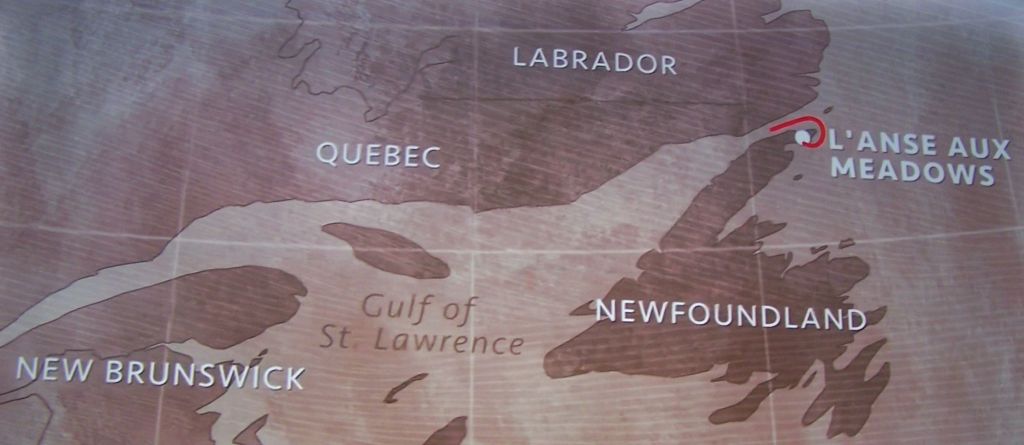


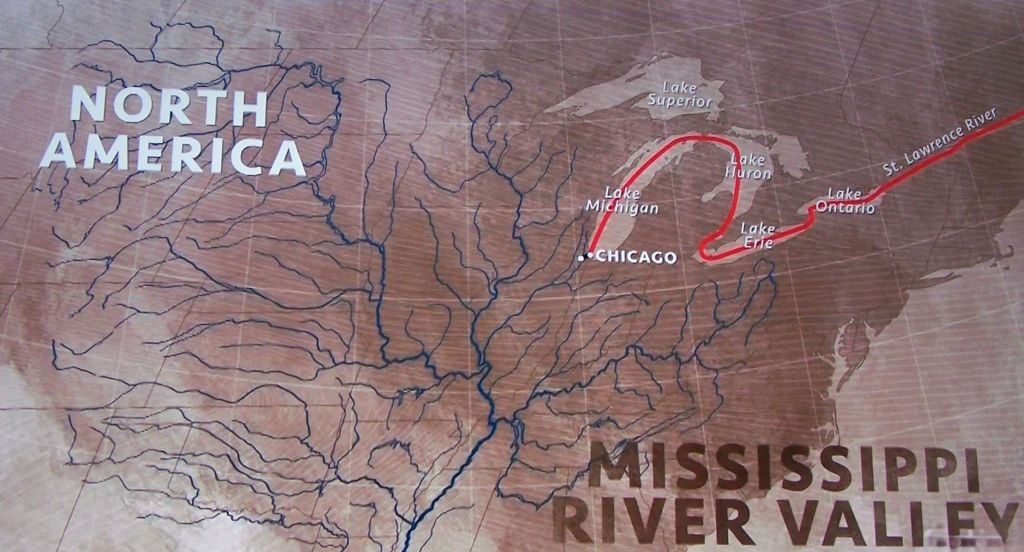
Their quest now is to discover first hand what might have been possible.
The Vinland Sagas describe a settlement, Straumsfjordr (meaning Rapid Current) where they overwintered and in the summer, some, but not all, went south to a settlement called Hop (meaning Tidal Lake).
But evidence for them is scarce and forgeries are not. In 1898 a sign of Viking presence was found in Minnesota in the Kensington Runestone, a 220 pound stone slab reportedly unearthed by a local settler and the runic inscription indicated that Greenland Vikings had reached that location in the 14th century, but analysis suggests it may be a hoax. The face of the stone reads:
“Eight Geats and twenty-two Norwegians on an exploration journey from Vinland to the west. We had camp by two skerries one day’s journey north from this stone. We were [out] to fish one day. After we came home [we] found ten men red of blood and dead. AVM (Ave Virgo Maria) save [us] from evil.”
And then down the one side:
“[We] have ten men by the sea to look after our ships, fourteen days’ travel from this island. [In the] year 1362.”
Could these Greenlanders have been killed by One Footers? Just as Thorvald Eirikson, Leif ‘the Lucky’s brother, had been killed by one in the Vinland Sagas? The Hraes’ Trading Company would have wanted to protect their trade route down the Mississippi at all costs. But just as 993 had been a bad year for tree rings, so too was 1352 for the Valley of the Mound Builders, and for pretty much the rest of the world for that matter. The Black Death plague was running rampant in Europe and had struck both Iceland and Greenland by 1352, wiping out a good half of the Viking populations there. And even the Hraes’ could not prevent the Pox from being transmitted through their trade routes, their trade likely even exacerbating the spread, and by 1352 the Bubonic Plague may have engulfed the Mississippi Valley, completely wiping out the mound cities of the local indigenous populations. When the Spanish Conquistadors arrived in the Americas a 150 years later, all they found of the mound cities were the ruins of thousands of buildings atop the overgrown earthen mound platforms. No trace of the original inhabitants remained and the surviving native populations avoided the cities like a, dare I say it, no, I will not. I will leave it up to you to think the word, but please don’t say it.
Several other obvious frauds are discussed, but one tiny artifact unearthed near Brooklin Maine in 1957 remains unexplained. A silver penny was found at the Goddard site, a silver penny minted during the reign of Norwegian King Olav ‘the Quiet’ who ruled between 1066 and 1095 AD. It was wondered if the coin might be a plant, but the coin is so rare now it is almost inconceivable. I have heard reports of some similar coin finds in native grave sites as well.

Meanwhile, the Draken made its way through the Seaway locks and past Lake Ontario before being stopped by the Niagara falls before Lake Erie. The narrator explains that the natives in ancient times had carved an 11 Kilometer portage route around the falls (or perhaps King Frodi built the road as detailed in Book 3 of my The Varangians Saga Series), but Draken took the Welland Canal locks up and around the falls. In Fairport Harbor Ohio, the crew of the Draken are confronted by American bureaucracy. They are required to have an American pilot on board their ship at all times at a cost of $9,000 USD per day. They carry on to Bay City Michigan on Lake Huron and are caught up in a very dangerous electrical storm on the way, but the people of Michigan welcome them very warmly on their successful arrival. Soon they are off to Chicago on Lake Michigan. From there the Vikings could have gone anywhere! The 10 kilometer Chicago portage would have allowed them access to the Mississippi River and the Valley of the Mound Builders and from there to the Gulf of Mexico and the Mayans of Central America (and their Gold as detailed in my The Varangians Saga Series).
But the Draken, instead, heads back up through the Great Lakes to Lake Erie and the Erie Canal to the Hudson River and New York City. A Viking horn once more announces their arrival in The Big Apple this time, a very special ship cruising along Manhattan causing a crew hand to call New York City a huge iceberg made of concrete and glass.

Draken’s owner, Sigurd Aase, who joins them in New York remarks, “They’ve proven what is possible. That a Viking crew using the technology of their time, could have made it deep into North America all the way to what is now Chicago. And from there, America’s rivers could have taken them anywhere.”
 SeiberTeck: 'The Varangians Series'
Quite right, Sir Kevin.
The Vikings used the British Isles as a slavers’ archepilago for centuries. Their piracy was but the tip of the iceberg of their Varangian Rus’ slave trading empire that sent thousands upon thousands of captive Angles, Saxons, Britons, Welsh, Irish and Scots to horrible fates via the slave markets of Baghdad and Constantinople. But as I got further into my research I realized there was a method to their madness and it was all about profits. Kievan Rus’ was founded by the Anglish Danes of Jutland and the profits garnered by the Eastern Vikings or Varangians fueled the Great Viking Manifestation of the Middle Ages.
And at the heart of it all was one line of Anglish Danish kings who apprenticed as Princes of Kiev before journeying west to take their rightful places as Kings of Denmark. Thus it was Prince Igor of Kiev who first became King Harde Knute (Hard Knot) I of Denmark, then secondly, his son, Prince Svein of Kiev who became King Sweyn ‘Forkbeard’ of Denmark and England and thirdly it was Harde Knute’s grandson, Prince Vladimir ‘the Great’ of Kiev who became King Canute III ‘the Great’ of England, Denmark and Norway.
There was a brief respite from Viking domination of England when King Edward ‘the Confessor’ ruled from 1042 to 1066, but then Duke William ‘the Conqueror’ Robertson defeated King Harold Godwinson at the Battle of Hastings and the Danes of Normandy resumed Viking rule of England through the other line of Danish kings, the Ragnar Lothbrok line, and the Normans have been ruling England through the House of Lords ever since.
AVM (Ave Virgo Maria) save [us] from evil.
LikeLike
The Sea people. or VIKING as called 100 years ago . All of them blood crazy pirates and slave takers .Cursed by all they came to capture . Alfred the Great beat them hard and in Chester many of them stoned to death in streets .Not wanted in England where many top famous pirate Vikings ended their days in snake pits .Where ever they adventured brought misery and plague . Rape was legal in their minds and animals they were
LikeLike