THE VARANGIANS / UKRAINIANS SAGA SERIES
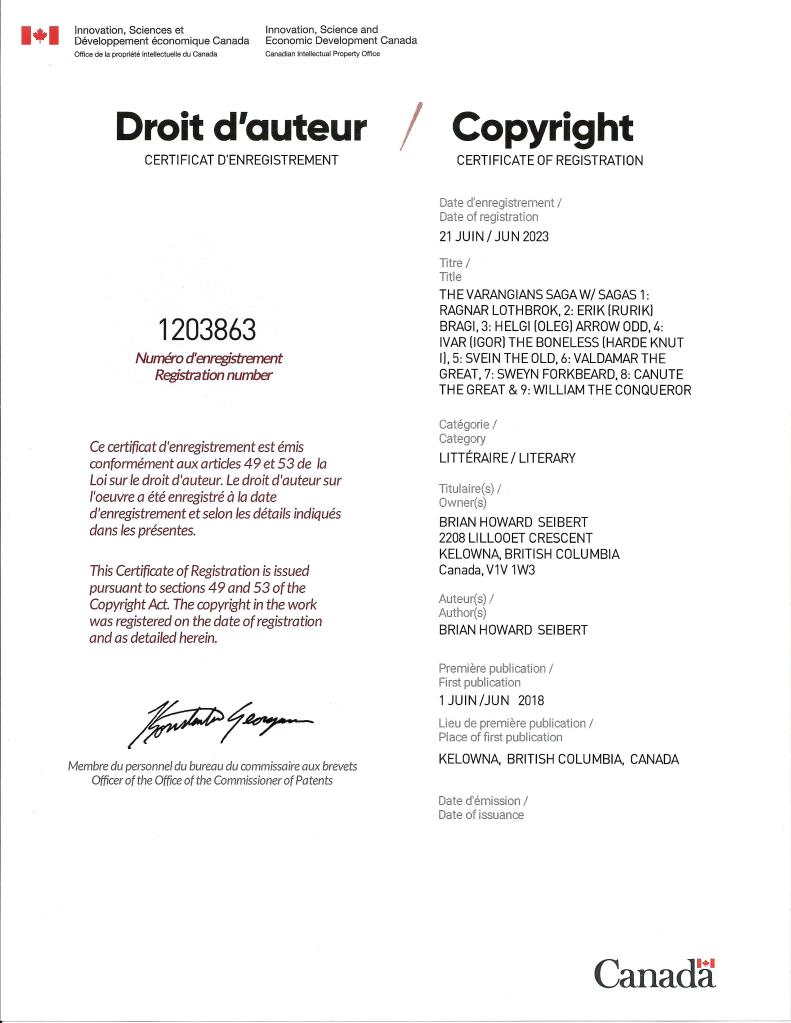
A Copyrighted Literary Work By
Brian Howard Seibert
© Copyright by Brian Howard Seibert
The title of the Copyrighted Literary Work ‘The VARANGIANS Saga Series’ was maximized to include the short form titles of the related Sagas included (but not limited) in the work as follows:
BOOK ONE: The Saga of King Ragnar ‘Lothbrok’ Sigurdson (Circa 800 – 822 CE)
BOOK TWO: The Saga of Prince Erik ‘Bragi’ Ragnarson (Circa 828 – 841 CE)
BOOK THREE: The Saga of Prince Helgi ‘Arrow Odd’ Erikson (Circa 839 – 912 CE)
BOOK FOUR: The Saga of Prince Ivar ‘the Boneless’ Erikson (Circa 896 – 945 CE)
BOOK FIVE: The Saga of Prince Svein ‘the Old’ Ivarson (Circa 943 – 976 CE)
BOOK SIX: The Saga of Grand Prince Valdamar ‘the Great’ Sveinson (Circa 968 – 990 CE)
BOOK SEVEN: The Saga of King Sweyn ‘Forkbeard’ Ivarson (Circa 986 – 1014 CE)
BOOK EIGHT: The Saga of King Canute ‘the Great’ Sweynson (Circa 1014 – 1035 CE)
BOOK NINE: The Saga of King William ‘the Conqueror’ Robertson (Circa 1036 – 1066+CE)
With Copyrighted Intellectual Property in the Work By
Brian Howard Seibert
© Copyright by Brian Howard Seibert
The Copyrighted Intellectual Property of the Work ‘The VARANGIANS Saga Series’ includes (but is not limited to) the following series of related ideas:
As well as making claim to a Literary Copyright, I, Brian Howard Seibert, lay claim to an Intellectual Property Copyright on a series of discoveries/ideas based upon four decades of research and evaluation that concludes that it was Danish kings and princes who founded what has come to be known as the Kievan Rus’ state with intellectual claims as follows:
BOOK ONE: The Saga of King Ragnar ‘Lothbrok’ Sigurdson is based upon Book Nine of The First Nine Books of the Danish History of Saxo Grammaticus and upon The Saga of the Volsungs. Because Ragnar ‘Lothbrok’ is the earliest and most legendary of the Hraes’ kings and princes, I waited until I had completed Book 8 before attempting Book 1 and, as Saxo, himself, saved Ragnar to the last of his Nine Books of Danish History, I am guessing he did the same for similar reasons. I am glad I waited, but many of my Book 1 theories remain from very early on in the research process and from them I hypothesized the following intellectual property discoveries:
1.1 That the famed shield called “Hrae’s Ship’s Round” mentioned in the Elder Edda was the shield that ‘Hrae’ Gunnar ‘Lothbrok’ Sigurdson took shelter under while attacking the Greek fire Breathing Byzantine bireme, Fafnir, and that the Hrae prename came from the roar of the pneumatically propelled Greek fire emulsion flame that flew from the firetube of the bireme.
“And his shield was called ‘Hrae’s Ship’s Round’,
And his followers were called the Hraes’.”
Eyvinder Skald-Despoiler; Skaldskaparmal
1.2 That the Rus’ were called ‘Dromitai’ by the Romans, meaning ‘men who run fast’, as an insult for the Rus’ retreat back up the riverways of Rus’ before the much larger army of the Khazars (Huns) in Saxo’s Book 5. This ‘men who run fast’ insult was continued forward when in 1018 AD Bishop Thietmar of Merseburg called the citizens of Kiev ‘Swift Danes and their Runaway Slavs’ after the Rus’ abandoned Kiev before the armies of the Germans and Poles. It was further carried on into 1040 AD when the English began calling their King Harald, successor of Canute, ‘the Harefoot’, meaning ‘the Swift’ as an insult and not ‘fleet of foot’ as is often surmised.
“These sentences give good sense if we abstract the words Áŋœřȧȿ … ßàþõ, for we then get left with the ordinary aetiological explanation of the two names of the Rus’, ‘Rhos’ and ‘Dromitai’: they are called ‘Rhos’ after the name of a mighty man of valour so called, and ‘Dromitai’ because they can run fast.”
Jenkins, Romilly: Studies on Byzantine History of the 9th and 10th Centuries.
1.2.1 That the Rus’ were called ‘Rhos’ by the Romans, after a mighty man of valour so called, this man being King Hraer (Hrothgar) of Zealand of the Beowulf poem. The Beowulf poem is actually a starvation story that befell the Danes of Zealand during a World Wide Cooling Period circa 500AD and King Hraer/Hrothgar received help against Grendal, a monstrous symbol of hunger, from Prince Beowulf, a Geat trader who took starving Danes south with him through the Austr Vegr (Eastern Way) to Dacia, at the mouth of the Danube, where they settled and flourished. In 536 AD a volcano erupted somewhere in the world and the ash caused a summerless season and the hunger returned to Denmark in the form of Grendal’s mother and Danes were dying once more. Prince Beowulf returned to aid King Hrothgar again and he took yet more Danes south through the riverways of Scythia to Dacia on the Danube. The Beowulf poem written in Anglia is actually a Hunger Analogy of a Great Danish Migration that followed the Great Gothic Migration that had occurred over a hundred years earlier for much the same reason.
This discovery added December 15th, 2025.
1.3 That the name Varangians comes from Vay, meaning Way, and Range, meaning to Wander, or Way Wanderers. In my early studies I learned that the Rang River in Iceland meant the Wandering River and Vay speaks for itself. Varangers were initially Wanderers of the Nor’Way as can be seen in the Varanger Fjord of the Northern Cape of Norway where the trading fleets gathered to catch the right wind to take them into the White Sea, which was the original Varangian Sea of the Sagas and Chronicles.
1.4 That the name Nor’Way comes from the original Northern Way trade route name for transportation and commerce of goods conducted across Norway’s North Cape and into the White Sea and the riverways of Northern Hraes’.
BOOK TWO: The Saga of Prince Erik ‘Bragi’ Ragnarson is based upon Book Five of The First Nine Books of the Danish History of Saxo Grammaticus and upon The Saga of King Heidrek ‘the Wise’ (aka Hervor’s Saga) by an unknown contemporary author. This was the first discovery. While preparing a University research essay on the origins of the play ‘Hamlet, Prince of Denmark’ by William Shakespeare, I read Books Three and Four of Saxo’s Nine Books of Danish History which contain the Tale of Prince Amleth, a story almost identical to the 16th century play that was compiled by Saxo in the 12th century. Reading on to Book Five of Saxo’s work I found a tale of two Norwegian brothers, Erik and Roller Ragnarson, who join their brother-in-law, King Frodi of Denmark, an Angle king of Jutland, in establishing a trading empire in Scythia that culminates in the famous Battle of the Goths and the Huns and the total victory of the Danes. Having studied Roman History in first year university and Khazar History in second, I came to the conclusion that this tale was about the 9th century entry of Varangians into Scythia and their conquest of Kiev from Khazar domination. In 1984 I set about turning Saxo’s 50 page Book Five History into a 500 page Historical Research Novel to investigate how well Saxo’s work, which he had placed in the time of Christ, would fare in 9th century Kievan Scythia. It did very well, and from it I hypothesized the following intellectual property discoveries:
2.1 That the Ragnar father and Kraka mother characters of the two Norwegian brothers in the saga were none other than King Ragnar ‘Lothbrok’ Sigurdson and Princess Aslaug ‘Kraka’ Sigurd-Fafnirsbanesdottir.
2.2 That Erik ‘the Eloquent’ Ragnarson was also known as King Heidrek ‘the Wise’ and Prince Rurik of Novgorod and perhaps Prince Horik of Jutland.
2.3 That King Roller Ragnarson of Norway later became Duke Rollo of Normandy.
2.4 That the three brothers of Saxo’s Book V, Erik, Roller and Frodi were the founding Varangian brothers, Rurik, Truvor and Sineus mentioned in the Russian Primary Chronicle.
2.5 That the children of King Frodi by Queen Alfhild, Princess Eyfura and Prince Alf, would play roles in the following two sagas.
2.6 That King Frodi ‘the Peaceful’ Fridleifson had assumed the Khazar title of Kagan of Kiev after taking the city from the Huns and that his brother-in-law, Prince Erik ‘Bragi’ Ragnarson, had assumed the title of Kagan-Bek.
“…along with his envoys the Emperor sent also some men who called themselves and their own people Rhos; they asserted that their king, Chacanus by name, had sent them to Theophilos to establish amity.”
Prudentius, Bishop of Troyes; Annales Bertiniani (839 AD)
2.7 According to the near contemporary Dudo of St. Quentin, writer of ‘Gesta Normannorum’:
“[Chapter] 5 Rollo is expelled from his native Dacia by an evil king”
“But in the region of Dacia there was, in those days, a certain old man [King Ragnar ‘Lothbrok’], most opulent with an abundance of all goods, and surrounded on all sides by a crowd of innumerable warriors, a man who never lowered the nape of his neck before any king, nor placed his hands in anyone else’s hands in committing himself to service. Holding almost the entire realm of Dacia, he claimed for himself the lands bordering on Dacia [Romania] and Alania [Scythia], and by force and power he subjugated the populace to himself through very many battles. For, of all the easterners, he was the mightiest due to his superior strength and the most distinguished due to his cumulated surplus of all the virtues. But when he died, his two sons, vigorous in arms, well-versed in warfare, in body most fair, in spirit most hardy, survived him. Truly the older of them was called Rollo [King Roller Ragnarson], but the other, the younger, Gurim [Prince Erik ‘Bragi the Old’ Ragnarson].”
Dudo’s chronicle goes on to tell us how the evil King of Dacia [King Frodi ‘the Peaceful’ of Denmark] drove Duke Rollo out of Dacia [Kievan Hraes’] and Rollo fled to Scania and then onward to Frankia where he carved out his own Duchy of Normandy. Perhaps this is how Rollo earned his byname ‘the Walker’, a more polite version of ‘the Swift’, or ‘Dromitai: one who flees from battle’.
This discovery added February 16th, 2025.
BOOK THREE: The Saga of Prince Helgi ‘Arrow Odd’ Erikson is based upon Book Five of The First Nine Books of the Danish History of Saxo Grammaticus and upon The Saga of Arrow Odd by an unknown contemporary author. Prince Helgi (Oleg) of Kiev (ruled c. 879-912) of the Chronicle corresponds with Helgi ‘Arrow Odd’ Erikson, of ‘Arrow Odd’s Saga’ fame, and was the bane of King Frodi and then his son, King Alf of Kiev. Prince Helgi (Oleg) ruled Kiev until his death from the poisonous bite of a snake that struck out from under the skull of a horse he had owned just after he had given it a kick, the same death that Arrow-Odd experiences in the Norse Saga. In the book I have hypothesized the following intellectual property discoveries:
3.1 That King Ragnar ‘Lothbrok’s death by poisonous snake bites was derived from the kenning for death by cuts of poisonous blood-snakes (swords) by twelve swordsmen so that no one person could be blamed for the death of the most famous Viking.
3.2 That Prince Helgi (Oleg) ‘Arrow Odd’s death by poisonous snake bite was derived from the kenning of death by a poisonous blood-snake (sword) under the skull of Faxi (the skull above the forestem of the longship ‘Fair Faxi’).
3.2a That Prince Helgi (Oleg) ‘Arrow Odd’s death by poisonous snake bite was an analogy for death from the STD Syphilis, which Helgi may have brought back with him from the Newfoundland. Once caught, Syphilis presented rather benign first and second stages, but it was the third unavoidable stage that appeared up to thirty years later that killed the victim, usually by attacking the shins and lower limbs, and in Helgi’s case, one foot in particular. This discovery added October 19th, 2023.
3.3 That Prince Helgi ‘Arrow Odd’ was the sea cow that killed King Frodi in Kiev because King Frodi had targeted Prince Helgi for death to avenge Helgi’s killing of Frodi’s twelve grandsons at the Holmganger on Samso.
3.4 That Prince Helgi ‘Arrow Odd’ killed King Frodi’s son and successor, King Alf ‘Bjalki’, in Kiev because he had refused to pay tithes to King Olmar of Tmutorokan.
3.5 That in the battle against Alf ‘Bjalki’ much witchcraft was used that is very similar to the witchcraft later used in the Battle of Hjorungavagr, namely the five arrows of death used by the spirit of Thorgerder Helgibruder and of Goddess Irpa.
3.6 That the Danish Great Heathen Army that attacked England in 867 AD originated out of Kievan Hraes’ (Rus’) and the Dnieper/Danube River Basin and was led by King Frodi ‘the Third’ Fridleifson of Hraes’ (Rus’) and Anglish Jutland in Denmark as stated in a contemporary report of that time:
Note on the Danish Great Heathen Army from ASSER’S LIFE OF KING ALFRED:
“The same year (866 AD) a great fleet of heathen came to Britain from the Danube,[51] and wintered in the kingdom of the East Saxons, which is called in Saxon East Anglia; and there they became in the main an army of cavalry.”
[51] Probably meaning the mouths of the Rhine (Stevenson).
[51] No. Probably meaning the Dnieper River and Kiev, which was at that time ruled by King Frodi ‘the Third’ Fridleifson who was also king of Anglish Jutland in Denmark. Asser may have stated the Danube as it was the closest European river to the Dnieper that would be known of by his audience. A hundred years later, Prince Svein ‘the Old’ Ivarson (Sviatoslav) of Kiev would move the Hraes’ (Rus’) capital from Kiev on the Dnieper to Pereyaslavets on the Danube, so, in the end, for a short time, Asser was correct (Brian Howard Seibert).
This discovery added August 30th, 2023.
3.7 That the Danish Great Heathen Army that attacked England in 867 AD originated out of Kievan Hraes’ (Rus’) and Denmark and was led by King Frodi ‘the Third’ Fridleifson of Hraes’ (Rus’) and Anglish Jutland in Denmark, a royal from ‘the Old Fridleif/Frodi Line of Danish Kings, and that references to the Great Heathen Army as being the ‘Scaldingi’ (Skioldungs) as stated in the ‘History of Saint Cuthbert’ chronicle of that time (and others):
“Chapter 12 of the HSC, after reporting once more on the crushing and slaying of the Northumbrian Kings Ælla and Osberht in 867 AD, says that ‘the Scaldingi slew nearly all the English in the southern and the northern parts [of England]’.”
Here the Scaldingi are the Skioldungs, the followers of the Skioldung King Frodi and, in the true fashion of the slavers that they had become, the Hraes’ Danes enslaved all captured English and transported them east to Kiev for sale in the slave markets of Baghdad (Brian Howard Seibert).
This discovery added September 10th, 2023.
3.8 The only Norwegian likely to have profited from King Frodi’s attack on Norway in 865 AD may have been King Harald ‘Fairhair’ Halfdanson, who may have sided with the Danish King Frodi. Leaving his last name be, the Hrafnsmal poem in his honour includes the lines:
“The highborn king [Haraldr] who took the Danish wife rejected the Holmrygir and the maidens of the Hordar, every single one from Hedmark and the family of Holgi (Helgi?).”
“How generous is [he] to those who guard [his] land, the excellent war-hastener [Warrior] to his men of skills?”
“Strife-displayers [Warriors] are greatly enriched, those who cast dice at Haraldr’s court. They are endowed with valuables and handsome treasures, with Hunnish metal and an eastern bondwoman.”
It would appear that King Harald ‘Fairhair’ took a Danish wife over his own Hordaland maidens and his men were rewarded with Hunnish gold and eastern bondmaidens (concubines?). King Frodi of Kiev had just defeated the Huns, so he likely had Hunnish metal and, being a slaver of monstrous proportions, he would have had access to innumerable eastern Slav concubines. He may have enticed Harald (Har ‘the Old’?) to join him in crushing Norway and allowed him to clean up and become the first full King of Norway (at least up to Halogaland, which is purported to have been named after Prince Helgi ‘Arrow Odd’).
This discovery added October 2nd, 2024.
3.9 The Anglo Saxon Chronicle entry for 883 AD claims that King Alfred ordered his ambassadors Sighelm and Athelstan to carry his pledged alms and gifts to Rome and also to India and the shrines of Saints Thomas and Bartholomew. The Roman Pilgrimage was central and easy, Alfred had made it himself years earlier, but the Indian pilgrimage was much harder, it being at the opposite end of the world from Alfred’s England. Alms to India would have been such a difficult offering that many historians claim that the Anglo Saxon Chronicle meant Judea, not India, but the Shrine of Saint Thomas was known to be in India, so, difficult or not, King Alfred ‘the Great’ dispatched Ambassadors Sighelm and Athelstan bearing alms to India.
Many scholars identify Bishop Sighelm of Sherbourne as Alfred’s Ambassador Sighelm. This seems quite plausible as return gifts of gems and spices from Indian Maharajas seem to have ended up in the Bishopric of Sherbourne. The identity of Ambassador Aethelstan is somewhat more elusive. There are few candidates with that name in the period involved and there is no confirmation of him having made it back nor any mentions of reciprocal gifts. There is one Athelstan, however, who appears to have been overlooked by all. And he had connections to a trade route that ran east, all the way to India.
There was a Viking named Guthrum who was one of the leaders of the Great Summer Army that arrived in Reading during April 871 to join forces with the Great Heathen Army for a planned conquest of the kingdoms of Anglo-Saxon England. The combined armies were successful in conquering the kingdoms of East Anglia, Northumbria, and parts of Mercia and overran Alfred the Great’s Wessex in January 878. The Great Heathen Army then attacked Chippenham, King Alfred’s royal stronghold, and most of the defenders were killed, except for King Alfred and a small band of followers. Some say he escaped, others say he was betrayed by some of his own Saxons and perhaps the Viking leader, Guthrum, captured and exiled the king and his band to Frankia. But Guthrum may also have gotten into the habit of collecting the beards of kings, and after divesting Alfred of his fine red beard, sent him off to Normandy!
King Alfred ‘the Great’ AEthelwulfson may have been received in Normandy by Prince Helgi ‘Arrow Odd’ Erikson, but under a different name, Raudgrani, which means: The Danish word “raud” means red, and from the Old Norse grani (“horse”), related to grǫn (“hair on the upper lip”), or ‘Red Moustache’, sans beard.
In ‘The Saga of Arrow Odd’ there is a character named Raudgrani who perhaps represented King Alfred ‘the Great’. The saga may also have a parallel character for Guthrum in a warlock named Ogmund ‘Eythjofsbane’ Tussock who was said to collect the beards of kings, weaving the hairs into a magical cloak that allowed him to have power over the kings and their lands. In the saga Raudgrani joins forces with Arrow Odd in Normandy and they lead a fleet, sailing under the Raven Banner of Ragnar ‘Lothbrok’, in an attack upon a monstrous Finngalkin in East England, the monster perhaps representing the forces of Ogmund/Guthrum who was ultimately defeated by Alfred at the Battle of Edington in 878. The Danube Danes retreated to their stronghold, where Alfred laid siege and eventually Guthrum was allowed to surrender after promisng to convert to Christianity. King Alfred sponsored his baptism, giving him the Christian name of Athelstan. This Athelstan was likely the mysterious ambassador to India who never seems to have returned.
The Siege of London of 883:
For many centuries the Romano British city of London had been left abandoned by the Anglo Saxons and was often occupied by Vikings, who sometimes sought shelter behind the Roman built walls of the city. Such was the case in 883 AD, when King Alfred became determined to drive occupying Vikings out from the shelter of Fortress London. Alfred was finding much fortune in the calling upon of saints in dreams so, it is likely that at the start of his siege of London, he’d had a dream of Saint Thomas of India promising him more success against Vikings if he but sent alms to the Shrine of Saint Thomas in India.
Did Guthrum of The Danelaw Meet With King Alfred To Offer The Dan’Way Trade Route as a Possible Pilgrimage to India?
While Ambassador Sighelm has been substantially identified as Bishop Sighelm of Sherbourne, the identity of Ambassador Athelstan has been elusive up until now. As can be ascertained from the above sources, it is possible that the Danish General Guthrum himself, as the Christian King Athelstan of the Danelaw, was Ambassador Athelstan. Through his true liege lord, King Frodi ‘the Peaceful’ of Kievan Hraes’ and Denmark, he would have had access to the Dan’Way Trade Route via the Baltic and Scythia all the way to Baghdad and perhaps on to India.
Fragments of both the Dan’Way and Nor’Way Trade Routes ended up in King Alfred’s translation into Old Saxon of Orosius’ Latin ‘The Geography of Europe’ and they both describe the trade routes all the way to the boundaries of Europe and no further. This would be expected, for, after all, it is a geography of Europe and not Asia.
On Guthrum’s advice, a Viking named Wulfstan may have been summoned to Westminster to outline the Dan’Way Trade Route with an offer of payment for aid with the alms for India. Or was Wulfstan a derogatory name King Alfred may have given to Athelstan for failing to return from the east? The Christian convert Athelstan having become a Wulf in sheep’s clothing as it were? At any rate, this Wulfstan gave King Alfred a description of the European end of King Frodi’s Dan’Way Trade Route to Baghdad, which Alfred included in his European Geography.
After Guthrum/Athelstan of The Danelaw failed to return from an eight month pilgrimage to India, King Alfred ‘the Great’ of Wessex may have sent for Prince Helgi ‘Arrow Odd’ Erikson of Normandy to discuss a second embassy. It would have been unnerving for King Alfred to learn from his latest guest Ohthere (Arrow Odd) that Athelstan (Guthrum), whom Alfred had earlier sent off with gold and gifts down the Dan’Way Trade Route on an embassy to India, was none other than Ogmund ‘Eythjofsbane’ Tussock, the war leader of the ‘Great Heathen Army’ of the Danube Danes that had ravaged England almost two decades earlier. Perhaps that is why a second embassy led by Sighelm was required. Ohthere (Arrow Oddr) gave King Alfred a description of the European end of King Ragnar ‘Lothbrok’s Nor’Way Trade Route to Baghdad, which Alfred also included in his European Geography.
But it took King Alfred more than three years to succeed with his siege of London. It was not until 886 AD that the Vikings were driven out of London. Perhaps it took Sighelm two years to complete his embassy, for he seems to have returned from India with many gifts and spices from likely numerous Maharajas. Prince Helgi ‘Arrow Odd’ likely returned as scheduled and kept King Alfred apprised of Ambassador Sighelm’s progress. Helgi would have been a busy prince at this time as he assisted Sighelm with his embassy while running the Nor’Way Trade Route and aiding his uncle, Duke Rollo, in the defence of Paris. But Sighelm and his Embassy would have completed their business, returning in the fall of 885, and by 886, London would once again be in English hands.
King Alfred ‘the Great’ rallied the saints of England and India up against the pagan witchcraft of the invading Heathens and from the low swamps of Athelney he built an army that took back England from the clutches of the Danube Danes in an effort that can be termed nothing short of a miracle.
This discovery added March 26th, 2025.
BOOK FOUR: The Saga of Prince Ivar ‘the Boneless’ Erikson is based upon Book Six of The First Nine Books of the Danish History of Saxo Grammaticus and upon The History of Leo ‘the Deacon’ by Leo ‘the Deacon’ of Constantinople, a contemporary author. Prince Eyfur (grandson of King Frodi) aka Ivar (Igor) of Kiev (ruled c. 912-945) of the Chronicle, corresponds with King Fridleif of Book Six of Saxo’s History and is also likely King Harde Knute I, who appears in Denmark for a twenty year period that corresponds with a twenty year lacuna in the Chronicle’s history. His descendants form a whole line of Danish kings called the Knotlings. In the book I have hypothesized the following intellectual property discoveries:
4.1 That Prince Ivar (Igor) of Kiev was Ivar ‘the Boneless’ of Scandinavian Sagas.
“Erik ‘Bragi’ came to me in a dream and he said, ‘Ivar the Boneless is Prince Igor of Kiev’, so I researched Ivar the Boneless. It was said in the Sagas that he had no bones in his legs. Then I researched Prince Igor of Kiev, hoping to find a similar nickname, but I could find none.
‘Show me,’ I pleaded with Erik. ‘Show me.’ He came to me in a dream again and repeated ‘Ivar the Boneless IS Prince Igor of Kiev.’ So I researched further and read The History of Leo ‘the Deacon’ and Leo relates how Emperor John Tzimiskes tells Ivar’s son Svein what had happened to his father: ‘on his campaign against the Germans, he was captured by them, tied to tree trunks, and torn in two.’
But Prince Erik said, ‘Prince Igor of Kiev IS Ivar the Boneless.’ Perhaps he did not die from this Roman form of execution. The Sagas also said he fought while borne into battle upon a shield so perhaps he was maimed by the attack. But even if he did die, he still would have been called ‘the Boneless’ post-mortem anyway. It was the Viking way.”
Comments: ‘The History of Leo ‘the Deacon’ as read by BH Seibert
4.2 That Prince Ivar (Igor) of Kiev was the son of Princess Eyfura Frodisdottir and may have originally been named Eyfur, the masculine form of Eyfura (meaning Island Fir or Pine). His father may have been Prince Erik ‘Bragi’ Ragnarson with Ivar once again tying the royal lines of ‘the Old Fridleif-Frodi Line of Anglish Danish kings’ with the Ragnar ‘Lothbrok’ Sigurdson Line of Norwegian Danish kings. Eyfur was an uncommon name and Ivar and sometimes Ingvar was used with Igor being the Slavic form of the name.
4.3 That Prince Ivar ‘the Boneless’ Erikson (and Eyfurason) of Kiev returned to Denmark as King Harde Knute I. Solely from a point of ‘Due Diligence’, I checked Danish History to see if a new Danish king had happened to turn up during a twenty year lacuna in the story of Prince Ivar (Igor) of Kiev in the Hraes’ Primary Chronicle between the years 916 and 936 AD and, unexpectedly, an unknown king had shown up! A King Harde Knut I of Denmark reigned from circa 915 AD for about thirty years according to Adam of Bremen, a contemporary historian, so, to about 945 AD, which is the year the Hraes’ Primary Chronicle tells us that Prince Ivar (Igor) of Kiev died! But Prince Igor reappears in the Hraes’ chronicle in 936, so it is possible that he ruled both lands.
The name ‘Harde Knut’ in Danish means ‘Hard Knot’, and I expostulated that it was a hard knot indeed that took the legs of our young prince. Harde Knut ‘the First’ was the start of a long line of Knot Kings or Knytlings, starting with several Canutes, Knuts, Knuds and many more Harde Knuts, all stemming from one of the most famous of Vikings, Prince Ivar ‘the Boneless’. There were no Knuts of any kind before him, but many after, and the preponderance of evidence continues to grow. King Harde Knut’s son in Denmark was King Gorm ‘the Old’, Gorm meaning worm or Snake and ‘the Old’ from the ‘Old’ Fridleif-Frodi line of Anglish Danish kings. His son in the east, as Prince Ivar ‘the Boneless’, was Prince Svein ‘the Old’, or Sveinald, with Svein meaning Swine and, again, ‘Old’ of the Fridleif-Frodi line. A storm is brewing here, the Swine being a mortal enemy of the Snake, the ‘Snake’-King AElla of York having taken the life of ‘the Old Boar’, King Ragnar ‘Lothbrok’, and Gorm’s byname being ‘ the Englishman’, perhaps signifying his mother was an English princess from York, perhaps Princess Blyia, granddaughter of AElla. In the novel we explore the most famous death of Ragnar ‘Lothbrok’ and the vengeances that were unleashed upon AElla and his line.
4.4 That Prince Fridleif ‘Hiarnsbane’ Frodeson of Book Six of Saxo’s Danish History was Prince Ivar ‘the Boneless’ Erikson (and Eyfurason) and he returned to Denmark from Hraes’ and killed the elected King Hiarn of Denmark and reclaimed his grandfather’s throne as king of the Anglish Danes of Jutland.
4.5 There is a fragmented Swedish Saga, the ‘Saga of Ingvar the Far Traveller’, that has had Swedish parts appended to the start and finish of the saga, but is primarily of Danish origin about Prince Ivar (Igor) ‘the Boneless’ of Kiev and his son, Prince Sveinald (Sviatoslav) ‘the Brave’ of Kiev. In it there is much information about Ivar’s attempt to extend a trade route through the eastern part of Scythia to the Caspian Sea and on from there to Baghdad.
Prince Ivar ‘the Boneless’ led a 943 AD expedition up the Kura River and captured Bardha’a, the capital of Arran. The Hraes’ allowed the locals to stay in the city, but according to the Arab chronicler Ibn Miskawaih, the local people broke the peace and Ivar ‘the Boneless’ and his warriors stayed in Bardha’a for several months plundering adjacent areas and garnering much booty.
The city was relieved by an outbreak of dysentery among the Hraes’ and Ibn Miskawaih records that the Hraes’ “indulged excessively in the fruit of which there are numerous sorts there. This produced an epidemic among them . . . and their numbers began thereby to be reduced.” When a Muslim army approached the city the Hraes’ sallied forth, their prince, Ivar ‘the Boneless’ riding out on a donkey, but they lost 700 warriors and retreated back into the Bardha’a fortress, where they were besieged. Finally they fled the fortress under cover of darkness, carrying on their backs all they could of their treasure, gems, and fine raiment, boys and girls as they wanted, and made for the Kura River and their ships and escaped back to Tmutorokan. Prince Ivar ‘the Boneless’ led the escape, no doubt still riding the donkey, as he had no legs, but the disease took its toll and he died shortly afterward. The Muslim army may have been composed of many Pashtun soldiers, giving rise to the Armenian born Eastern Roman Emperor John Tzimiskes’ belief that it was while on his campaign against these Germans that Prince Ivar (Igor) of Kiev lost his life.
This discovery added February 16th, 2025.
4.6 Prince Ivar ‘the Boneless’ of Kiev may have posed as King Hagrold (Gold Harald) of Dacia in order to save the life and rule of a young prince of Normandy, the western holding of the Hraes’ Trading Company. He posed as King Hagrold (Gold Harald) of Dacia instead of Prince Ivar (Igor) of Kiev or King Harde Knute of Denmark so that he could attack the Franks with impunity without putting his Dan’Par trade route at risk.
According to the near contemporary Dudo of St. Quentin, writer of ‘Gesta Normannorum’:
“Chapter 40 The two Bernards enlist the aid of Richard’s relative, King Hagrold of Dacia, against King Louis:”
Following the assassination of the great Duke William, King Louis kidnapped his son Richard, and kept him hostage in Paris. Meanwhile, King Louis tarried in Rouen, setting Norman affairs in order as though he were lord, pretending that he was indeed the king and advocate of the Normans.
“The Norman magnates sent warriors of rather influential nobility and wealth to Hagrold [Gold Harald], King of Dacia, so that he would hasten to assist his relative Richard, son of the great Duke William, because the king of the Frankish nation was claiming for himself the monarchy of all Normandy, taking away by force every honor from the boy Richard, even though the boy had been plucked from Louis’ chains.
“Truly Hagrold, the magnanimous King of Dacia, honorably received the Norman ambassadors, for love of his close relative Richard and, having constructed ships and filled them with victuals and warriors, came as quickly as he could with an incredible multitude of young recruits…”
King Hagrold [Gold Harald] met King Louis in battle and captured him, thereby gaining Duke Richard back his Duchy of Normandy.
This discovery added February 16th, 2025.
BOOK FIVE: The Saga of Prince Svein ‘the Old’ Ivarson is based upon Book Six of The First Nine Books of the Danish History of Saxo Grammaticus and upon The Hraes’ Primary Chronicle. Prince Svein ‘the Old’ Ivarson or Sveinald (Sviatoslav) of Kiev (ruled c. 945-972) of the Chronicle corresponds to King Frodi of Book Six of Saxo’s History. This Svein is Sviatoslav ‘the Brave’ who almost defeated the whole Eastern Roman Empire before getting himself booted out of Rus’ in favour of his three sons, Yaropolk (Ivar), Oleg (Helgi) and Vladimir (Valdamar). Prince Svein returns to Denmark as King Sweyn Forkbeard and culminates his career by conquering England on Christmas Day of 1013 before being poisoned 5 weeks later. The second Hraes’ prince to come from Kiev to take his place as a Danish king was Prince Svein ‘the Old’ Ivarson, or Sveinald, who took the throne from his nephew, King Harald ‘Bluetooth’ Gormson, son of King Gorm ‘the Old’ Knut/Ivarson after his victory at the Battle of Hjorungavagr. In this Book 5 I have hypothesized the following intellectual property discoveries:
5.1 That Prince Svein (Slavic: Sviatoslav) did not die in the 972 AD attack of Pechenegs at the Ford of Vrar as told in the Hraes’ Primary Chronicle, as the tale of his skull being turned into a cup was a Roman fiction lifted from the death of Roman Emperor Nicephorus ‘the First’ a hundred years earlier, who had his skull turned into a cup by Khan Krum of Bulgaria. Prince Sviatoslav’s General Sveinald, who escaped the battle and made his way to Kiev, was actually Prince Sveinald himself and he did make it to Kiev to celebrate the gifted survival of his earlier Battle of Dorostolon against Emperor John Tzimiskes of Rome.
5.2 That Prince Svein left Hraes’ to his three sons, Ivar, Helgi and Valdamar, and went to Denmark and met with Harald ‘Bluetooth’ and then left for Norway with Jarl Haakon Sigurdsson, where he was adopted by the jarl and befriended by his son Eirik.
5.3 That Prince Svein was also known as Gold Harald because he was quite rich when compared against his nephew, King Harald ‘Bluetooth’, who was historically lacking in wealth.
5.4 That Prince Svein was victorious at the famed Battle of Hjorungavagr and that he pursued and drove King Harald ‘Bluetooth’ out of Roskilde and took his court as King Sweyn ‘Forkbeard’ Ivarson of Denmark.
5.5 That Prince Svein/King Sweyn is also portrayed as King Frodi, the second king in Book Six of Saxo’s Danish History.
BOOK SIX: The Saga of Grand Prince Valdamar ‘the Great’ Sveinson is based upon Book Six of The First Nine Books of the Danish History of Saxo Grammaticus and upon The Hraes’ Primary Chronicle. Prince Valdamar (Vladimir) ‘the Great’ of Kiev (ruled c. 980-1015) of the Chronicle, corresponds with King Ingjald of Book Six of Saxo’s History and would, years later, return to the west as King Canute ‘the Great’ of England, Denmark and Norway, (ruled c. 1016-1035) after the death of his father, King Sweyn Forkbeard of England. Coincidentally, just as his great great grandfather King Frodi had married a Khazar princess to gain the title Kagan, so too did Prince Valdamar of Kiev marry the Roman Princess Anna Porphyrogennetos (meaning born of the purple) to gain the title of Czar (Caesar) for all his subsequent offspring in Russia. In this Book 6 I have hypothesized the following intellectual property discoveries:
6.1 That Grand Prince Valdamar ‘the Great’ of Kiev corresponds with the third royal, King Ingjald of Book Six of Saxo’s Danish History and would, years later, return to the west as King Canute ‘the Great’ of England, Denmark and Norway. The wanton profligacy of both characters matches unmistakably.
6.2 That when young Prince Valdamar fled to the Varangians to escape the wrath of his older brother Ivar, who had just killed their middle brother Helgi, he sought sanctuary with Jarl Haakon of Lade in Norway and with Prince Svein, his father, who was living there. They returned to Hraes’ with a Norwegian army and the two Varangians who killed Prince Ivar for his fratricide were none other than Prince Svein and Jarl Eirik Haakonsson (Blud).
6.3 That Prince Valdamar (Slavic: Vladimir) did not die of disease in 1015 AD as told in the Hraes’ Primary Chronicle, as the tale of his body being rolled up in a carpet and lowered down a floor was a Roman fiction lifted from the death of Roman Emperor Nicephorus ‘the Second’ a few decades earlier, when he was murdered by John Tzimiskes in his palace in Constantinople. This same Roman tale is carried on into the deaths of Princes Boris and Gleb and their manservant who was beheaded after death, as was Emperor Nicephorus.
BOOK SEVEN: The Saga of King Sweyn ‘Forkbeard’ Ivarson is based upon The Saga of the Jomsvikings and upon The Anglo Saxon Chronicle. In this Book 7 I have hypothesized the following intellectual property discoveries:
7.1 That King Sweyn ‘Forkbeard’ waged a decades long series of raids against England for both wealth and slaves to feed his Hraes’ trade routes through Scythia to Constantinople and Baghdad.
7.2 That King Sweyn’s slave trading business was partially responsible for the enslavement of Prince Olaf Tryggvason and led to the later Christianization of Olaf in England and the resulting conflicts between the two royals when Olaf became the Christian King of Norway, likely with English support.
7.3 That King Athelred ‘the Unready’ of England ordered the Saint Brice’s Day massacre of Danes in 1002 AD in retribution against King Sweyn for his slaying of King Olaf at the Battle of the Svold in 1000 AD.
7.4 That the massacre led to an outright war between the Danes of Denmark, Hraes’ and Normandy and the Saxons of England. King Sweyn was helped in this decade long war by his son, Grand Prince Valdamar (Vladimir) ‘the Great’ of Kiev, which may help account for the paucity of events in the Hraes’ Primary Chronicle on the rule of Prince Vladimir in this period. King Sweyn forced King Athelred out of England and took his throne Christmas Day of 1013 AD, but was dead, likely poisoned, by February of 1014 AD. His son, Prince Valdamar ‘the Great’ was elected King of England after his father’s death, but King Athelred returned from exile in Normandy and the English rose up in revolt and drove Prince Valdamar out of England.
7.5 That Prince Valdamar fled with his fleet, but stopped on the Isle of Sandwich on his way south east and maimed 200 hostages that his father had taken over the years and left them on the sands of Sandwich. By royal rights he could have slain them all there but he did not, because even in Kiev, after becoming a Christian, he would no longer execute capital criminals for fear of God’s retribution in the afterlife. Also, Prince Valdamar’s maimings were selectively deliberate, as the Hraes’ had always retrained their own maimed warriors for other military tasks and Valdy had future plans for his maimed hostages when he returned from Hraes’ to retake England.
7.6 That during this period of decades long strife with the English, King Sweyn financed his wars with profits from fur and slave trading through the riverways of Hraes’ and that this terrible trade had always fully financed ‘The Great Viking Manifestation of the Middle Ages’.
7.7 That the Hraes’ Danes of Denmark had begun direct sailings to the Newfoundland and had extended their vast trading network up the Kanata (Canada) River (St. Laurence) and into the Great Lakes and down the Mississippi River which was soon to become the Valley of the Mound Builders.
7.8 That Chapter 13 of Erik ‘the Red’s Saga describes the Hraes’ Cavalry Legion of the One Footers, soldiers that had lost a leg in battle and had been trained to become cavalry officers, as follows:
“One morning Karlsefni’s people beheld as it were a glittering speak above the open space in front of them, and they shouted at it. It stirred itself, and it was a being of the race of men that have only one foot, and he came down quickly to where they lay. Thorvald, son of Eirik the Red, sat at the tiller, and the One-footer shot him with an arrow in the lower abdomen.”
“Then they journeyed away back again northwards, and saw, as they thought, the land of the One-footers. They wished, however, no longer to risk their company.”
“Now, when they sailed from Vinland, they had a southern wind, and reached Markland, and found five Skrœlingar; one was a bearded man, two were women, two children. Karlsefni’s people caught the children, but the others escaped and sunk down into the earth. And they took the children with them, and taught them their speech, and they were baptized. The children called their mother Vœtilldi, and their father Uvœgi. They said that kings ruled over the land of the Skrœlingar, one of whom was called Avalldamon, and the other Valldidida. They said also that there were no houses, and the people lived in caves or holes. They said, moreover, that there was a land on the other side over against their land, and the people there were dressed in white garments, uttered loud cries, bore long poles, and wore fringes. This was supposed to be Hvitramannaland (whiteman’s land). Then came they to Greenland, and remained with Eirik the Red during the winter.”
The above caves or holes are apt descriptions of the longhalls reconstructed at L’Anse Aux Meadows, the Viking settlement in Newfoundland. The men in white garments bearing long poles and wearing fringes are knights. The above descriptions have been in Erik ‘the Red’s Saga for over a thousand years and people still don’t get it? Learn your history or you are doomed to repeat it!
7.9 That Chapter 13 of Erik ‘the Red’s Saga, in describing the Land of the One Footers, may have been using a derogatory term for the Hraes’ traders of the Newfoundland who had caught the STD Syphilis, which may have been prevalent in the local Indigenous population which had become essentially immune. Once contracted by the newcomers, Syphilis presented rather benign first and second stages, but the third unavoidable stage appeared between one to thirty years later and killed the victims, usually by attacking the shins and lower limbs, and with the Hraes’ traders, perhaps one foot in particular, giving them the byname ‘One Footers’.
This discovery added October 19th, 2023.
BOOK EIGHT: The Saga of King Canute ‘the Great’ Sweynson is based upon Book Ten of The First Nine Books of the Danish History of Saxo Grammaticus and upon The Anglo Saxon Chronicle. In this Book 8 I have hypothesized the following intellectual property discoveries:
8.1 That King Sweyn ‘Forkbeard’ Ivarson of Denmark was helped in his decade long war against the Saxons of England by his son, Grand Prince Valdamar (Vladimir) ‘the Great’ Sveinson of Kiev, which may help account for the paucity of events in the Hraes’ Primary Chronicle on the rule of Prince Vladimir in this period. King Sweyn forced King Athelred out of England and took his throne Christmas Day of 1013 AD, but was dead, likely poisoned, by February of 1014 AD. His son, Prince Valdamar ‘the Great’ was elected King of England after his father’s death, but King Athelred returned from exile in Normandy and the English rose up in revolt and drove Prince Valdamar out of England and back to Kievan Hraes’, which he had already given over to his many sons to rule.
8.2 That Prince Valdamar planned to continue his father’s war against the Saxons of England, financing his war with profits from fur and slave trading through the riverways of Hraes’ and with gold that was being obtained through trade the Hraes’ Danes of Denmark and Kiev had begun earning through direct sailings for trade in the Newfoundland, extending their vast trading network up the Kanata (Canada) River (St. Laurence) and into the Great Lakes and down the Mississippi River and the Valley of the Mound Builders.
8.3 That Prince Valdamar ‘the Great’ changed his title and name to King Canute ‘the Great’ to facilitate his acceptance as king by the English as a new Latin Christian convert versus his former Orthodox Christian faith because the Great Schism between Latin and Orthodox Christianity was growing exponentially.
8.4 That in late 1014 AD Prince Valdamar returned to Hraes’ to raise an army to facilitate his reconquest of England and in January of 1016 AD he led this army south through Hraes’ where his Black Sea fleet was augmented by Roman bireme ships loaned him by his brother-in-law, Emperor Basil of Constantinople, and that, for this favour, Prince Valdamar trained his army by attacking Khazars in Scythia for the Romans. Valdy needed these large ships to defeat the new English ships (Cogs) that had been built to defeat Viking longships quite effectively.
8.5 That Prince Valdamar’s eldest son, Prince Svein (Slavic: Boarus), left Kiev in the hands of his brother, Prince Sviatopolk, and helped his father raise said army and then led them south, not against Pechenegs as described in the Hraes’ Primary Chronicle, but against said Khazars and that he was assisted in this by his adopted brother, Prince Godwin of Sussex (Slavic: Gleb), who had come with Prince Valdamar in his retreat from England. Saints Boris and Gleb of Kievan Rus’ are likely Prince Sveinald of Kiev, grandson of King Sweyn, and Prince Godwin, son of Wolfnoth Cild of Sussex:
From Wiki: Gleb (Ukrainian: Гліб) is a Slavic male given name derived from the Old Norse name Guðleifr, which means “heir of god.” It is popular in Ukraine due to an early martyr, Saint Gleb, who is venerated by Eastern Orthodox churches and is the Ukrainian form of the Old Norse name Guðleifr, which was derived from the elements guð “god” and leif “inheritance, legacy”.
From Wiki: Godwin was born c. 1001, likely in Sussex. Godwin’s father was probably Wulfnoth Cild, who was a thegn of Sussex. His origin is unknown but ‘Child’ (also written Cild) is cognate with ‘the Younger’ or ‘Junior’ and is today associated with some form of inheritance. In 1009 Wulfnoth was accused of unknown crimes at a muster of Æthelred the Unready’s fleet and fled with twenty ships [the new larger and taller ships]; the ships sent to pursue him were destroyed in a storm.
From The Rus’ Primary Chronicle 1953: 119, 250 n103 and Franklin and Shepard 1996: 200):
“The Byzantine historian John Skylitzes tells of a certain Sphengos, prince of the Rus, who cooperated with a Byzantine naval expedition against ‘Khazaria’ in [January of] 1016. ‘Sphengos’ is probably a Greek enunciation of a Scandinavian name such as Svein or Sveinki. At around the same time Mstislav himself is reported to have subjugated the Kasogians (the Adyge of the Kuban region and northern Caucasus)”.
8.6 That Prince Sveinald ‘Boarus’ Valdamarson returned to Hraes’ from helping his father in his war on England and was slain by his brother, Sviatopolk, who did not want to give up his throne in Kiev. Prince Godwin ‘Gleb’ Wulfnothson of Sussex seems to have returned with him and is said to have also been slain, but this is likely false, as Godwin survived. The writers of the Hraes’ Primary Chronicle continue killing off every prince that leaves Rus’. Even the evil Prince Sviatopolk is killed off as he is driven out of Rus’ by Prince Yaroslav. His bones supposedly grow soft as he rides to Hungary and sanctuary, but the disease kills him of course. Perhaps he was struck down by the same disease that set upon Prince Ivar ‘the Boneless’.
8.7 That Prince Valdamar ‘the Great’, having returned to England as King Canute ‘the Great’, defeated King Edmund Athelredson at the Battle of Assandun on October 18, 1016 AD, and though agreeing to share the kingdom, Canute captured Edmund five weeks later in a siege (that included the war crime of crossbow slaying of defecating soldiers) and sent Edmund and 800 of his retainers, including at least two of his sons, as prisoners back to Kievan Hraes’.
8.8 That in 1018 AD King Boleslaw of Poland, with German assistance, attacked Kiev, possibly in an effort to free King Edmund, and that Bishop Thietmar of Merseburg described the Kievan Hraes’ populace of that time as being ‘Swift Danes’ and their ‘Runaway Slaves’ (meaning Slavs) and that this description is meant to be an insult to the Danish rulers of Kiev by the historian in that it refers to the Roman reference to the Hraes’ two centuries earlier as Dromitai, ‘those who run fast’, as in ‘run from battle’. Prince Ivaraslav (Yaroslav) Valdamarson and his Danes fled Kiev before the attack for the safety of Novgorod according to the Hraes’ Primary Chronicle. The ‘Swift Danes’ insult is carried forward to Valdamar’s son, King Harald ‘Harefoot’ Canuteson, of England, the Harefoot meaning ‘one who flees fast’ and not the ‘fleet of foot’ as it is often interpreted. King Edmund and his retainers had already been sent on to serve in the Varangian Guard of Emperor Basil in Constantinople, but King Boleslaw did seem to have saved two of Edmund’s sons, Edmund Junior and Edward ‘the Exile’, as they were rescued and sent to safety in the Hungarian royal court that Prince Sviatopolk later fled to.
8.9 That in 1024 AD, according to the contemporary Roman History of John Skylitzes, King Edmund may have attempted to escape from service in Constantinople with his retainers and return to England, when it was recorded that a relative of Vladimir’s named Chrysocheir, meaning Gold Hand or Edmund, with a company of 800 men were slaughtered after refusing to lay down their arms in Constantinople. It must be remembered that later, King Harald ‘Hardruler’ Sigurdsson of Norway was also sent into exile in Kievan Hraes’ and then the Varangian Guard in Constantinople from which he escaped successfully. Here is historian Alex Feldman’s interpretation of the event:
FROM ROSSICA ANTIQUA 2018, The First Christian Rus’ Generation:
Contextualizing the Black Sea Events of 1016, 1024 and 1043 by Alex Feldman
The same can be said for another episode mentioned exclusively by Skylitzēs, dating to 1024, when a squadron of Rus’ allegedly attacked imperial positions south of Constantinople (Skylitzes Ioannis 1973: 368 [16:46]8). In Wortley’s translation (Skylitzes Ioannis 2010: 347):
“Anna, the emperor’s sister, died in Russia, predeceased by Vladimir, her husband. Then a man named Chrysocheir, a relative of his, embarked a company of eight hundred men and came to Constantinople, ostensibly to serve as mercenaries. The emperor ordered him to lay down his arms and then he would receive him but [the Russian] was unwilling to do this and sailed through the Propontis. When he came to Abydos he gave battle to the commander there whose duty was to protect the shores and easily defeated him. He passed on to Lemnos where, beguiled by offers of peace, they were all slaughtered by the navy of the Kibyrrhaiote [theme], the commander of Samos, David of Ochrid, and the duke of Thessalonike, Nikephoros Kabasilas”. Wortley claims in a corresponding footnote that “this episode reveals how the Varangian guard was replenished.” While this supposition seems fair, due to this episode’s appearance in this source alone, I would be cautious to assign too much weight to any given theory, such as that of Blöndal and Benedikz (Blöndal, Benedikz 1978: 50), for example, who propose that the name of the Rus’ leader itself, Chrysocheir, could be read as Eadmund, and therefore tie “English noblemen” to Kiev as early as the first quarter of the 11th century.
From Wiki:
‘In the view of M. K. Lawson, the intensity of Edmund’s struggle against the Danes in 1016 is only matched by Alfred the Great’s in 871, and contrasts with Æthelred’s failure. Edmund’s success in raising one army after another suggests that there was little wrong with the organs of government under competent leadership. He was “probably a highly determined, skilled and indeed inspiring leader of men”. Cnut visited his tomb on the anniversary of his death and laid a cloak decorated with peacocks on it to assist in his salvation, peacocks symbolising resurrection.’
King Canute may have exiled King Edmund to the east until he got his Great Northern Empire established, planning to resurrect King Edmund in Wessex as one of the kings under Emperor Canute’s command. Valdamar would need legitimate kings subject to him if he was to be seriously considered as a true Emperor or Caesar to compete with the Czar title that his son, Ivaraslav (Yaroslav) carried by blood.
BOOK NINE: The Saga of King William ‘the Conqueror’ Robertson is based upon TBA. In this Book 9 I have hypothesized the following intellectual property discoveries:
9.1 In 1240 AD, English historian Matthew Paris recorded in his Chronica Majora that:
“Rumour abounded in England that the Danes were preparing to invade
the kingdom. This did not, however, happen, for the ships loaded with
men and women were sent elsewhere in order to repopulate, cultivate
and occupy the lands that the Mongols had devastated.”
The above was his entry for 1240 AD and seems to indicate that King Valdamar ‘the Second’ had been preparing a fleet for an impending attack on England, but an event had occurred to change his plans: Kievan Hraes’ was once more under attack from the east. But this time it was the Mongols. In 1240 AD King Valdamar ‘the Second’ of Denmark sent aid to Kiev because the Danes were the original Hraes’ Varangian founders of Kievan Hraes’ which eventually became Ukraine.
This discovery added August 27th, 2025.
To be Continued…
BOOK BY BOOK SUMMARY OF THE VARANGIANS / UKRAINIANS BOOK SERIES
BOOK ONE: The Saga of King Ragnar ‘Lothbrok’ Sigurdson (Circa 800 – 822 CE)
BOOK ONE: King Ragnar ‘Lothbrok’ Sigurdson’s third wife, Princess Aslaug, was a young survivor of the Saga of the Volsungs and was a daughter of King Sigurd ‘the Dragon-Slayer’ Fafnirsbane, so this is where Ragnar’s story begins in almost all the ancient tales (except Saxo’s). In our series, we explore this tail end of the Volsungs Saga because King Sigurd appears to be the first ‘Dragon-Slayer’ and King Ragnar ‘Lothbrok’ would seem to be the second so, it is a good opportunity to postulate the origins of Fire Breathing Dragons and how they were slain. King Ragnar would lose his Zealand Denmark to the Anglish Danes of Jutland, who spoke Anglish, as did the majority of Vikings who attacked England, where both Anglish and Saxon languages were spoken, sometimes mistakenly called a common Anglo-Saxon language. The Angles and Saxons of England never really did get along, as shall be demonstrated in the following books. King Ragnar assuaged the loss of Zealand by taking York or Jorvik, the City of the Boar, in Angleland and Stavanger Fjord in Thule from which he established his Nor’Way trade route into Scythia. Ragnar died quite famously in his ‘City of the Boar’ and he placed a curse on King AElla of Northumbria and his family that was to reverberate down through the ages.
BOOK TWO: The Saga of Prince Erik ‘Bragi’ Ragnarson (Circa 828 – 841 CE)
Book Two of the Nine Book The Varangians and Ukrainians Series places The Saga of Prince Erik ‘Bragi’ Ragnarson from Book Five of The First Nine Books of the Danish History of Saxo Grammaticus (c. 1200 AD) about King Frodi ‘the Peaceful’ puts the saga into its proper chronological location in history. In 1984, when I first started work on the book, I placed Prince Erik’s birth at circa 800 CE, but it has since been revised to 810 CE to better reflect the timelines of the following books in the series. Saxo had originally placed the saga at the time of Christ’s birth and later experts have placed the story at about 400 CE to correspond with the arrival of the Huns on the European scene but, when Attila was driven back to Asia, the Huns didn’t just disappear, they joined the Khazar Empire, just north of the Caspian Sea, and helped the Khazars control the western end of the famous Silk Road Trade Route. Princes Erik and Roller, both sons of Ragnar ‘Lothbrok’, sail off to Zealand to avenge their father’s loss, but Erik falls in love with Princess Gunwar, the sister of the Anglish King Frodi of Jutland and, after his successful Battle Upon the Ice, wherein he destroys the House of Westmar, Erik marries Gunwar and both brothers become King Frodi’s foremost men instead, and the story moves on to the founding of Kievan Hraes’ in present day Ukraine and Belarus. The Danes defeat the Khazars in the famous ‘Battle of the Goths and the Huns’ to establish their position as the great Hraes’ trading empire.
BOOK THREE: The Saga of Prince Helgi ‘Arrow Odd’ Erikson (Circa 839 – 912 CE)
Book Three, The Saga of Prince Helgi ‘Arrow Odd’ Erikson, recreates Arrow Odd’s Saga of circa 1200 AD to illustrate how Arrow Odd was Prince Helgi (Oleg in Slavic) Erikson of Kiev, by showing that their identical deaths from the bite of a snake was more than just coincidence. The book investigates the true death of Ragnar ‘Lothbrok’ by poisoned blood-snakes in York or Jorvik, the ‘City of the Boar’, and how his curse of ‘calling his young porkers to avenge the old boar’ sets up a death spiral between swine and snake that lasts for generations. The book then illustrates the famous Battle of the Berserks on Samso, where Helgi ‘Arrow Odd’ and Hjalmar ‘the Brave’ slay the twelve berserk grandsons of King Frodi on the Danish Island of Samso, setting up a death struggle that takes the Great Pagan Army of the Danes from Denmark to ravage Norway and then England and on to Helluland in Saint Brendan’s Newfoundland. A surprise cycle of vengeance manifests itself in the ‘death by snakebite’ of Helgi ‘Arrow Odd’.
BOOK FOUR: The Saga of Prince Ivar ‘the Boneless’ Erikson (Circa 896 – 945 CE)
Book Four, The Saga of Prince Ivar ‘the Boneless’ Erikson, reveals how Ivar ‘the Boneless’ Ragnarson was actually Prince Eyfur or Ivar (Igor in Slavic) Erikson of Kiev and then King Harde Knute ‘the First’ of Denmark. By comparing a twenty year lacuna in the reign of Prince Igor in The Hraes’ Primary Chronicle with a coinciding twenty year appearance of a King Harde Knute (Hard Knot) of Denmark in European Chronicles, Prince Igor’s punishment by sprung trees, which reportedly tore him apart, may have rather just left him a boneless and very angry young king. Loyal Danes claimed, “It was a hard knot indeed that sprung those trees,” but his conquered English subjects, not being quite as polite, called him, Ivar ‘the Boneless’. The book expands on the death curse of Ragnar ‘Lothbrok’ and the calling of ‘his young porkers to avenge the old boar’ when Ivar leaves his first son, King Gorm (Snake) ‘the Old’, to rule in Denmark and his last son, Prince Svein (Swine) ‘the Old’ to rule in Hraes’, further setting up the death spiral between the swine and snake of the ‘Lothbrok’ curse.
BOOK FIVE: The Saga of Prince Svein ‘the Old’ Ivarson (Circa 943 – 976 CE)
Book Five, The Saga of Prince Svein ‘the Old’ Ivarson, demonstrates how Prince Sveinald (Sviatoslav in Slavic) ‘the Brave’ of Kiev was really Prince Svein ‘the Old’ Ivarson of Kiev, who later moved to Norway and fought to become King Sweyn ‘Forkbeard’ of Denmark and England. But before being forced out of Russia, the Swine Prince sated his battle lust by crushing the Khazars and then attacking the great great grandfather of Vlad the Impaler in a bloody campaign into the ‘Heart of Darkness’ of Wallachia that seemed to herald the coming of the Four Horsemen of the Apocalypse and included the famed 666 Salute of the Army of the Impalers. The campaign was so mortifying that the fifteen thousand pounds of gold that Emperor John Tzimiskes of Constantinople paid him to attack the Army of the Impalers seemed not nearly enough, so Prince Svein attacked the Eastern Roman Empire itself. He came close to defeating the greatest empire in the world, but lost and was forced to leave Hraes’ to his three sons. He returned to the Nor’Way and spent twelve years rebuilding Ragnar’s old trade route there.
BOOK SIX: The Saga of Grand Prince Valdamar ‘the Great’ Sveinson (Circa 968 – 990 CE)
Book Six, The Saga of Grand Prince Valdamar ‘the Great’ Sveinson, establishes how Grand Prince Valdamar (Vladimir in Slavic) ‘the Great’ of Kiev, expanded the Hraes’ Empire and his own family Hamingja by marrying 700 wives that he pampered in estates in and around Kiev. Unlike his father, Svein, he came to the aid of a Roman Emperor, leading six thousand picked Varangian cataphracts against Anatolian rebels, and was rewarded with the hand of Princess Anna Porphyrogennetos of Constantinople, a true Roman Princess born of the purple who could trace her bloodline back to Julius and Augustus Caesar. She was called ‘Czarina’, and after her, all Hraes’ Grand Princes were called ‘Czars’ and their offspring were earnestly sought after, matrimonially, by European royalty.
Princess Anna Porphyrogennetos of Constantinople
BOOK SEVEN: The Saga of King Sweyn ‘Forkbeard’ Ivarson (Circa 986 – 1014 CE)
In The Saga of King Sweyn ‘Forkbeard’ Ivarson, Prince Svein anonymously takes the name of Sweyn ‘Forkbeard’ in Norway and befriends the Jarls of Lade in Trondheim Fjord in Norway as he expands the Nor’Way trade route of his grandfather, Ragnar ‘Lothbrok’. He had come close to defeating the Eastern Roman Empire, and still felt that he was due at least a shared throne in Constantinople. He used the gold from the Nor’Way trade to rebuild his legions and his Hraes’ cataphracts and though his brother, King Gorm ‘the Old’, was dead, his son, Sweyn’s nephew, King Harald ‘Bluetooth’ Gormson had usurped the throne of Denmark and had hired the famed Jomsvikings to attack Prince Sweyn in Norway, setting up the famous Battle of Hjorungavagr in a fjord south of Lade. King Sweyn ‘Forkbeard’ would emerge from that confrontation and then he would defeat King Olaf Tryggvason of Norway in the Battle of Svolder in 1000 AD, in an engagement precipitated over the hand of Queen Sigrid ‘the Haughty’ of Sweden. Later he attacked England in revenge for the following St. Brice’s Day Massacre of Danes in 1002 AD and he fought a protracted war with the Saxon King Aethelred ‘the Unready’ that could only be described as the harvesting of the English for sale as slaves in Baghdad and Constantinople. With the help of his son, Prince Valdamar of Kiev, and the legions and cataphracts of Hraes’, he conquered England on Christmas Day of 1013, but victory was not kind to him.
BOOK EIGHT: The Saga of King Canute ‘the Great’ Sweynson (Circa 1014 – 1035 CE)
Prince Valdamar ‘the Great’ Sveinson of Kiev, who had supported his father, King Sweyn ‘Forkbeard’ of Denmark in attacks upon England left his ‘Czar’ sons in charge of Hraes’ and took over as King Valdamar of England, but the Latin Christian English revolted against his eastern name and Orthodox Christian religion and brought King Aethelred back from exile in Normandy and Valdamar had to return to Hraes’ and gather up the legions he had already sent back after his father’s victory. His half brother was ruling in Denmark and his sons were ruling in Hraes’ so, in 1015 AD Grand Prince Valdamar ‘the Great’ of Kiev was written out of Hraes’ history and in 1016 the Latin Christian Prince Canute ‘the Great’ returned to England to reclaim his throne. He defeated Aethelred’s son, King Edmund ‘Ironside’ of England, at the Battle of Assandun to become King Canute ‘the Great’ of England and later King Knute ‘the Great’ of Denmark and Norway as well. But that is just the start of his story and later Danish Christian Kings would call his saga, and the sagas of his forefathers, The Lying Sagas of Denmark, and would set out to destroy them, claiming that, “true Christians will never read these Sagas”.
BOOK NINE: The Saga of King William ‘the Conqueror’ Robertson (Circa 1036 – 1066+CE)
The Third Danish Conquest of Angleland was seen to herald the end of the Great Viking Manifestation of the Middle Ages, but this, of course, was contested by the Vikings who were still in control of it all. Danish Varangians still ruled in Kiev and Danes still ruled the Northern Empire of Canute ‘the Great’, for the Normans were but Danish Vikings that had taken up the French language, and even Greenland and the Newfoundland were under Danish control in a Hraes’ Empire that ran from the Silk Road of Cathay in the east to the Mayan Road of Yucatan in the west. “We are all the children of Ragnar ‘Lothbrok’,” Queen Emma of Normandy often said. Out of sheer spite the Saxons of England took over the Varangian Guard of Constantinople and would continue their fight against the Normans in Southern Italy as mercenaries of the Byzantine Roman Empire. They would lose there as well, when in the Fourth Crusade of 1204, the Norman Danes would sack the City of Constantinople and hold it long enough to stop the Mongol hoards that would crush the City of Kiev. It would be Emperor Baldwin ‘the First’ of Flanders and Constantinople who would defeat the Mongol Mongke Khan in Thrace. But the Mongols would hold Hraes’ for three hundred years and this heralded the end of the Great Viking Manifestation. The Silk Road was dead awaiting Marco Polo for its revival. But the western Mayan Road would continue to operate for another hundred years until another unforeseen disaster struck. Its repercussions would be witnessed by the Spanish conquerors who followed Christopher Columbus a hundred and fifty years later in the Valley of the Mound Builders.
Please note that in this, The VARANGIANS / UKRAINIANS Book Series, all references to Kievan territory shall be made as Kievan Hraes’, as found in the description of Ragnar Lothbrok’s famed shield, Hraes’ Ship’s Round, the original Edda reference of Hraes’, in lieu of any Rus’ reference which has also been annexed by the later arriving Rus’sians. Likewise, references to the country of Ukraine shall be as ‘Ukraine’, and not ‘the Ukraine’, in respect of the proper name of the country, just as Canada is now called ‘Canada’ and not ‘the Canada’ as it was originally called when it was but a river. However, The Varangians or The Ukrainians is acceptable with the definitive article or adjective THE, as it denotes a people or group, such as The Canadians or The Americans. THE is a definite article and is used at the beginning of noun groups, a country being singular and its people being a group.
THE ORIGINS OF THE VARANGIANS / UKRAINIANS BOOK SERIES
The Nine Book Series is based upon The First Nine Books of the Danish History of Saxo Grammaticus which was compiled and written circa 1200 AD by Saxo under the auspices of Bishop Absalon of Lund. Danish Historians have likened the work of Saxo to the British Histories of Geoffrey of Monmouth. “The History of the Kings of Britain is now usually considered a literary forgery containing little reliable history,” (Wiki). This is a grievous error on their part, for Saxo was much more contemporary with the period he was dealing with and he had much more extant Saga material to work with, far more than has survived today. The problem with Saxo is in the arrangement. And perhaps the Bishop of Lund had something to do with that.
Book Five of Saxo’s History has the greatest clarity and cohesiveness of all his books and looks to be a complete Saga that he may have found in his journeys to Norway, for it is claimed that he did travel in search of material. The book tells the tale of Princes Erik and Roller Ragnarson who seem to be the sons of King Ragnar ‘Lothbrok’, for their mother is Kraka, a byname of Princess Aslaug, a wife of Ragnar’s. The story is placed in the time of Christ, but this is likely the musings of the Bishop, for, when I first read the story while researching the Origins of Hamlet (which is the Amleth tale in the preceding Books Three and Four of Saxo’s work) in University, I immediately suspected that the tale was really about the founding of Kievan Hraes’ in Ukraine circa 800 AD. I took courses in Kievan Rus’ history and courses in Scandinavian Sagas and everything I learned convinced me I was correct in my theory. Prince Erik Ragnarson of Norway was also Prince Rurik of Novgorod and the Battle of the Goths and the Huns, which is a central part of the Book Five Saga is actually describing the Battle of the Danes and the Khazars (of which the defeated Huns make up their seventh tribe). So I rewrote Book Five as my first book, The Saga of Prince Erik ‘Bragi’ Ragnarson, putting the tale in its proper timeframe of circa 800 AD and I turned Saxo’s fifty page novella into a five hundred page novel and everything fit. I successfully blended Saxo’s Book Five Erik into the circa 800 AD story, in the Monk Nestor’s The Rus’ Primary Chronicle, of Prince Rurik of Novgorod.
Then I got married, and I was designing gas plants and building them to be shipped all over the world, and I would often travel around the world starting them up in client’s countries. One of my modularized gas plants was even flown to Islamabad on a Ukrainian Air Antonov 124 cargo plane, one of the world’s largest, and I fear I saw a photograph of it blown up by the godless Russians in the airport of Kyiv. It made me sick.
But I always maintained my research while raising four lovely children and in 2014 I finally realized that the Ragnar and Kraka in the Book Five tale were likely King Ragnar ‘Lothbrok’ and Princess Aslaug. This was a mixed blessing, for it gave me a fantastic lead, but the lead was away from Kievan Hraes’ history and into the totally confusing world of Scandinavian history. Viking history is an absolute boar’s nest, and we’re not talking Dukes here, hazardous or otherwise. There are only two things Vikings fear, and they are fog and their own focked up history! I, personally, wanted nothing to do with that mess!
However, my next book into the series turned out to be an exercise in blending Arrow Odd’s Saga into the circa 880 AD timeframe of Prince Oleg of Novgorod, who both suffer identical deaths in their respective Norse and Hraes’ sagas, the foretold death by snakebite from a poisonous viper that crawls out from under the weathered skull of their favourite expired horse. Not only are the deaths identical, but they are identically foretold, similarly avoided, and identically foiled and executed, the one death in Kiev and the other in Norway, thousands of miles apart. It is the Saga of the death of the same man as told by chroniclers of completely diverse societies. Or are they? If Prince Erik conquered Kiev as is detailed in the defeat of the Slavic King Olmar of what seems to be Kiev, and if Kiev was peopled by ‘Swift Danes’ and ‘Runaway Slavs’ as is detailed by Bishop Thietmar in his Chronicles of Merseburg of 1018 AD, a contemporary history, then perhaps Arrow Odd was Prince Oleg as I have written in my The Saga of Prince Helgi ‘Arrow Odd’ Erikson, and the coincidental deaths are actually the same death as told by two very related peoples. Imagine, Danes in Kiev! Have you ever seen a blonde haired blue eyed Ukrainian? Duh…Yes! Quite often, actually.
By 2017 I was getting quite perturbed by the poor state of Viking history, particularly the focked up version of it that was being portrayed in The Vikings television series. I even wrote to Take Five Productions and offered them the use of my books for a show on Eastern Vikings or Varangians. They didn’t respond, but the next season they came up with their own even more focked up version of Varangian Kievan history. Their portrayal of Prince Ivar ‘the Boneless’ as a Slytherin was what I found most outrageous, because the Ivar ‘the Boneless’ I had learned about was a prince who had lost his legs and was carried into battle on a shield. Loss of limbs in battle was one of the most common injuries on the battlefields of Scandinavia. Razor sharp swords and round shields that stopped at the knees was a very hazardous combination for both Dukes and Princes. One night, before falling asleep, I asked my Prince Erik, “Who was Ivar ‘the Boneless?” I literally clenched my fists and I asked it twice, so angered was I by Take Five Productions, and about four in the morning (it took about five hours) Prince Erik said to me in a very deep and serious voice, “Ivar ‘the Boneless’ is Prince Igor of Kiev!” In my dream I told him, “That is the stupidest thing I have ever heard!” to which he responded, “Ivar ‘the Boneless’ IS Prince Igor of Kiev!” So the next day I began researching Prince Igor of Kiev, looking for bynames that could possibly match Beinlausi (Boneless) or some such other discovery, but I could find nothing. I was frustrated, so before sleeping again, I asked Prince Erik the same question twice, explaining that I could find nothing to work with. His reply was, “Ivar ‘the Boneless’ IS Prince Igor of Kiev!” So I did more research and then I found the link. In the Byzantine History of Leo the Deacon, Emperor John Tzimiskes tells one of his subjects that Prince Sviatoslav of Kiev’s father had lost his legs when the Germans used Death by Sprung Trees on him, and his father was Prince Igor of Kiev! The Danish form of Igor is Ivar and this was Ivar ‘the Boneless’! Whether he survived the attack or not, the Danes would have attached that name to him, and in my next book, it is a very angry Prince Ivar ‘the Boneless’ of Kiev that I unleash upon the world.
Solely from a point of ‘Due Diligence’, and Engineers would get this, I checked Danish History to see if a new Danish king had happened to turn up during a twenty year lacuna in the story of Prince Igor of Kiev in the Hraes’ Primary Chronicle between the years 916 and 936 AD and, low and behold, Wiki popped one up! A King Harde Knut I of Denmark reigned from circa 915 AD for about thirty years according to Adam of Bremen, a contemporary historian, so to about 945 AD, which is the year the Hraes’ Primary Chronicle tells us that Prince Igor of Kiev died! But Prince Igor reappears in the Hraes’ chronicle in 936, so it is possible that he ruled both, especially when one considers that Prince Erik originally went to Kiev to found a Danish trade route through Ukraine and the trade route existed, in fact, flourished to the point that the Kievan Hraes’ had attacked Constantinople two or three times by then in order to garner better trade agreements. So I wrote the next book based on this discovery (copyright of course) and I even found a similar history in Book Six of Saxo’s work, the story of a King Fridlief (from ‘the Old’ Fridleif / Frodi line of Anglish Danish kings) who returned to Denmark from Hraes’ and killed a usurper, King Hiarn, and took back Denmark for himself. And one can see here, the propensity of evidence popping up everywhere shows us that Saxo’s work is not to be compared with the writings of Geoffrey of Monmouth at all. Saxo was doing some really solid historical research, and it appears that church authorities were likely following behind him and screwing up the order of things. But I got a novel’s worth of information out of the histories and I called it The Saga of Prince Ivar ‘the Boneless’ Erikson.
The name ‘Harde Knut’ in Danish means ‘Hard Knot’, and I expostulated that it was a hard knot indeed that took the legs of our young prince. Harde Knut ‘the First’ was the start of a long line of Knot Kings or Knytlings, starting with several Canutes, Knuts, Knuds and many more Harde Knuts, all stemming from one of the most famous of Vikings, Prince Ivar ‘the Boneless’. There were no Knuts of any kind before him, but many after, and the preponderance evidence continues to grow. King Harde Knuts son in Denmark was King Gorm ‘the Old’, Gorm meaning worm or Snake and ‘the Old’ from the ‘Old’ Fridleif-Frodi line of Anglish Danish kings. His son in the east, as Prince Ivar ‘the Boneless’, was Prince Svein ‘the Old’, or Sveinald, with Svein meaning Swine and, again, ‘Old’ of the Fridleif-Frodi line. A storm is brewing here, the Swine being a mortal enemy of the Snake, the ‘Snake’-King AElla of York having taken the life of ‘the Old Boar’, King Ragnar ‘Lothbrok’, and Gorm’s byname being ‘ the Englishman’, perhaps signifying his mother was and English princess from York, perhaps Princess Blyia, granddaughter of AElla. In the novel we explore the most famous death of Ragnar ‘Lothbrok’ and the vengeances that were unleashed upon AElla and his line.
This discovery of mine, the concept of Hraes’ Princes retiring and returning to Denmark as Kings carries on through Saxo’s Book Six to a King Frodi who is none other than Prince Svein ‘the Old’ (Sviatoslav ‘the Brave’) of Kiev, who returns to Denmark as King Sweyn ‘Forkbeard’ after killing his brother, Gorm’s son, King Harald ‘Bluetooth’, who had usurped his rightful throne, for Viking rules of succession passed the crown to surviving brothers before passing it down to surviving sons. Prince Sweyn and his Ladejarl allies defeat the Danes and their Jomsviking allies at the famous Battle of Hjorungavagr in 986 AD by using witches and goddesses that shoot arrows five at a time, causing the death of a man with each dart, and I recalled just such a goddess being employed in Arrow Odd’s Saga and my writing of it in my The Saga of Prince Helgi ‘Arrow Odd’ Erikson and I began to realign my writing to reflect more of the Viking religion and its witchcraft into my books. Personally, I am a man of science and engineering, so I had originally intended to downplay the Aesir religion and its inherent witchcraft, deeming them likely unbelievable to men of the sword, but I kept coming across sagas whereby highly intelligent and capable leaders were recorded as having used witches to gain military victories. I have come to the conclusion that they really believed this stuff. They were putting their lives on the line and making extreme sacrifices to use the witchcraft, so it must have been proffering them some kind of benefit, so I decided to expand upon witchcraft and the whole Viking Aesir religion. My youngest daughter suggested I read The Golden Ass by the Vanir Roman writer Apuleius, it being the only Roman novel surviving the fall of Rome in its entirety.
The Golden Ass is a contemporary novel of pagan Rome and its tripartite gods Vanir religion of Jupiter (Zeus Father), Mars and Mercury that compares directly with the Viking Aesir tripartite gods religion of Odin, Thor and Frey and it is full of witchcraft, particularly the transformational craft of humans turning into animals and it was full of sex and many the variations of it, including nith sex, which was forbidden, but practiced in Scandinavia. After reading the book I could understand why 95% of all Roman literature has been lost, likely because 90% of it was burned by Christians. It became apparent to me why ancient Vanir Romans feared and persecuted the Christians of their time: the Christians were totally intolerant of other religions and their beliefs and practices. And the Scandinavian Sagas are chock full of this Christian intolerance. It is no wonder that 90% of surviving Aesir religious writings and sagas are found only in remote Iceland. And it’s only because Iceland had scriptoriums and scholars such as Snorri Sturluson who could ignore the edicts of intolerant Christian kings. The King of Norway, however, did manage to land a Norwegian strike force on Iceland and they did kill Snorri Sturluson in battle while attacking his estate and scriptorium, so this freedom of expression was not without cost. I have often pondered what might become of me if I fell into the hands of the KGB. I know that poisons and radiation are the M O of the KGB and I have used both types of hits in my books.
I had always wanted to write my Nine Books of Danish History, first and foremost, truthfully and faithfully, and secondly, in the manner that Viking skalds might have written them from the contemporary perspective as believers in their Aesir religion and the witchcraft inherent in it. Although all the sagas and histories that I have been working with have been rewritten and copied by Christian monks under the auspices of their bishops, some sagas, such as Arrow Odd’s Saga, have been recopied as manuscripts with a less heavy hand than others. That is why I have taken care to include the giants and dwarves and the elves and wee folks that are described in it. And the books have no antiquated language in them, methinks because I wanted to show their lives in the way they had lived them, as the latest and foremost generation of their time. Their ships were the best of that time and were brightly painted and embossed in gold and silver and their poetry and writing was of the latest stylings and of the best prose. And their clothing was dyed as brightly as could be afforded and the styles were not static and of one kind for a thousand years, but varied from generation to generation as has always been, even to this day. The frivolous fashions of the 14th century Frankish courts were not a first and would not be the last.
And it is not the last of the Princes of Hraes’ returning to Denmark as Kings, for the last king of Saxo’s Book Six is called Ingjald for some unknown reason. Ing ‘the Old’, the son of Prince Svein ‘the Old’ of Kiev, is Grand Prince Valdamar ‘the Great’ of Hraes’ (Slavic Vladimir), and he is described in both Book Six and The Hraes’ Primary Chronicle as being a wonton profligate of immense proportions, having seven hundred wives in and around Kiev and one Princess Anna Porphyrogennetos (born of the purple blood of the Caesars) as detailed in the Hraes’ chronicle. But Valdamar is an eastern name so he comes to reclaim King Sweyn’s throne in England as King Canute ‘the Great’, hoping the English will respect his Knytling heritage, if not his earlier Orthodox Christian conversion. And they do. The kings and dukes and princes of Europe all want to marry his Czar daughters, born of the purple blood of the Roman Caesars, so that they, too, could call themselves Czars, as Valdamar’s sons in Hraes’ were now titling themselves. And it is with these sources and this information that I wrote The Saga of Prince Svein ‘the Old’ Ivarson, then Prince Valdamar ‘the Great’ Sveinson, then The Saga of King Sweyn ‘Forkbeard’ and finally The Saga of King Canute ‘the Great’ Sweynson, Canute being the last of the Hraes’ princes to return as kings in the west.
This may be the end of my Hraes’ Princes returning to Scandinavia as Kings of Denmark and England and Norway, but it is not the end of the Hraes’ Trading Company that financed ‘The Great Viking Manifestation of Medieval Europe’. The Ninth Book shall seek to show what becomes of King Canute’s Great Northern Empire and what was the true result of the Viking discovery of the Newfoundland, America. Oh yes…and a little thing called the Norman Hraes’ reconquest of England of 1066 AD, The Saga of William ‘the Conqueror’ Robertson, to be written soon, hopefully.
APPENDIX B: MAP OF EASTERN EUROPE OF THE NINTH CENTURY

 SeiberTeck: 'The Varangians Series'