RUSSIAN FURY IN BUCHA CHAPTER 3 VOKZAL’NA ROAD
Last week was the Second Anniversary of Ukraine’s greatest victory at the Battle of Vokzal’na Road. Following the Russian debacle on Vokzal’na Street, President Vladimir Putin perhaps should have ordered an end to his Special Operation for which he had not even bothered to declare war. Instead he doubled down and sent even more Russian troops into Ukraine to die. Here is how. Don’t ask why.
SUPPORT UKRAINE !!!
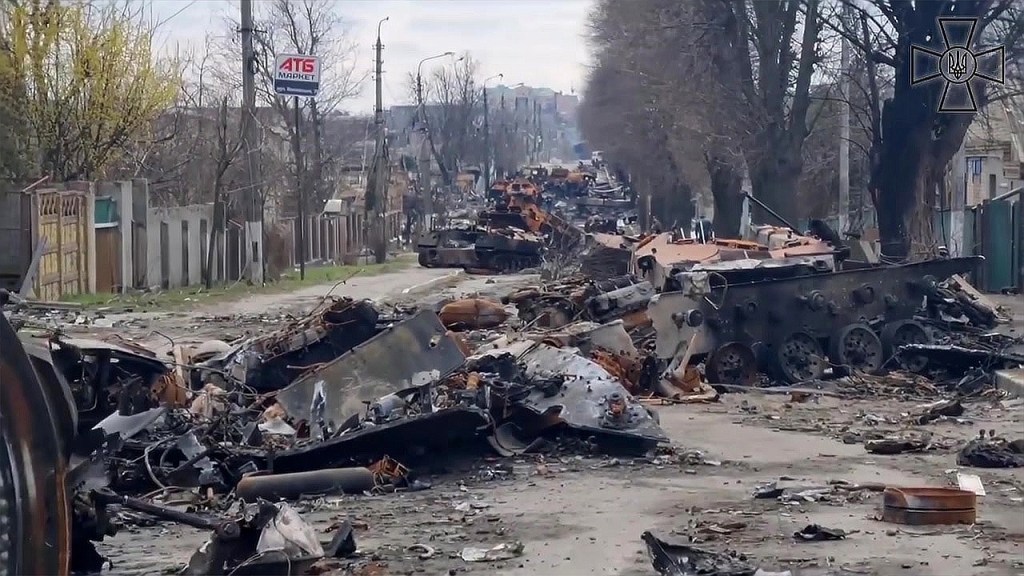
Smashed Russian Armour Along Vokzal’na Road in Bucha – Photo by Ukrinform TV & Ukrainian Armed Forces
A Novel By Brian Howard Seibert
© Copyright by Brian Howard Seibert
WRITER’S UNCUT EDITION
(Contains Scenes of Violence and Abuse Consistent with War)
(May be Offensive to Some)
EXPERIENCES OF A BELARUS JOURNALIST
DURING ONE MONTH’S EMBEDMENT WITH
THE RUSSIAN ARMY IN UKRAINE
BY L. MOKVELDSKA
War-Correspondent of “Da Minsk”
TRANSLATED BY
B. SEIBERT
Correspondent of “SeiberTeck.Com”
ANOTHER DOTCOM COMPANY
LONDON NEW YORK TORONTOMCMXVII MMXXIV
RUSSIAN FURY IN BUCHA
CONTENTS
CHAPTER 1: THE CROSSROADS
CHAPTER 2: THREE DAYS ON A BUS
CHAPTER 3: VOKZAL’NA ROAD
CHAPTER 4: TBD
CHAPTER III: VOKZAL’NA ROAD
As I had mentioned before, one of the great benefits of my publishing the reports on the Russian Fury in Bucha two years after the event is that it gives me the opportunity to add later bits of information that I’ve uncovered into the mix of the original story. Captain Zmurko had told me that he’d had to hold the Bucha River Bridge for one more day and that it would later become known to me exactly why and he was exactly correct. But it was several months later that I learned why.
The story starts much earlier in the Canadian Village on the outskirts of Kyiv. An artillery colonel of the Army of Ukraine had been invited to watch a movie called Argo by a Canadian visitor staying in the village. Now Argo was a movie about the occupation of the American Embassy in Tehran in 1979 and the escape of six American hostages who made it to the Canadian Embassy nearby and how their further escape from Iran was orchestrated by the Canadian Ambassador. The officer enjoyed the movie so much that his host put on a newer Canadian movie called Hyena Road about Canadian soldiers fighting in Afghanistan and the movie started with a Canadian sniper squad that was hiding in the hills near Kandahar watching a local boy burying a 122 mm high explosive shell casing as an Improvised Explosive Device on Hyena Road. The snipers center-punched the poor young boy with a 50 caliber sniper round and the boy fell to his knees and died in a position of prayer, perhaps facing east, but the idea of using the 122 mm shell as an IED fascinated the Ukrainian Army officer and he began to ponder about a faster safer way to deploy the device. In the end, the Canadian snipers who had killed the boy ended up calling their own Canadian artillery barrage in upon themselves to avoid capture by the Taliban
The colonel began experimenting with detonatorless 122 mm high explosive rounds equipped with proximity switches that his artillery units could use as targeting rounds for framing out artillery barrages. The targeting rounds would bury themselves on impact and not explode until the proximity switches on their anteriors were set off by metal masses driving above them. He had, in effect, developed an IED that could be planted remotely…if the proximity switches weren’t triggered by the extreme forces generated by the impact of the shell with the ground. He found the solution for this in bubble wrap, the packing material that the proximity switches were shipped in. But bubble wrap was very light and caused the IED rounds to be slightly lighter than the original high explosive rounds and this affected their use as a targeting round. And there was the fact that bubble wrap wasn’t sufficiently protective when he began experimenting with more advanced electronics for remote programmable detonation of the IEDs.
Rubberized gels were found to be more effective for the higher end detonation devices and soon the colonel was developing timed detonators, remotely activated devices, metal and personnel activated detonators and then finally drone activated detonation. The gels were made to equal density of the high explosives which corrected the targeting errors progress was soon being made in computer controlling this new type of IED barrage warfare. And all of it was done under wraps, under full security secrecy of the Army of the Ukraine.
A few years later, the colonel finds himself setting up an artillery battery on the southern outskirts of Irpin protecting the way into Kyiv on the news that an expected Russian attack had just materialized and it had come, as expected, from the Belarus border. Russian troops and armoured units had been training in Belarus and satellite photography had shown that they were training for an attack upon Ukraine. Had the Russians trained in Russia the satellite imaging would have been blocked, but Belarus was much laxer in their satellite and spy plane protocols. Two practice staging areas had been set up for training but satellite imaging had only identified one of them, Vokzal’na Street in Bucha. So that is where they sent the artillery officer and his special IED battery. The officer had spent his last two years designing 122 mm high explosive shells that could be fired without detonators and would bury themselves completely in earth for activation as radio controlled IEDs. But there was one problem. The ground was frozen in February and was so hard that it would make proper penetration of the shells difficult. The Ukrainians needed a day to lay down coal and straw to set aflame in order to thaw out the ground to a reasonable depth.
While the special IED battery was setting up in Irpin, coal was being laid down at the upper and lower ends of Vokzal’na Street and radio controlled drones were being deployed from surrounding buildings along the road. And Captain Zmurko was, of course, holding the bridge and buying them that one day. Once the ground was thawed, the special IED battery began firing their detonatorless high explosive IED rounds as spotting and targeting fire to zero in their upcoming barrage accuracy and the rounds did indeed bury themselves in the thawed roadway. Drones were then flown above the IEDs to activate and orchestrate them, and once approved, to deactivate them until needed. Ground crews then came out and cleaned up the mess and patched the perforated pavement so any damage was difficult to observe. It looked more like a pothole brigade had swept through the street than a 122 mm artillery targeting operation.
When our bus advanced toward Bucha there was much gunfire and fighting going on well ahead of us so we had to pull over and we spent another night sleeping on the bus. Officers would arrive from time to time to relieve each other and word went about that armoured units were assembling along Vokzal’na Street in Bucha for the great push into Kyiv. Permission had been granted to local authorities for buses to be sent from Kyiv to evacuate the local civilian populace. This humanitarian convoy would, of course, be commandeered to act as a human shield for the advancing Russian troops. All the way to Maidan Square. But my warning to Captain Zmurko must have gotten through to headquarters, for the buses quickly returned to Kyiv empty and the locals were informed about the human shield plot.
In the early morning, the vanguard of armour along Vokzal’na Road began advancing south towards southern Bucha and Irpin and the Canadian Village, but they immediately came under attack from local terrorists. Then drones were seen flying above the streets and the IEDs were activated and armoured vehicles that drove above them activated metal detectors that set off the high explosive rounds and dozens of tanks and APCs were destroyed almost all at once, trapping the rest of the armour in the narrow street. As squads of Russian troops went over other IEDs, the drones detonated them, wiping out whole platoons at a time. Then the artillery barrage began, directed by observation drones, and the shelling ran from south to north until almost all the Russian armour was destroyed. Units that escaped the slaughter either advanced further south in a running battle with local freedom fighters and retreating Ukrainian Army spotters or they fled north coming towards our approaching buses. Russian tanks and APCs that were fleeing toward us were being followed by an artillery barrage that was advancing toward us as well. Our driver pulled over along the street but we could not retreat because there was a whole convoy behind us.
If war was hell, then Vokzal’na Road was Hade’s Main Street.
The artillery barrage kept advancing toward us as tanks were smashed and exploding and piling into each other and then suddenly the shelling stopped. The Ukrainians had run out of 122 mm shells just before the barrage reached the buses. I had worked my way up to the front of the bus and was blindly and covertly photographing the oncoming destruction and when the barrage stopped I was first off the bus. I was praying that the Ukrainians wouldn’t resume their shelling, but I wanted to set up my laptop on the fender of a smoldering tank so I could properly film the destruction while I typed up a report. Burning tanks were exploding right in front of me and tank rounds were going off all over the street sending showers of flames skyward in the early morning light. A few flames erupted from the tank I was working from so I cradled my laptop and filmed using the ghost imaging as I advanced down the street. I was shocked to find the political officer that had orchestrated the rape at the crossroads lying dead in the street with the mangled bodies of his fellow rapists lying about him, victims of an IED that had exploded beneath them. They were all quite mangled and burned but still quite recognizable in a grotesque way. More images to haunt my dreams, as if the screams weren’t enough.
While I was filming this, two Ukrainian fighter jets began a strafing missile attack on some tanks that had escaped destruction but remained trapped in the wreckage. The planes came from the direction of Starokonstantyniv and destroyed most of the remaining blockaded armour. On the way back, I saw that one plane was shot down, and the pilot was killed. Now I was glad I had taken my little walk to Bucha two days earlier. I don’t think I could have made it through this destruction had I not first been tempered by the prior horrors. Slowly I made my way back to the bus, filming as I went. The convoy behind us gradually retreated to northern Bucha and we spent the rest of the day alongside a road.
I didn’t know what had happened to the Russian units that had escaped the barrage by charging south but I was later able to piece together what went on there from Ukrainian reports I was able to glean from their military channels and correspondents and it went something like this:
It was 7:10 in the morning when the Russian convoy first entered Bucha, knocking out a water tower on the way in. The defenders of Bucha were mostly civilians and retired military personnel, as the Ukrainian Army had begun setting up defences south of Irpin along the Irpin River. The civilians were waiting for the Russians near Novus and said that the Russian invaders were driving their tanks like it was a Kremlin Parade with paratroopers sitting on top of their APCs singing victory songs.
The first Russian armoured vehicle flew past the intersection at high speed. A Ukrainian grenadier hit the third or fourth vehicle in the procession from an ambush location under the local ‘Monument to International Soldiers’. That was why Russians were later filmed firing at the armoured scout car that was part of the monument. Four civilian freedom fighters then began throwing Molotov cocktails at the convoy from behind a fence and one of the APCs caught fire. The Russians opened fire on them. One civilian was wounded in the leg. Civilians on the other side of the street diverted their fire to themselves by shooting small arms at the attackers. The four men escaped the firefight under this covering fire.
After being attacked, the Russians lined up in combat formation and fired at the town’s defenders with everything they had – assault rifles, 12.7 mm machine guns, and 30 mm infantry fighting vehicle cannons. The defenders of Bucha said that they literally saw bullets flying past in all directions. The defenders retreated in a car and two APCs chased them into a parking lot, but they escaped past some buildings. Taking advantage of the defenders’ retreat, the Russians took the damaged APC off the road with a tank and set off towards the town of Irpin in combat order. They were moving south and mopping-up. Anyone moving or travelling was immediately shot.
During that time, a group of freedom fighters moved south before them in two cars to the Giraffe shopping centre on the border of Irpin and Bucha, where Ukrainian defenders had set up defensive positions. Local volunteers were being assisted by soldiers from the National Guard, the Armed Forces, the paratroopers, and the 8th Special Forces regiment. Ukrainian forces destroyed a bridge connecting Bucha and Irpin, killing a Russian officer and preventing Russian forces from advancing into Irpin.
Later in the day Ukrainian authorities warned the residents of Bucha not to get on any buses that were evacuating out of the city, as Ukrainian officials had not initiated any evacuation procedures. Ukrainian officials claimed that it was part of a plan by Russian forces, wherein the Russians would use the civilians as human shields by following behind the buses, in order to gain entry into Kyiv.
In retrospect, following the Russian debacle at the Battle of Vokzal’na Road, President Vladimir Putin perhaps should have ordered an end to his Special Operation for which he had not even bothered to declare war. Instead he doubled down and sent even more Russian troops into Ukraine to die. He had his personal chef, Yevgeny Prigozhin, leader of the Wagner Group, call up Russian criminals and rapists to enlist in kamikaze attack elements that were absolutely chewed up by this new Ukrainian IED artillery warfare whereby one artillery barrage could wipe out one attack and leave buried IEDs all over the battlefield to wipe out further daily attacks while the Ukrainian artillery units could move on and protect other sectors from massive criminal attacks. Prigozhin never did figure out what the Ukrainian Army was doing to his Wagner Group levies, but he knew something was up, and that he had to get his forces the hell out of the long and winding road called Vokzal’na.
Note: This website is about Vikings and Varangians and the way they lived over a thousand years ago. The content is as explicit as Vikings of that time were and scenes of violence and sexuality are depicted without reservation or apology. Reader discretion is advised.
The VARANGIANS / UKRAINIANS or The Nine Books of Saxo’s Danish History Per Brian Howard Seibert
BOOK ONE: The Saga of King Ragnar ‘Lothbrok’ Sigurdson
King Ragnar ‘Lothbrok’ Sigurdson’s third wife, Princess Aslaug, was a young survivor of the Saga of the Volsungs and was a daughter of King Sigurd ‘the Dragon-Slayer’ Fafnirsbane, so this is where Ragnar’s story begins in almost all the ancient tales (except Saxo’s). In our series, we explore this tail end of the Volsungs Saga because King Sigurd appears to be the first ‘Dragon-Slayer’ and King Ragnar ‘Lothbrok’ would seem to be the second so, it is a good opportunity to postulate the origins of Fire Breathing Dragons and how they were slain. King Ragnar would lose his Zealand Denmark to the Anglish Danes of Jutland, who spoke Anglish, as did the majority of Vikings who attacked England, which spoke both Anglish and Saxon languages, sometimes mistakenly called a common Anglo-Saxon language. The Angles and Saxons of England never really did get along, as shall be demonstrated in the following books. King Ragnar assuaged the loss of Zealand by taking York or Jorvik, the City of the Boar, in Angleland and Stavanger Fjord in Thule from which he established his Nor’Way trade route into Scythia.
BOOK TWO: The Saga of Prince Erik ‘Bragi’ Ragnarson
Book Two of the Nine Book The Varangians / Ukrainians Series places The Saga of Prince Erik ‘Bragi’ Ragnarson from Book Five of The First Nine Books of the Danish History of Saxo Grammaticus (c. 1200 AD) about King Frodi ‘the Peaceful’ into its proper chronological location in history. In 1984, when I first started work on the book, I placed Prince Erik’s birth at circa 800 CE, but it has since been revised to 810 CE to better reflect the timelines of the following books in the series. Saxo had originally placed the saga at the time of Christ’s birth and later experts have placed the story at about 400 CE to correspond with the arrival of the Huns on the European scene but, when Attila was driven back to Asia, the Huns didn’t just disappear, they joined the Khazar Empire, just north of the Caspian Sea, and helped the Khazars control the western end of the famous Silk Road Trade Route. Princes Erik and Roller, both sons of Ragnar ‘Lothbrok’, sail off to Zealand to avenge their father’s loss, but Erik falls in love with Princess Gunwar, the sister of the Anglish King Frodi of Jutland and, after his successful Battle Upon the Ice, wherein he destroys the House of Westmar, Erik marries Gunwar and both brothers become King Frodi’s foremost men instead, and the story moves on to the founding of Hraes’ and Gardar Ukraine.
BOOK THREE: The Saga of Prince Helgi ‘Arrow Odd’ Erikson
Book Three, The Saga of Prince Helgi ‘Arrow Odd’ Erikson, recreates Arrow Odd’s Saga of circa 1200 AD to illustrate how Arrow Odd was Prince Helgi (Oleg in Slavic) Erikson of Kiev, by showing that their identical deaths from the bite of a snake was more than just coincidence. The book investigates the true death of Ragnar ‘Lothbrok’ by poisoned blood-snakes in York or Jorvik, the ‘City of the Boar’, and how his curse of ‘calling his young porkers to avenge the old boar’ sets up a death spiral between swine and snake that lasts for generations. The book then illustrates the famous Battle of the Berserks on Samso, where Helgi ‘Arrow Odd’ and Hjalmar ‘the Brave’ slay the twelve berserk grandsons of King Frodi on the Danish Island of Samso, setting up a death struggle that takes the Great Pagan Army of the Danes from Denmark to ravage Norway and then England and on to Helluland in Saint Brendan’s Newfoundland. A surprise cycle of vengeance manifests itself in the ‘death by snakebite’ of Helgi ‘Arrow Odd’.
BOOK FOUR: The Saga of Prince Ivar ‘the Boneless’ Erikson
Book Four, The Saga of Prince Ivar ‘the Boneless’ Erikson, reveals how Ivar ‘the Boneless’ Ragnarson was actually Prince Eyfur or Ivar (Igor in Slavic) Erikson of Kiev and then King Harde Knute ‘the First’ of Denmark. By comparing a twenty year lacuna in the reign of Prince Igor in The Hraes’ Primary Chronicle with a coinciding twenty year appearance of a King Harde Knute (Hard Knot) of Denmark in European Chronicles, Prince Igor’s punishment by sprung trees, which reportedly tore him apart, may have rather just left him a boneless and very angry young king. Loyal Danes claimed, “It was a hard knot indeed that sprung those trees,” but his conquered English subjects, not being quite as polite, called him, Ivar ‘the Boneless’. The book expands on the death curse of Ragnar ‘Lothbrok’ and the calling of ‘his young porkers to avenge the old boar’ when Ivar leaves his first son, King Gorm (Snake) ‘the Old’, to rule in Denmark and his last son, Prince Svein (Swine) ‘the Old’ to rule in Hraes’, further setting up the death spiral between the swine and snake of the ‘Lothbrok’ curse.
BOOK FIVE: The Saga of Prince Svein ‘the Old’ Ivarson
Book Five, The Saga of Prince Svein ‘the Old’ Ivarson, demonstrates how Prince Sveinald (Sviatoslav in Slavic) ‘the Brave’ of Kiev was really Prince Svein ‘the Old’ Ivarson of Kiev, who later moved to Norway and fought to become King Sweyn ‘Forkbeard’ of Denmark and England. But before being forced out of Russia, the Swine Prince sated his battle lust by crushing the Khazars and then attacking the great great grandfather of Vlad the Impaler in a bloody campaign into the ‘Heart of Darkness’ of Wallachia that seemed to herald the coming of the Four Horsemen of the Apocalypse and included the famed 666 Salute of the Army of the Impalers. The campaign was so mortifying that the fifteen thousand pounds of gold that the Emperor of Constantinople paid him to attack the Army of the Impalers seemed not nearly enough, so Prince Svein attacked the Eastern Roman Empire itself. He came close to defeating the greatest empire in the world, but lost and was forced to leave Hraes’ to his three sons. He returned to the Nor’Way and spent twelve years rebuilding Ragnar’s old trade route there.
BOOK SIX: The Saga of Grand Prince Valdamar ‘the Great’ Sveinson
Book Six, The Saga of Grand Prince Valdamar ‘the Great’ Sveinson, establishes how Grand Prince Valdamar (Vladimir in Slavic) ‘the Great’ of Kiev, expanded the Hraes’ Empire and his own family Hamingja by marrying 700 wives that he pampered in estates in and around Kiev. Unlike his father, Svein, he came to the aid of a Roman Emperor, leading six thousand picked Varangian cataphracts against Anatolian rebels, and was rewarded with the hand of Princess Anna Porphyrogennetos of Constantinople, a true Roman Princess born of the purple who could trace her bloodline back to Julius and Augustus Caesar. She was called ‘Czarina’, and after her, all Hraes’ Grand Princes were called ‘Czars’ and their offspring were earnestly sought after, matrimonially, by European royalty.
BOOK SEVEN: The Saga of King Sweyn ‘Forkbeard’ Ivarson
In The Saga of King Sweyn ‘Forkbeard’ Ivarson, Prince Svein anonymously takes the name of Sweyn ‘Forkbeard’ in Norway and befriends the Jarls of Lade in Trondheim Fjord in Norway as he expands the Nor’Way trade route of his grandfather, Ragnar ‘Lothbrok’. He had come close to defeating the Eastern Roman Empire, and still felt that he was due at least a shared throne in Constantinople. He used the gold from the Nor’Way trade to rebuild his legions and his Hraes’ cataphracts and though his brother, King Gorm ‘the Old’, was dead, his son, Sweyn’s nephew, King Harald ‘Bluetooth’ Gormson had usurped the throne of Denmark and had hired the famed Jomsvikings to attack Prince Sweyn in Norway, setting up the famous Battle of Hjorungavagr in a fjord south of Lade. King Sweyn ‘Forkbeard’ would emerge from that confrontation and then he would defeat King Olaf Tryggvason of Norway in the Battle of Svolder in 1000 AD, in an engagement precipitated over the hand of Queen Sigrid ‘the Haughty’ of Sweden. Later he attacked England in revenge for the following St. Brice’s Day Massacre of Danes in 1002 AD and he fought a protracted war with the Saxon King Aethelred ‘the Unready’ that could only be described as the harvesting of the English for sale as slaves in Baghdad and Constantinople. With the help of his son, Prince Valdamar of Kiev, and the legions and cataphracts of Hraes’, he conquered England on Christmas Day of 1013, but victory was not kind to him.
BOOK EIGHT: The Saga of King Canute ‘the Great’ Sweynson
Prince Valdamar ‘the Great’ Sveinson of Kiev, who had supported his father, King Sweyn ‘Forkbeard’ of Denmark in attacks upon England left his ‘Czar’ sons in charge of Hraes’ and took over as King Valdamar of England, but the Latin Christian English revolted against his eastern name and Orthodox Christian religion and brought King Aethelred back from exile in Normandy and Valdamar had to return to Hraes’ and gather up the legions he had already sent back after his father’s victory. His half brother was ruling in Denmark and his sons were ruling in Hraes’ so, in 1015 AD Grand Prince Valdamar ‘the Great’ of Kiev was written out of Hraes’ history and in 1016 the Latin Christian Prince Canute ‘the Great’ returned to England to reclaim his throne. He defeated Aethelred’s son, King Edmund ‘Ironside’ of England, at the Battle of Assandun to become King Canute ‘the Great’ of England and later King Knute ‘the Great’ of Denmark and Norway as well. But that is just the start of his story and later Danish Christian Kings would call his saga, and the sagas of his forefathers, The Lying Sagas of Denmark, and would set out to destroy them, claiming that, “true Christians will never read these Sagas”.
BOOK NINE: The Saga of King William ‘the Conqueror’ Robertson
The Third Danish Conquest of Angleland was seen to herald the end of the Great Viking Manifestation of the Middle Ages, but this, of course, was contested by the Vikings who were still in control of it all. Danish Varangians still ruled in Kiev and Danes still ruled the Northern Empire of Canute ‘the Great’, for the Normans were but Danish Vikings that had taken up the French language, and even Greenland and the Newfoundland were under Danish control in a Hraes’ Empire that ran from the Silk Road of Cathay in the east to the Mayan Road of Yucatan in the west. “We are all the children of Ragnar ‘Lothbrok’,” Queen Emma of Normandy often said. Out of sheer spite the Saxons of England took over the Varangian Guard of Constantinople and would continue their fight against the Normans in Southern Italy as mercenaries of the Byzantine Roman Empire. They would lose there as well, when in the Fourth Crusade of 1204, the Norman Danes would sack the City of Constantinople and hold it long enough to stop the Mongol hoards that would crush the City of Kiev. It would be Emperor Baldwin ‘the First’ of Flanders and Constantinople who would defeat the Mongol Mongke Khan in Thrace. But the Mongols would hold Hraes’ for three hundred years and this heralded the end of the Great Viking Manifestation. The Silk Road was dead awaiting Marco Polo for its revival. But the western Mayan Road would continue to operate for another hundred years until another unforeseen disaster struck. Its repercussions would be witnessed by the Spanish conquerors who followed Christopher Columbus a hundred and fifty years later in the Valley of the Mound Builders.
Conclusion:
By recreating the lives of four generations of Hraes’ Ukrainian Princes and exhibiting how each generation, in succession, later ascended to their inherited thrones in Denmark, the author proves the parallels of the dual rules of Hraes’ Ukrainian Princes and Danish Kings to be cumulatively more than just coincidence. And the author proves that the Danish Kings Harde Knute I, Gorm ‘the Old’ and Harald ‘Bluetooth’ Gormson/Sweyn ‘Forkbeard’ were not Stranger Kings, but were Danes of the Old Jelling Skioldung Fridlief/Frodi line of kings who only began their princely careers in Hraes’ and returned to their kingly duties in Denmark with a lot of Byzantine Roman ideas and heavy cavalry and cataphracts.

